Growth rarely fails loudly. It fails in small, repeatable ways: a finance team that cannot close without spreadsheets, a warehouse that disagrees with the website on what is actually in stock, a leadership meeting where revenue means three different things to three different people.
The question is never really which software to buy. It is which transactions the business can no longer trust.
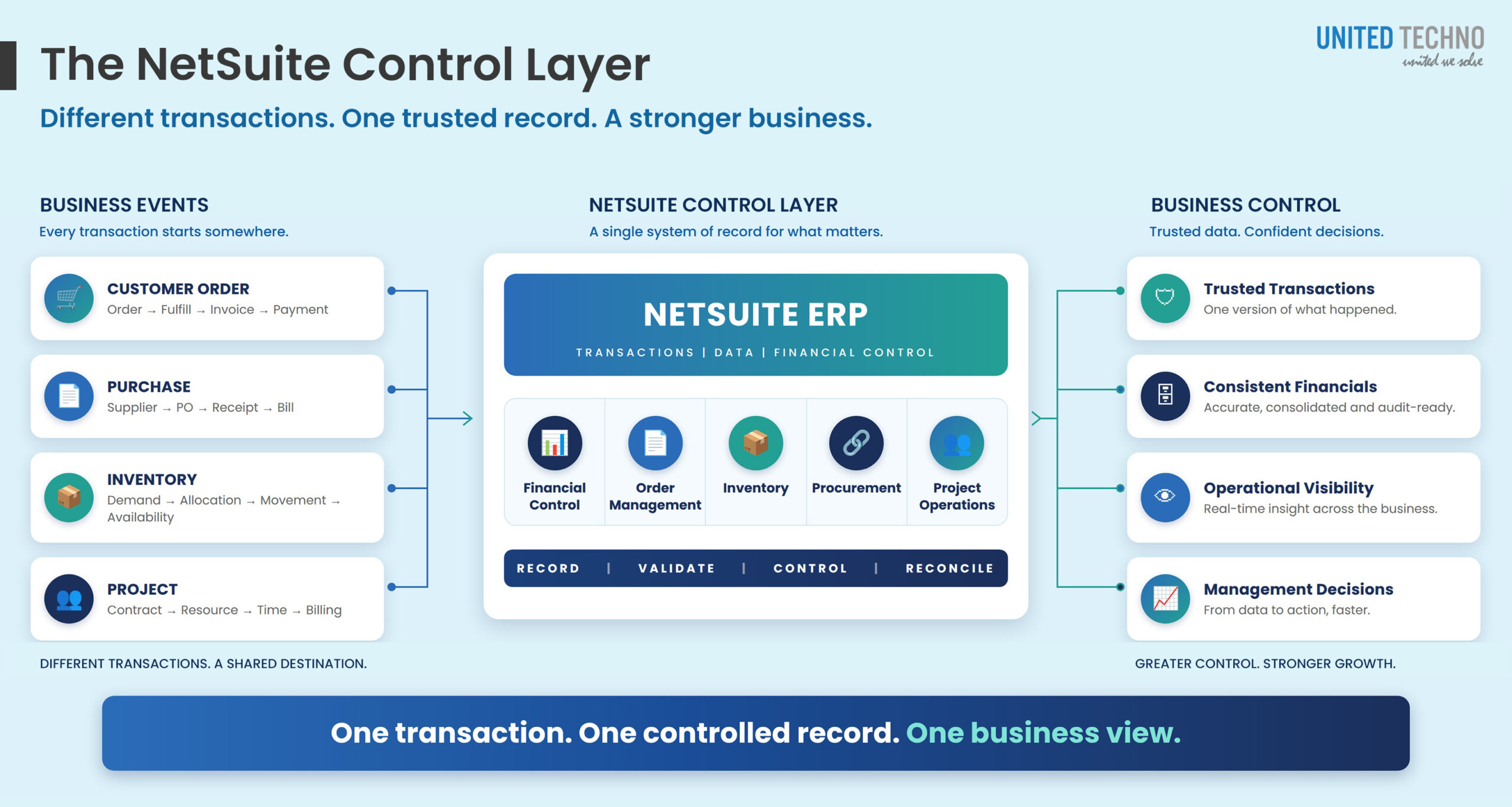
That is where Oracle NetSuite ERP earns its place, not as a feature list, but as the control layer that decides which numbers the company can run on.
NetSuite Is a Control Layer, Not a Software Purchase
 Most companies evaluate ERP backward. They compare modules, vendor logos, and demo screens. The sharper question is architectural:
Which transactions must the business trust end-to-end, from the moment a commitment is made to the moment it hits the ledger?
A sale is not one event. It is a chain: customer, order, inventory commitment, fulfillment, invoice, payment, revenue. A purchase is a different chain: supplier, order, receipt, stock, bill, payment. A project is a third: contract, resource, time, cost, billing, margin.
When those chains live in isolated systems, the business spends its time reconciling reality instead of operating on it. Oracle NetSuite ERP provides value by giving every chain a single transaction record – one version of what actually happened.
The Decision That Outlasts the Implementation: Control, Connect, or Leave Outside
Cloud delivery matters less than most buyers think. The decision that shapes long-term cost in an Oracle NetSuite ERP implementation is where the operational truth should live.
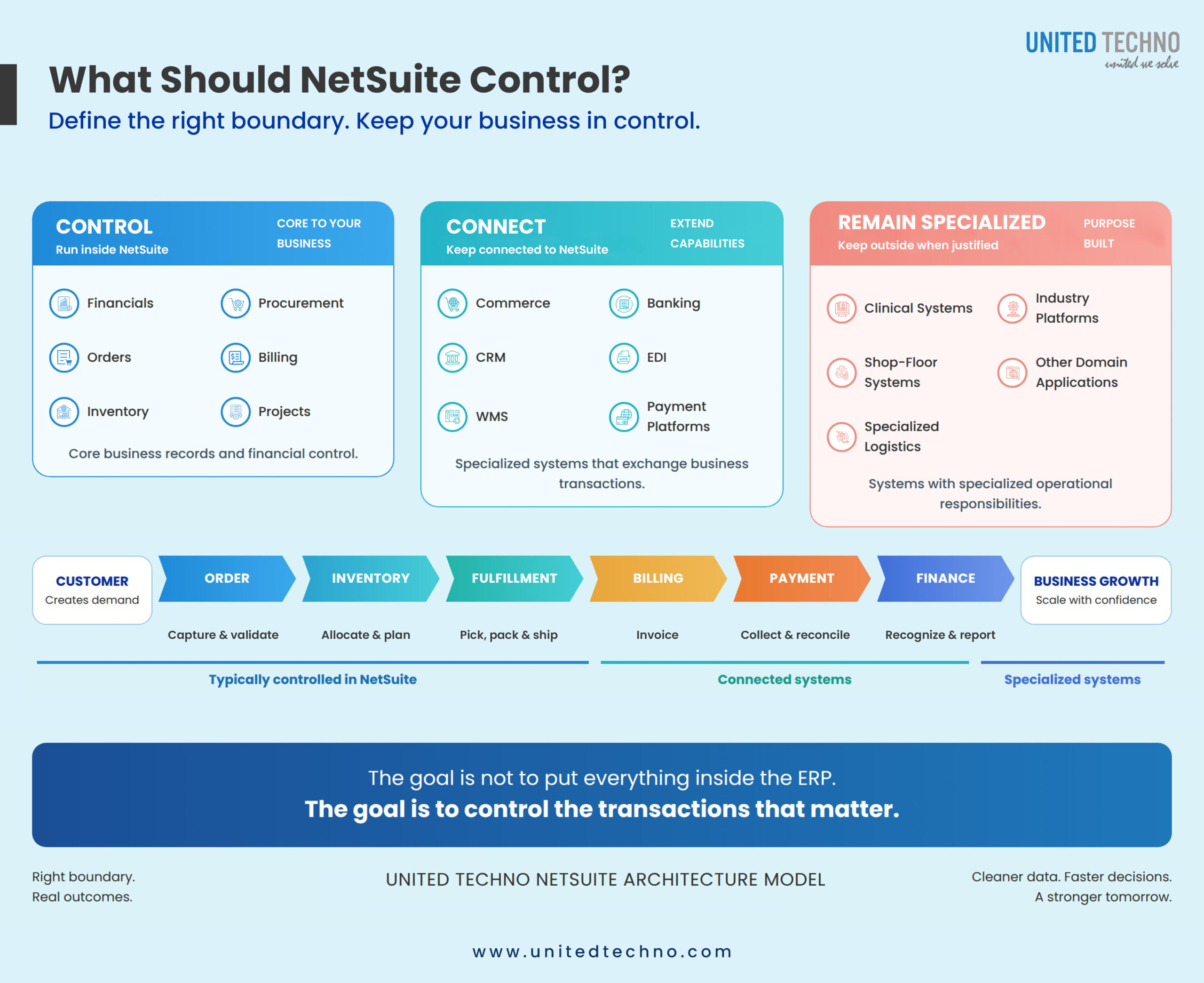
A pragmatic architecture separates systems into three buckets:
- Control inside NetSuite – financials, orders, inventory, procurement, projects, billing
- Connect, but don’t replace – commerce, CRM, warehouse execution, banking, industry-specific platforms
- Leave outside – clinical systems, shop-floor execution, specialized logistics that justify their own footprint
A retailer may keep the storefront in its commerce platform. A manufacturer may retain a dedicated shop-floor system. A bank will never run core banking inside an ERP. NetSuite does not need to absorb them; it needs to connect the transactions that feed financial and operational control.
Get this boundary wrong and the ERP becomes a replica of the old mess, only more expensive.
What Friction Actually Looks Like, by Industry
Retail and ecommerce. A product shows 23 units online. Six orders land in fifteen minutes. Three of those units were quietly committed to a wholesale buyer. By noon, customer service is apologizing for delays. The failure is not the website; it is the gap between sales, inventory, and fulfillment. When Oracle NetSuite ERP connects these systems through a shared transaction record, inventory accuracy moves from a guessing game to a number the business can defend.
Distribution. A distributor running thousands of SKUs across four warehouses often measures success in working capital. Order fulfillment time, inventory turns, backorder rate, purchase-cycle time, gross margin; these are not software features, they are survival metrics. NetSuite starts to pay back the moment purchasing, inventory, and finance stop arguing about whose number is right.
Manufacturing. A customer order triggers demand, material requirements, production, quality checks, finished goods, shipment, invoice. Break that chain and the company ships late, bills wrong, and cannot explain margin by product line. The ERP’s job is to connect the commercial commitment to its production and financial consequences.
Professional services. No warehouse, no SKUs – but the same chain exists: client, contract, resource, time, cost, invoice, revenue. The pain shows up as month-end margin reports rebuilt in spreadsheets because nobody trusts the project system.
The Readiness Signals That Say “Now”
A business has usually outgrown its current model long before anyone names the problem. The signals are consistent across industries:
- Finance cannot close the books without spreadsheet support
- Operations cannot answer a basic inventory question in minutes
- Sales and finance report different revenue figures
- A new sales channel creates a new reconciliation project
- Management waits days for data that should already exist
- People move information between systems instead of acting on it
If three or more of these apply, the organization is not shopping for software. It is ready to evaluate Oracle NetSuite ERP as part of an ERP architecture assessment, and skipping that step is how implementations overrun.
The Cost Question Has No Single Number
Asking for the price of NetSuite is like asking for the price of a building. It depends on the shape of the business.
A single-entity company with one sales channel and simple finance shares almost nothing in common with a seven-entity business running three currencies, four warehouses, ecommerce, EDI partners, and multiple tax jurisdictions. Both may say “we need NetSuite.” Their implementation effort, integration scope, and long-term operating cost will be completely different.
That is why a serious assessment should come before the license conversation – not after.
Standardize First. Customize Only When Justified
The single most expensive habit in ERP is replicating legacy exceptions inside a new platform. A strong implementation follows a deliberate sequence: remove what is unnecessary, standardize what remains, configure before customizing, integrate deliberately, and customize only when the process is genuinely strategic.
Get this right and the ERP simplifies the enterprise. Get it wrong and it adds another layer of complexity on top of the old one.
AI Comes After Trustworthy Data
AI is entering every ERP conversation, but it should never be the reason to buy one. The sequence that actually produces value is reliable transactions, then consistent data, then business context, then analytics, then AI-assisted decisions.
Once order, inventory, purchasing, and supplier information are connected, the business can finally ask useful questions: which orders need intervention, which suppliers repeatedly cause delays, which products tie up working capital, and where planners should focus tomorrow. The AI opportunity starts the moment the operational data becomes trustworthy, not before.
What a Good NetSuite Program Should Measure
If three or more of the readiness signals above sound familiar, request a NetSuite architecture review before committing to licenses, the cost of scoping is a fraction of the cost of over-scoping.
Go-live is not the finish line. The real indicators settle in afterward:
| Business area | What to measure |
| Finance | Close-cycle time |
| Order management | Order-to-cash duration |
| Inventory | Inventory accuracy |
| Procurement | Purchase-cycle time |
| Operations | Volume of manual transactions |
| Reporting | Time to produce management reports |
| Integration | Failed transaction rate |
| Data | Duplicate or inconsistent master records |
The most valuable metric is often the simplest: how much less manual coordination does the business need to run itself?
The United Techno Approach
United Techno treats Oracle NetSuite ERP as an enterprise architecture decision, not a software rollout. The assessment covers business processes, ERP scope, integration with platforms such as Celigo, data governance, migration, analytics, and long-term optimization designed to make the platform simplify the enterprise rather than add complexity.
Start with a NetSuite Architecture Assessment. Get a clear ERP boundary map, an integration risk scan, a data readiness score, and a 90-day implementation roadmap before any license commitment.
Request a NetSuite Architecture Assessment →