Enterprise Integration Has Changed
The old enterprise integration model was straightforward:
Application A → Middleware → Application B
Today, one business transaction may cross a SaaS application, API gateway, integration platform, event broker, ERP, warehouse system, payment service and cloud data platform.
The integration problem is no longer simply connecting systems.
It is deciding where APIs, events, orchestration, messaging, data movement and business logic should live, and how those capabilities should operate together.
That is where Cloud-Native Integration vs Traditional Middleware becomes an important architectural consideration.
Cloud-native integration is not traditional middleware moved into the cloud.
It changes how you design, deploy, scale, secure, observe, and operate integration.
Middleware Solved a Different Problem
Traditional middleware earned its place in enterprise architecture for good reasons.
ESBs and integration platforms centralized:
- Routing
- Transformation
- Protocol mediation
- Application adapters
- Messaging
- Orchestration
- Security
- Transaction handling
For environments built around ERP, CRM, databases and on-premises applications, that model made sense.
A typical landscape might have looked like:
ERP → ESB → CRM
ERP → ESB → Warehouse
CRM → ESB → Billing
The middleware became the controlled meeting point between applications.
But today’s enterprise landscape is much more distributed:
SaaS + APIs + Microservices + Events + Cloud Applications + Legacy Systems + Partners + Data Platforms
The architectural question has therefore changed:
How should different types of enterprise connectivity be handled when the systems themselves are distributed?
This is the fundamental architectural shift behind Cloud-Native Integration vs Traditional Middleware.
Cloud-Native Does Not Mean “Hosted in the Cloud”
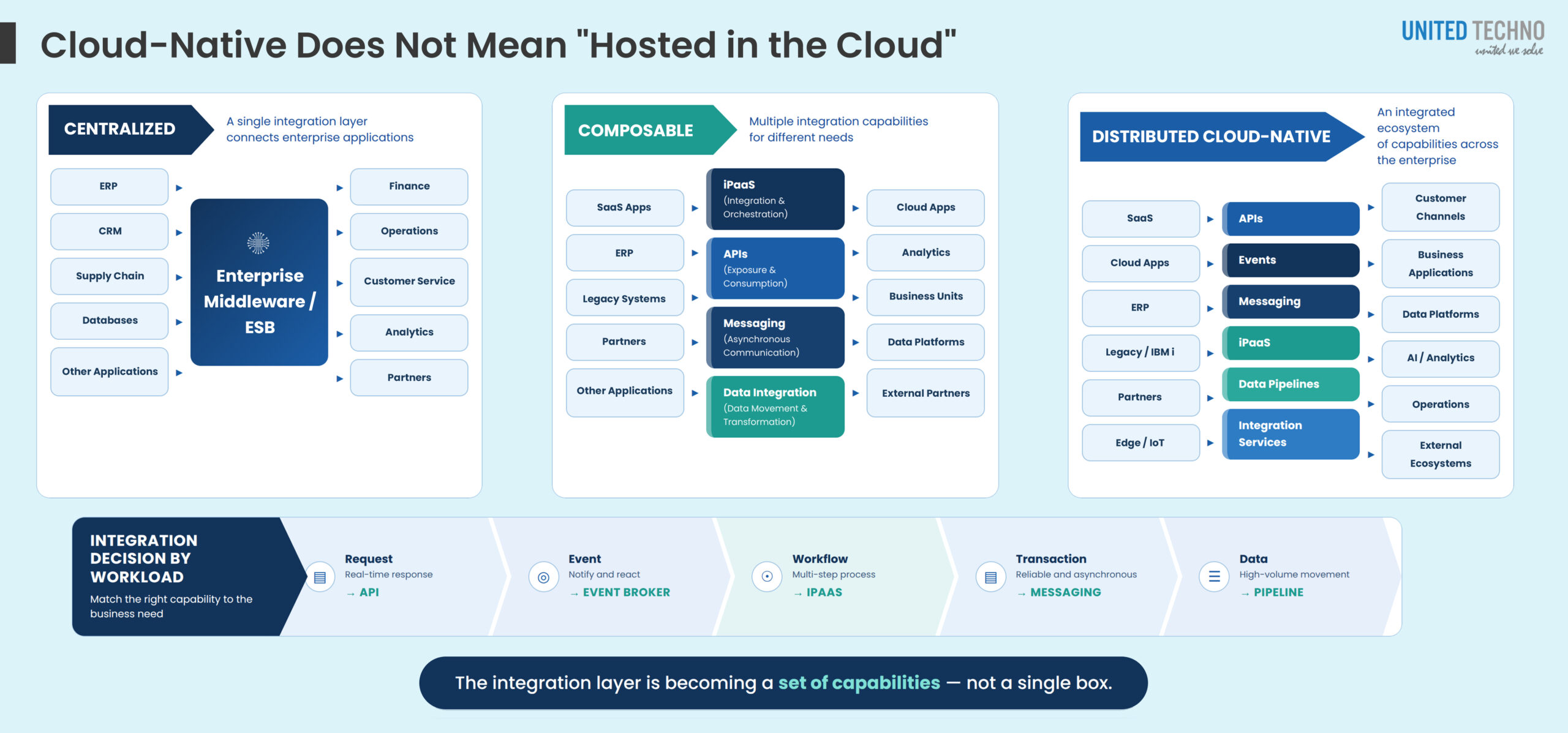 Moving an existing middleware runtime onto a cloud virtual machine does not automatically create a cloud-native integration architecture.
The deployment location changed.
The operating model may not have.
A cloud-native integration architecture is designed around capabilities such as:
- Elastic or workload-driven scaling
- Distributed execution
- API-first connectivity
- Event-driven communication
- Managed or containerized runtimes
- Automated deployment
- Infrastructure automation
- Centralized observability
- Identity-driven security
- Fault isolation
The important distinction is architectural, not cosmetic.
The integration environment becomes a collection of capabilities that can be deployed and operated according to workload requirements.
The Architecture Is Splitting Into Capabilities
The biggest change is not the disappearance of middleware.
It is the distribution of integration responsibilities.
APIs
APIs are suited to request-and-response interactions.
Examples include:
- Retrieving customer information
- Submitting an order
- Checking account status
- Invoking a business service
Customer Portal → API → Order Service
The consumer asks for something and expects a response.
Events
Events are suited to announcing that something happened.
For example:
Order Confirmed
can produce events consumed independently by:
- Inventory
- Fulfillment
- Customer communications
- Finance
- Analytics
The producer does not need a direct integration with every downstream consumer.
Messaging
Messaging is suited to reliable asynchronous communication where delivery, buffering, ordering or transactional behavior matters.
Examples include:
- ERP transactions
- Legacy workloads
- High-value business messages
- Asynchronous processing
- Systems that should not remain tightly coupled
iPaaS and Orchestration
iPaaS is particularly useful for multi-step application processes:
Connect → Transform → Validate → Route → Execute
This is where platforms such as Boomi and other enterprise integration platforms continue to have an important role.
The point is not to replace iPaaS.
It is to determine where iPaaS belongs within the larger architecture.
Data Integration
Data movement has a different set of requirements.
A pipeline moving large volumes into Snowflake, Databricks or Microsoft Fabric does not necessarily need to behave like an order-processing integration.
Its priorities may instead be:
- Throughput
- Incremental processing
- Transformation
- Data quality
- Lineage
- Batch or streaming execution
- Governance
- Observability
Treating every integration as an application workflow creates unnecessary complexity.
The Real Shift: One Stack Becomes Several
Instead of:
Everything → Central Middleware → Everything
the enterprise increasingly looks more like:
Applications
↓ API
API Management
↓
Integration / Orchestration
↓
Events & Messaging
↓
Data Integration
↓
ERP | CRM | WMS | SaaS | Legacy | Partners
Each capability performs a different job.
That is why “replace middleware” is usually the wrong modernization strategy.
The better question is:
Which connectivity pattern fits the workload?
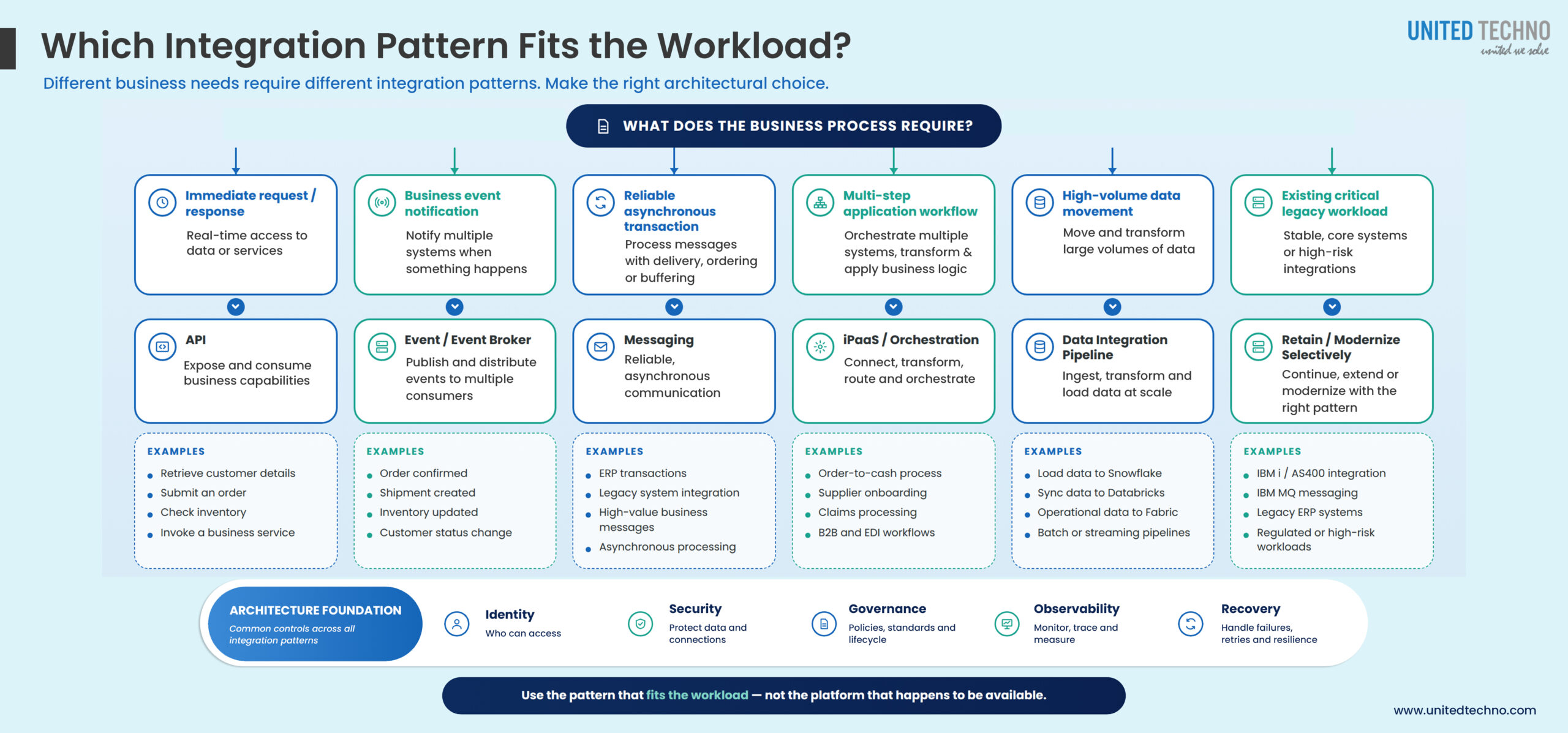 APIs or Events? Start With the Business Interaction
The simplest way to make this decision is to start with the business requirement.
If the consumer needs an answer now
Use an API.
Customer Portal → API → Order Service
If the enterprise needs to announce that something happened
Use an event.
Order Confirmed → Event Broker → Multiple Consumers
If a transaction must be processed reliably and asynchronously
Consider messaging.
ERP → Message Queue → Processing Service
If several applications participate in a business workflow
Use orchestration or integration workflow capabilities.
Order → Validate → Enrich → Approve → Fulfill → Reconcile
If the objective is moving high volumes of information
Use data integration pipelines.
Operational Sources → Transformation → Data Platform
The architectural decision becomes much clearer when the business requirement comes before the platform choice.
Does Traditional Middleware Still Matter?
Yes.
A mature cloud integration strategy should not assume every existing middleware workload needs to be rewritten.
Traditional middleware can remain appropriate for:
- IBM MQ environments
- IBM i / AS400 workloads
- Established ERP transactions
- High-volume messaging
- Stable B2B integrations
- Existing ESB estates
- Regulated workloads
- Long-running business processes
- Systems that are expensive or risky to change
The better modernization question is not:
“How quickly can the middleware be removed?”
It is:
“Which workloads benefit from a different integration pattern, and which are already operating effectively?”
That distinction keeps modernization focused on business value rather than technology replacement.
Most Enterprises Will Be Hybrid
For many organizations, the target architecture will not be purely cloud-native.
It will be hybrid by design.
A realistic enterprise may contain:
IBM i / ERP
↓
IBM MQ / Existing Integration
↓
API Management
↓
Cloud Applications
↓
Event Streaming
↓
Snowflake / Databricks / Microsoft Fabric
That is not an architectural failure.
It is the reality of enterprise modernization.
The challenge is making the different layers work together with clear ownership, security, observability and operational controls.
Operational Visibility Becomes a First-Class Requirement
Operational visibility is another important consideration when evaluating Cloud-Native Integration vs Traditional Middleware.
Distributed integration changes the operating model.
The traditional model is often:
Deploy → Monitor → Fix
A modern integration environment requires:
Develop → Test → Deploy → Observe → Recover → Improve
Teams need visibility into:
- API failures
- Event delivery
- Message queues
- Transformation errors
- Integration latency
- Dependency failures
- Retry behavior
- Dead-letter queues
- Workflow state
- Transaction outcomes
- Runtime health
- Security events
- Integration costs
For Boomi environments, capabilities such as Runtime Management and runtime observability can become part of this operational layer, providing visibility into runtime behavior and supporting broader monitoring practices.
But the principle extends beyond any one platform.
A successful API call is not necessarily a successful business transaction.
An order can reach the integration layer and still fail because:
- Inventory is unavailable
- ERP rejects the transaction
- Payment authorization expires
- A downstream API times out
- The warehouse system cannot accept the request
Cloud-native integration therefore requires business-process observability, not just infrastructure monitoring.
Security Moves With the Data
Distributed integration also changes the security model.
A traditional environment may focus heavily on:
Platform → Connection → Credential
A modern architecture has to secure:
Identity → API → Workload → Event → Data → Transaction
That means considering:
- Workload identity
- OAuth and token-based access
- Secrets management
- API authorization
- Encryption
- Event access controls
- Network boundaries
- Data policies
- Transaction authorization
- Audit trails
As integration becomes more distributed, governance cannot remain trapped inside a single middleware platform.
It needs to become an architecture-wide capability.
Modernization Without a Rewrite
Cloud integration modernization does not have to begin with replacing the entire integration estate.
A more controlled approach starts with the existing landscape.
1. Map the estate
Identify:
Applications | APIs | Middleware | Queues | Events | Batch Jobs | Data Pipelines
2. Classify the workload
Is it:
Transactional?
Synchronous?
Event-driven?
Batch?
B2B?
Data movement?
3. Select the pattern
Determine whether the workload belongs on:
API | Event | Messaging | iPaaS | Data Pipeline | Existing Middleware
4. Modernize selectively
Prioritize integrations where modernization can improve:
- Reliability
- Delivery speed
- Scalability
- Operational visibility
- Maintenance effort
- Business responsiveness
5. Establish common controls
Define standards for:
- API lifecycle
- Event design
- Authentication
- Error handling
- Observability
- Ownership
- Versioning
- Recovery
For data-heavy modernization programs, United Techno’s DataAccel provides a practical example of the same architecture principle. Its configuration-driven framework supports Snowflake, Databricks and Microsoft Fabric, with reusable Bronze–Silver–Gold pipelines, governance, monitoring and hybrid ingestion.
United Techno’s DataAccel delivery metrics include up to 5× faster pipeline deployment, approximately 80% fewer manual tasks and 200+ GB of data processed daily in a documented delivery environment.
This is also an important consideration when evaluating Cloud-Native Integration vs Traditional Middleware: modernization should remove repetitive engineering work without removing architectural control.
Modernization should remove repetitive engineering work without removing architectural control.
The United Techno Approach
United Techno approaches cloud integration architecture as an enterprise design problem rather than a platform replacement exercise. This perspective is central to evaluating Cloud-Native Integration vs Traditional Middleware.
The assessment starts with the landscape:
Applications → APIs → Events → Messaging → Integration Platforms → Data Platforms → Legacy Systems
Each workload is then evaluated against its actual requirements.
The resulting architecture can combine:
- Boomi and iPaaS
- API management
- Event-driven integration
- Kafka and messaging
- IBM MQ
- ERP and CRM integration
- IBM i / AS400 connectivity
- B2B and EDI
- Cloud applications
- Snowflake, Databricks and Microsoft Fabric
- Data integration pipelines
- DataAccel for configuration-driven data ingestion and governed pipeline delivery
The objective is straightforward:
Build an integration architecture in which each connectivity mechanism has a defined purpose, ownership is clear, and the entire environment remains observable and governable.
Cloud-Native Integration Is an Architecture Shift
The future of enterprise integration is not necessarily:
Old middleware → New platform
It is more accurately:
Centralized connectivity → Distributed integration capabilities
- APIs handle synchronous access.
- Events propagate business changes.
- Messaging supports reliable asynchronous transactions.
- iPaaS orchestrates application workflows.
- Data pipelines move and transform information.
- Middleware continues to support workloads where it remains appropriate.
- Governance connects all of them.
That is the real change.
Cloud-native integration is not about putting integration in the cloud. It is about designing connectivity for a distributed enterprise.
For organizations evaluating iPaaS, API-led connectivity, event-driven architecture or middleware modernization, the first decision should not be:
Which platform should be purchased?
It should be:
What should each integration capability be responsible for?
United Techno helps enterprises assess, modernize and build integration architectures across cloud, SaaS, APIs, events, data platforms and legacy environments.
Ready to Modernize Your Integration Architecture?
Talk to United Techno about designing a cloud integration strategy aligned to your applications, workloads and business processes.