ERP Selection Should Start With the Business, Not the Product
An ERP decision can look straightforward during a software evaluation.
The requirements are documented. Vendors demonstrate their platforms. Functional teams compare modules. Finance reviews reporting capabilities. IT reviews integrations. Leadership reviews cost.
Then implementation begins, and the difficult questions emerge.
Where should a business process actually live?
Which applications should remain outside the ERP?
How much customization is reasonable?
How should multiple entities operate?
What happens when the company enters another country?
How will the ERP interact with CRM, eCommerce, warehouse, banking and data platforms?
These questions reveal something important:
ERP selection is ultimately an operating-model decision.
When evaluating NetSuite vs Oracle Fusion Cloud ERP, both platforms can support sophisticated organizations, but the right choice depends on how the business is structured, how processes operate, how much control the enterprise requires and how the technology landscape is expected to evolve.
The objective is therefore not to identify the platform with the longest feature list.
It is to identify the platform that can support the right operating model without creating unnecessary complexity around it.
Complexity Is More Than Company Size
Company revenue is often used as a convenient way to think about ERP requirements.
It can help provide context, but it does not explain how complicated a business actually is.
Consider two companies.
Company A
- Multiple business units
- Several legal entities
- International operations
- Standardized processes
- Limited manufacturing
- Moderate integration requirements
Company B
- Fewer employees
- One primary market
- Complex manufacturing
- Highly customized processes
- Multiple warehouses
- Extensive partner integrations
- Heavy transaction dependencies
The second organization may have the more difficult ERP environment even though it is smaller.
This is why ERP architecture should be examined through the shape of the business, not simply its size.
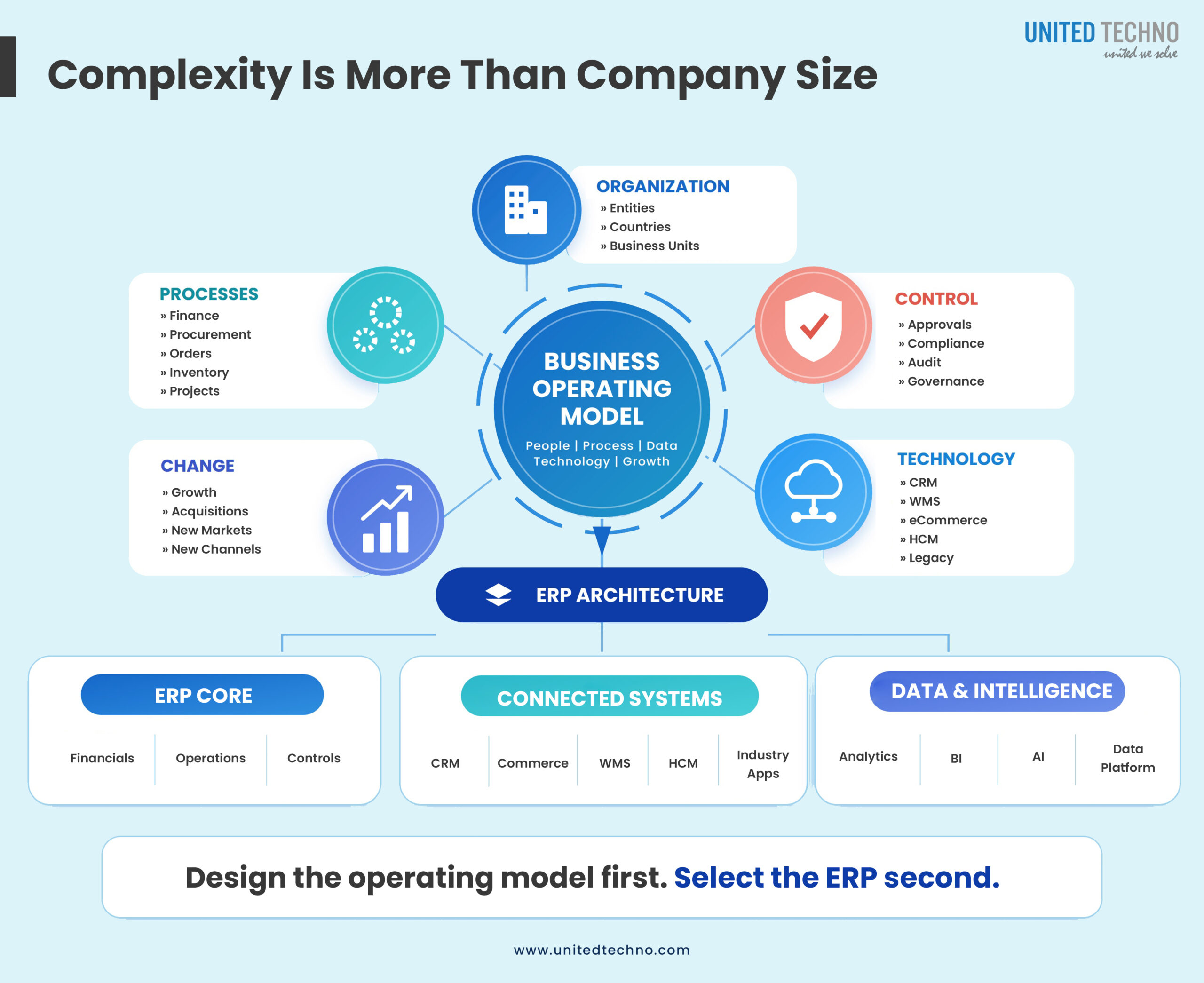
A useful assessment starts with five questions:
- How is the business structured?
- How does it transact?
- How much process variation exists?
- How much control is required?
- What surrounding technology must the ERP coordinate?
Those answers provide a much stronger basis for platform selection.
Five Forces That Shape the ERP Requirement
1. Organizational Structure
The ERP has to reflect how the organization is actually organized.
Consider:
- Legal entities
- Subsidiaries
- Locations
- Countries
- Currencies
- Shared services
- Intercompany activity
- Business-unit structures
The more complicated the organizational model becomes, the more important centralized financial and operational control becomes.
A company planning acquisitions or international expansion should also evaluate whether the selected ERP can accommodate that future structure without forcing another major transformation.
2. Process Complexity
Two companies may perform the same business function very differently.
For example, order management could mean:
Order → Fulfillment → Invoice → Payment
Or it could involve:
Customer Order → Availability Check → Multiple Warehouses → Allocation → Partial Fulfillment → Returns → Credits → Reconciliation
The ERP requirement changes significantly between those two models.
The same applies to procurement, manufacturing, inventory, projects and financial close.
ERP selection should therefore examine how processes behave, not simply whether the software contains a corresponding module.
3. Financial Control
Finance is often where ERP complexity becomes visible first.
Important considerations include:
- Consolidated reporting
- Intercompany accounting
- Multiple currencies
- Revenue recognition
- Financial close
- Tax requirements
- Approval structures
- Audit controls
- Management reporting
The question is not simply whether an ERP can perform accounting functions.
The more important question is:
How much financial complexity must the platform control consistently across the organization?
4. Integration Dependency
Modern ERP environments rarely operate independently.
A typical landscape may include:
CRM → eCommerce → ERP → WMS → Shipping → Banking → Data Platform
Additional systems may support:
- HCM
- EDI
- Tax
- Payments
- Procurement
- Customer service
- Manufacturing
- Planning
- Analytics
As these dependencies increase, ERP selection becomes partly an integration architecture decision.
The platform must fit into the broader enterprise rather than becoming another isolated technology island.
5. Change Requirements
One of the most overlooked ERP questions is what happens after implementation.
Businesses change.
They add entities. Launch products. Enter markets. Acquire companies. Change fulfillment models. Introduce new sales channels. Consolidate applications.
The selected ERP should therefore be evaluated against the organization’s expected rate of change, not just its current requirements.
A platform that works well today but requires extensive redesign every time the operating model changes may create long-term architectural friction.
Where NetSuite Enters the Decision
NetSuite can be considered when an organization wants to bring core financial and operational activities together within a cloud ERP environment and establish a more standardized operating foundation.
This can be particularly relevant when the business wants stronger coordination across areas such as:
- Financial management
- Order management
- Inventory
- Procurement
- Projects
- Manufacturing
- Reporting
- Multi-entity operations
The important consideration is not whether the platform has enough individual capabilities.
The question is whether the organization can establish its desired operating model around those capabilities without excessive customization or unnecessary surrounding complexity.
That distinction matters when evaluating NetSuite vs Oracle Fusion.
An ERP should support the business process rather than become a collection of exceptions built around the way the business used to operate.
Where Oracle Fusion Cloud ERP Enters the Decision
Oracle Fusion Cloud ERP becomes a different architectural consideration when the organization requires a broader enterprise operating environment with extensive financial, procurement, control and organizational requirements.
The discussion can become more focused on:
- Complex global structures
- Enterprise financial management
- Sophisticated procurement
- Broader governance requirements
- Large operational environments
- Extensive enterprise application landscapes
- Complex business processes
- Broader Oracle application strategies
- Long-term enterprise transformation
The key question remains the same:
Does the organization actually need that level of enterprise architecture?
A broader platform should not be selected simply because the company is growing.
It should be selected when the operating model requires the additional control, breadth and architectural capability.
The Overlap Is Where the Real Analysis Happens
ERP decisions are rarely as clean as:
Smaller company → Platform A
Larger company → Platform B
Real organizations do not fit neatly into those boxes.
A growing organization may have relatively straightforward financial processes but increasingly complex supply chain operations.
Another may have sophisticated financial requirements but relatively simple operational processes.
A third may have moderate business complexity but an extremely complicated technology environment because of years of acquisitions and application growth.
That creates an important evaluation zone where both platforms may deserve serious consideration.
This is where a structured architecture assessment becomes more valuable than a generic comparison chart.
The question becomes:
What complexity must the ERP absorb, and what complexity should remain outside it?
That distinction can materially change the platform decision.
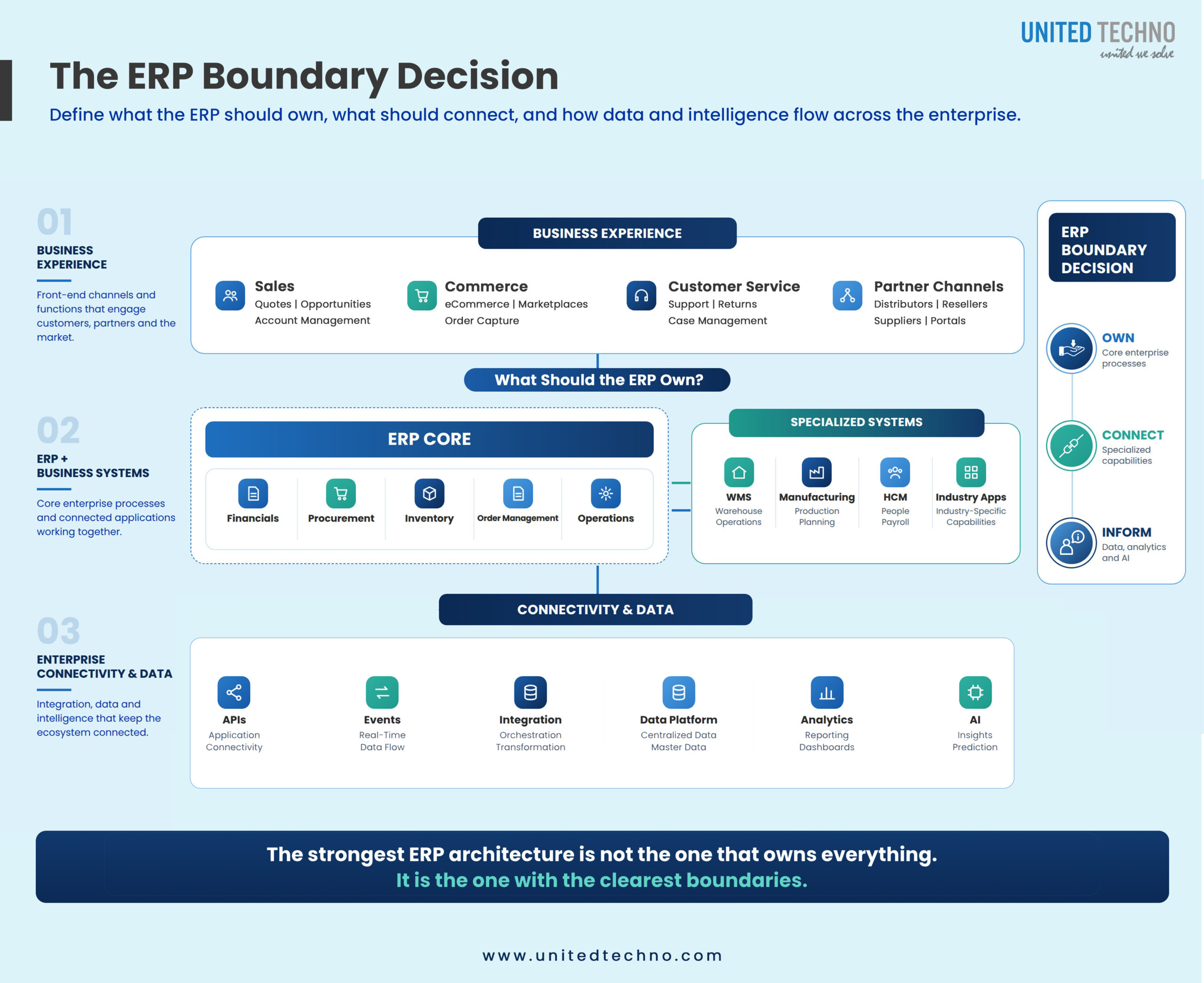
Do Not Turn the ERP Into the Entire Enterprise
One of the common mistakes in ERP transformation is trying to make the ERP responsible for everything.
The ERP should have a clearly defined boundary.
For example:
ERP
Financials | Core Operations | Procurement | Order Management | Inventory
Connected Applications
CRM | eCommerce | WMS | HCM | Specialized Industry Applications
Enterprise Data
Analytics | Data Warehouse | BI | AI | Reporting
Integration Layer
APIs | Events | EDI | Data Flows | Orchestration
This separation creates an important architectural principle:
The ERP should control the processes it is designed to own while remaining connected to the systems that provide specialized capabilities.
That makes the ERP decision much more manageable.
Customization Should Be Treated as an Architecture Decision
Customization is not automatically bad.
Some business requirements genuinely justify extending an ERP.
The problem begins when customization becomes the default response to every process difference.
Before modifying the platform, the organization should ask:
- Is the requirement genuinely business-critical?
- Can the process be standardized instead?
- Can configuration address it?
- Should the capability belong in another application?
- Can an integration solve the requirement?
- What happens to the customization during future upgrades?
- Will the modification create dependency elsewhere?
This is where ERP architecture and business-process design need to work together.
It is also an important consideration in a NetSuite vs Oracle Fusion evaluation, as the long-term implications of customization can influence implementation complexity, upgrade flexibility and maintenance effort.
The objective is not maximum customization.
It is controlled differentiation.
The Integration Architecture Can Change the ERP Decision
Suppose the organization has:
- Salesforce
- Shopify
- A warehouse platform
- Multiple payment providers
- EDI partners
- A legacy manufacturing application
- A cloud data platform
The ERP is now part of a much larger ecosystem.
A platform evaluation that examines only ERP functionality misses a significant part of the architecture.
The assessment should instead trace important business transactions across the ecosystem.
Example
Customer Order
↓
Commerce Platform
↓
ERP
↓
Inventory / Warehouse
↓
Fulfillment
↓
Invoice
↓
Payment
↓
Financial Reporting
The ERP is only one component of the transaction.
That is why ERP selection should include integration topology, data ownership, transaction orchestration and failure handling.
Think About the Next Operating Model
Selecting an ERP only for today’s organization can create another transformation problem several years later.
Instead, model the organization forward.
Consider:
Growth
Will the company enter new markets?
Structure
Will additional entities or acquisitions be introduced?
Operations
Will manufacturing, distribution or fulfillment become more sophisticated?
Channels
Will the business add eCommerce, marketplaces or direct-to-consumer operations?
Technology
Will more specialized applications be introduced?
Data
Will analytics and AI become more dependent on ERP data?
Governance
Will regulatory and financial control requirements increase?
These questions help establish the future ERP boundary.
A United Techno Approach to ERP Platform Selection
United Techno approaches ERP selection through the operating model first.
01 — Understand
Map the business structure, processes and critical transactions.
02 — Diagnose
Identify operational friction, manual work, duplicated data and control gaps.
03 — Define
Establish what the ERP should own and what should remain outside it.
04 — Architect
Design the ERP, integration, application and data landscape together.
05 — Compare
Evaluate NetSuite vs Oracle Fusion Cloud ERP and other relevant options against the defined architecture.
06 — Validate
Test the shortlisted architecture against real business scenarios rather than generic demonstrations.
07 — Roadmap
Define implementation phases, integration priorities, data requirements and future-state capabilities.
This approach prevents the platform from dictating the operating model.
The business architecture comes first.
NetSuite vs Oracle Fusion: The Questions That Actually Matter
NetSuite vs Oracle Fusion, Instead of asking which platform has more features, leadership teams should ask:
| Decision Area | Question |
| Business Structure | How complex is the organization today? |
| Process Model | How standardized or differentiated are core processes? |
| Financial Model | How sophisticated are consolidation, controls and reporting requirements? |
| Operations | How much complexity exists across inventory, manufacturing, procurement and fulfillment? |
| Integration | How many critical systems must participate in core transactions? |
| Governance | How much centralized control does the organization require? |
| Change | How frequently will the operating model evolve? |
| Future State | What should the enterprise look like three to five years from now? |
| ERP Boundary | What should the ERP own, and what should it not own? |
The answers will usually reveal more than a conventional product scorecard.
The Right ERP Is the One That Fits the Operating Model
NetSuite vs Oracle Fusion Cloud ERP should not be evaluated as simply two products competing for the same checkbox list.
The more meaningful decision is architectural.
One organization may need a connected ERP foundation around which standardized financial and operational processes can be built.
Another may require a broader enterprise architecture capable of supporting greater organizational, financial, operational and governance complexity.
And some organizations may sit between those models.
That is why the ERP decision should begin with the business.
Understand the operating model. Map the complexity. Define the ERP boundary. Design the architecture. Then select the platform.
Evaluate Your ERP Platform Fit
United Techno can help assess your business complexity, ERP boundary, integration landscape and future operating model before the platform decision is made.