Project Overview
The client operates a large digital commerce ecosystem where data is generated across multiple enterprise applications, marketing platforms, and operational systems. With datasets arriving from various regions and formats, managing and integrating this data into a unified analytics platform became increasingly complex.
To address this challenge, United Techno implemented a modern cloud-based data warehouse architecture centered on Snowflake. The solution integrates data from multiple enterprise sources through automated ingestion pipelines and orchestrated workflows.
This centralized architecture provides a scalable and reliable data foundation that supports analytics, reporting, and business decision-making across the organization.
Business Challenges
Managing large-scale enterprise data pipelines introduced several operational challenges:
High Volume of Data Sources – Data from 35+ source systems needed to be ingested daily, each with different formats, schedules, and validation requirements.
Manual Monitoring of Nightly Batch Processes – Nightly batch runs required continuous manual monitoring throughout the year to ensure successful ingestion and transformation of data.
Data Validation Complexity – Comparing and validating data across multiple environments and databases was time-consuming and prone to human error.
File-Based Integration Complexity – Data arrived through multiple channels such as SFTP servers, storage accounts, and business-managed file locations, requiring automated validation and processing.
Migration Complexity – The organization migrated its data warehouse from Azure SQL Database to Snowflake to improve scalability and performance, requiring careful validation and phased migration.
Operational Overhead – Monitoring pipelines, validating data, and maintaining ETL processes required significant manual effort and operational resources.
United Techno’s Solution Approach
Centralized Data Warehouse on Snowflake – Snowflake was implemented as the central analytical data warehouse to provide scalable storage and fast query performance. Data was loaded into Snowflake, Snowpipe for automated ingestion, and Matillion ETL pipelines for transformation and processing.
Intelligent Orchestration and Scheduling – Pipeline orchestration and scheduling were handled using Azure Logic Apps, Matillion scheduling, WebJobs, and Azure Functions. Logic Apps managed daily batch workflows and audit logs, while Matillion scheduled ETL jobs. WebJobs and Azure Functions supported workflow automation and ensured reliable pipeline execution.
Automated File Processing and Validation – Custom processing logic implemented through WebJobs and Function Apps validated incoming files before ingestion. These processes ensured correct file structure, naming conventions, and availability of expected datasets before triggering downstream pipelines.
Integrated Data Ingestion – Data was ingested through BrickFTP, client SFTP servers, Azure Storage Accounts, and BOX locations used by business teams.
Data Quality Validation – Apache Hop was used for automated data validation including row count checks and database comparisons. A custom C# comparison tool was also developed to validate datasets across environments during the Azure SQL to Snowflake migration.
Reporting and Governance – Processed data was delivered through Microsoft Power BI dashboards. Development and deployment were managed using Azure DevOps and GitHub, while JIRA and Confluence supported issue tracking and documentation.
Business Impact and Outcomes
The implementation of the Snowflake-based data warehouse delivered significant technical and operational benefits.
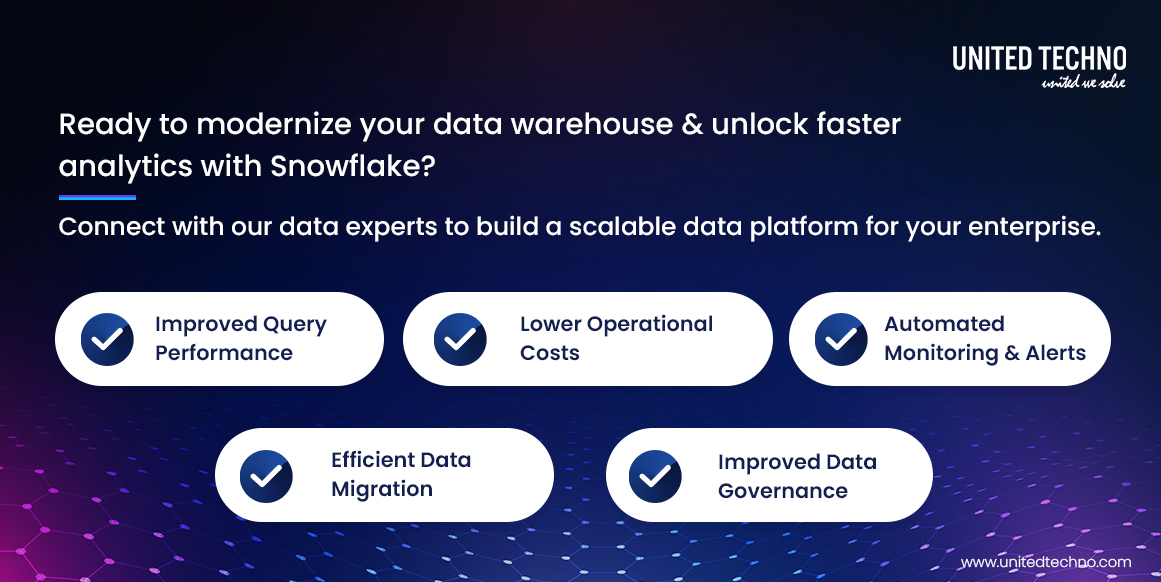
Improved Query Performance
Snowflake delivered faster query execution compared to the legacy Azure SQL warehouse, especially for large and complex analytical workloads.
Lower Operational Costs
Snowflake’s consumption-based pricing and automatic scaling optimized infrastructure usage and reduced overall operational costs.
Automated Monitoring and Alerts
An internal monitoring automation tool was developed to track nightly pipeline runs and generate alerts in case of failures, significantly reducing manual monitoring efforts.
Efficient Data Migration
Using Matillion, the team successfully migrated data from Azure SQL to Snowflake through a phased, source-by-source migration strategy with incremental testing and validation.
Improved Data Governance
Taken a major step forward in modernizing our data ecosystem. By replacing legacy NetSuite dependencies with SAP-aligned data models, we’ve simplified our architecture and established stronger governance standards that ensure consistency, compliance, and scalability.
To further enhance security and trust, we’ve implemented Snowflake Role-Based Access Control (RBAC) and Network Policies. Together, these measures deliver:
- Streamlined architecture – reducing complexity and technical debt.
- Robust governance – enforcing standardized data structures and compliance frameworks.
- Granular access control – ensuring the right people have the right level of access.
- Enhanced security – restricting connections to trusted networks only.
This layered approach creates a resilient, compliant, and future-ready data foundation that empowers advanced analytics, supports innovation, and builds confidence across the organization.
Enhanced Reporting Capabilities
Access to richer and better-structured enterprise data improved analytics capabilities and enabled more comprehensive reporting.
Conclusion
United Techno helped the client modernize a complex multi-source data ecosystem into a centralized and scalable cloud data warehouse platform. By leveraging Snowflake and automated orchestration frameworks, the organization now benefits from streamlined data pipelines, improved governance, and enhanced analytics capabilities. The modernized platform provides a strong and scalable foundation to support the organization’s long-term data and analytics strategy.