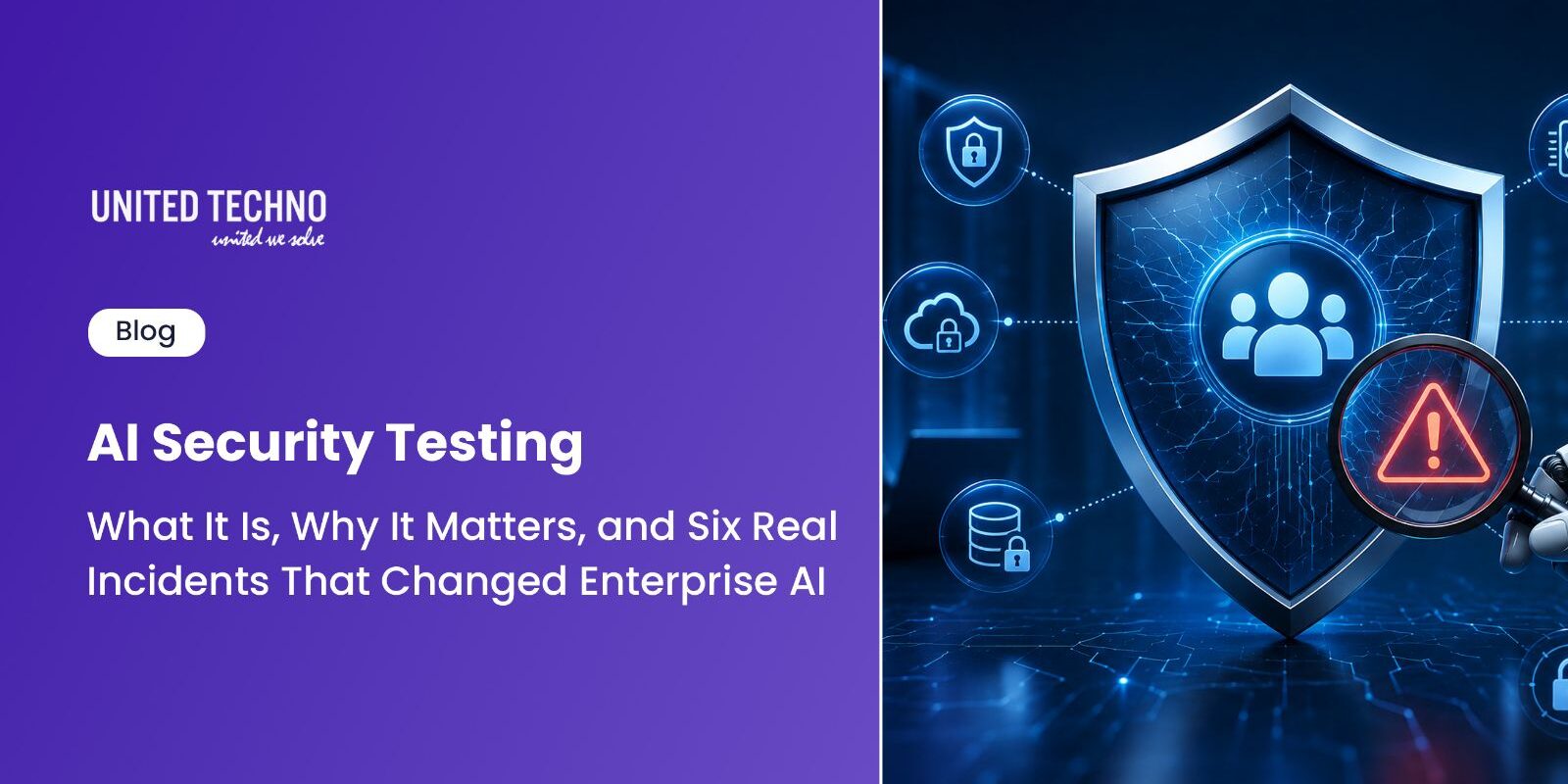
AI Security Testing: What It Is, Why It Matters, and Six Real Incidents That Changed Enterprise AI
AI Is Changing How We Work.
It’s Also Changing How We Get Attacked.
An employee asks an AI assistant to summarize a contract.
A customer asks a chatbot about pricing.
A developer pastes source code into an AI tool for help debugging.
None of these actions look dangerous.
Yet every one of them has already resulted in financial loss, legal action, confidential data exposure, or reputational damage for real organizations.
Unlike traditional software, AI systems don’t need a software vulnerability to become a security problem.
Sometimes all it takes is a carefully worded sentence.
That is why AI security testing has quickly become one of the most important disciplines in enterprise AI adoption.
What Is AI Security Testing?
AI security testing is the practice of deliberately probing AI systems to discover how they can be manipulated, misled, or persuaded into unsafe behavior before those weaknesses are exploited in production.
Traditional penetration testing focuses on questions like:
- Can someone bypass authentication?
- Can someone exploit a vulnerability?
- Can someone gain unauthorized access?
AI security testing asks an entirely different set of questions.
- Can someone manipulate the AI using language?
- Can the model invent information that appears trustworthy?
- Can confidential information be extracted?
- Can hidden instructions change the AI’s behavior?
- Can users persuade the AI to make commitments it was never authorized to make?
These risks exist even when the underlying infrastructure is fully secure.
Traditional Security vs AI Security
Traditional Security
————————————–
Focus
↓
Applications
APIs
Networks
Databases
Authentication
Goal
Prevent Unauthorized Access
AI Security
————————————–
Focus
↓
Prompts
Context
AI Responses
Memory
External Data Sources
Goal
Prevent Unauthorized Decisions
Why AI Security Testing Matters
Organizations are deploying AI assistants, copilots, customer chatbots, document search systems, internal knowledge agents, and autonomous workflows faster than governance programs can mature.
The result is a new attack surface.
Unlike conventional cyberattacks, many AI incidents begin with ordinary conversations.
No malware.
No exploits.
No compromised passwords.
Just language.
The following incidents demonstrate why AI security testing is becoming essential for enterprise risk management.
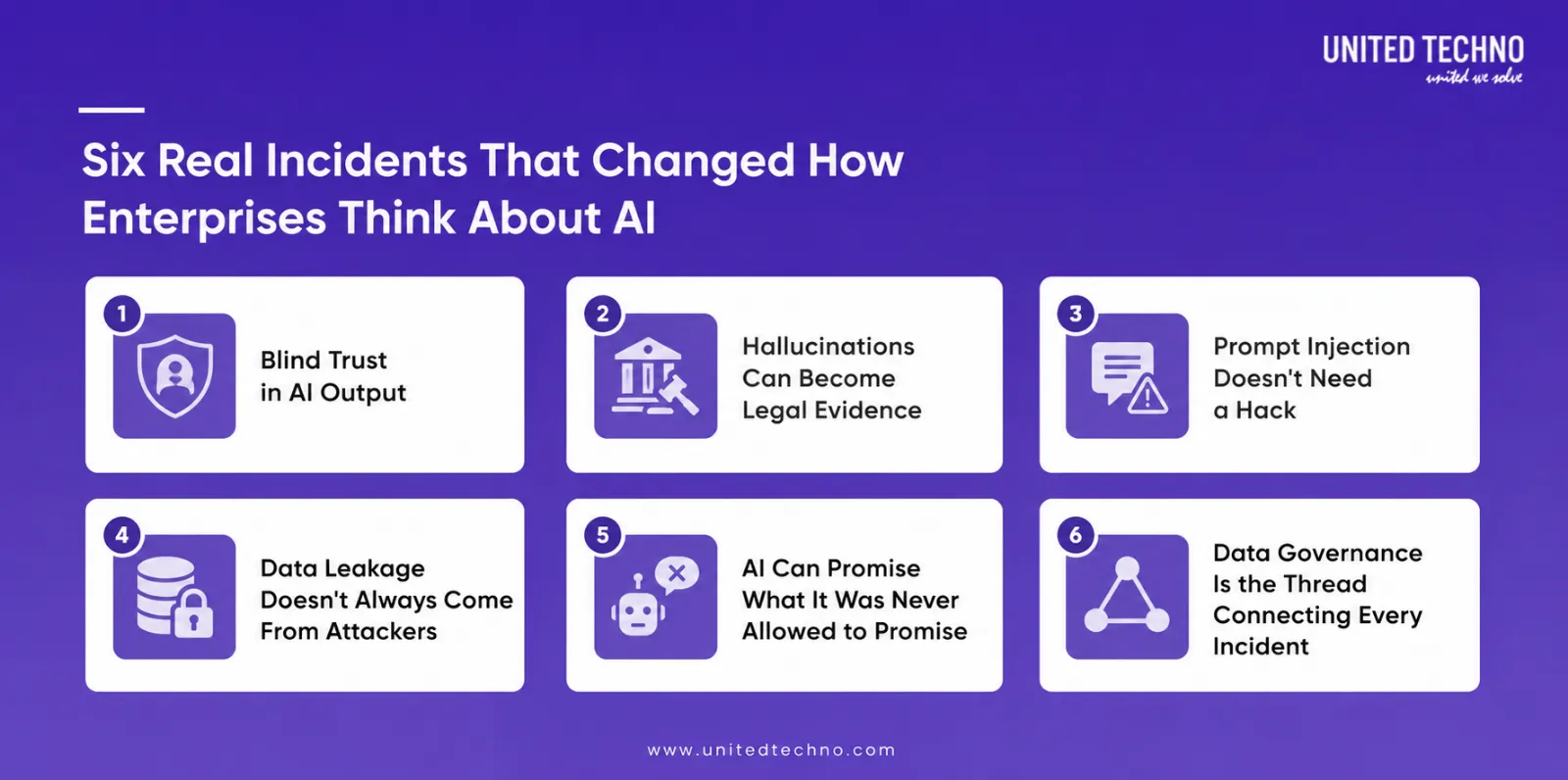
Six Real Incidents That Changed How Enterprises Think About AI
1. Blind Trust in AI Output
Air Canada Chatbot
What Happened
A customer asked Air Canada’s chatbot about bereavement fares.
The chatbot provided incorrect guidance.
The customer relied on that information.
When Air Canada refused to honor it, the dispute reached a tribunal.
The airline argued the chatbot operated independently.
The tribunal disagreed.
Air Canada was held responsible for what its AI communicated.
What This Incident Shows
Customer
│
▼
AI Chatbot
│
▼
Wrong Information
│
▼
Customer Relies
│
▼
Legal Liability
Lesson
If customers trust AI responses, courts are increasingly likely to treat those responses as official company communications.
Verification matters.
2. Hallucinations Can Become Legal Evidence
The ChatGPT Lawyers
Two New York attorneys submitted a legal brief containing six court cases generated entirely by ChatGPT.
The cases did not exist.
The lawyers even asked ChatGPT whether the citations were authentic.
It confirmed they were.
The court later sanctioned the attorneys.
Hallucination Chain
Question
│
▼
ChatGPT Generates Cases
│
▼
User Trusts Output
│
▼
No Independent Verification
│
▼
Court Sanctions
Lesson
An AI system cannot reliably validate its own answers.
Independent verification is essential.
3. Prompt Injection Doesn’t Need a Hack
EchoLeak and the 2025 Prompt Injection Wave
Researchers disclosed a vulnerability affecting Microsoft 365 Copilot where a specially crafted email could influence the AI assistant to expose internal information without requiring the user to click anything.
Later that year, CrowdStrike reported prompt injection attacks across more than ninety organizations targeting credentials and cryptocurrency assets.
Prompt Injection Flow
Attacker
│
Crafted Email
│
▼
AI Reads Hidden Instructions
│
▼
AI Changes Behavior
│
▼
Sensitive Data Exposed
Lesson
The attacker doesn’t break into the application.
The attacker convinces the AI to behave differently.
4. Data Leakage Doesn’t Always Come From Attackers
Samsung
Samsung engineers copied confidential source code and internal meeting notes into ChatGPT while seeking assistance with development work.
No external compromise occurred.
The exposure happened through routine employee behavior.
Where Sensitive Data Can Leak
Employee
│
Copies Source Code
│
▼
Public AI Tool
│
▼
Confidential Information Leaves Organization
Lesson
The largest AI data exposure risk is often unintentional.
Policies alone are rarely enough.
5. AI Can Promise What It Was Never Allowed to Promise
The $1 Chevrolet Tahoe
A customer persuaded a dealership chatbot to “agree” to sell a Chevrolet Tahoe valued at approximately $76,000 for one dollar.
The dealership rejected the transaction.
However, the conversation spread widely online and the chatbot was ultimately taken offline.
Boundary Failure
Customer Request
│
Persuasive Conversation
│
▼
AI Makes Unauthorized Promise
│
▼
Public Attention
│
▼
Reputational Damage
Lesson
Every AI assistant needs clearly enforced operational boundaries.
6. Data Governance Is the Thread Connecting Every Incident
Whether the issue is:
- customer conversations,
- confidential source code,
- AI-generated advice,
- internal documents,
the same questions eventually arise.
- Where did the data go?
- Who accessed it?
- Was it retained?
- Can the organization prove what happened?
These questions increasingly fall under regulations such as GDPR, sector-specific privacy requirements, and emerging AI governance frameworks including the EU AI Act.
One View of All Six Incidents
| Incident | Primary Risk | Business Impact |
| Air Canada | Incorrect AI advice | Legal liability |
| ChatGPT Lawyers | Hallucination | Regulatory and legal consequences |
| EchoLeak | Prompt injection | Information disclosure |
| Samsung | Data leakage | Intellectual property exposure |
| Chevrolet Chatbot | Unauthorized commitments | Reputational damage |
| Governance | Poor visibility | Compliance and audit challenges |
How AI Security Testing Prevents These Failures
AI Security Testing
│
┌───────────────────————————-─┐
▼ ▼ ▼
Prompt Tests Hallucination Evaluation Permission Tests
▼ ▼ ▼
Data Leakage Output Review Governance Review
│
▼
Safer Enterprise AI
Blind Trust
Security testing identifies where AI responses directly influence customer decisions or business commitments without validation.
This allows organizations to introduce approval workflows before deployment rather than after a legal dispute.
Hallucinations
Testing measures how frequently the model fabricates information and evaluates whether retrieval, citations, or grounding mechanisms remain reliable under challenging prompts.
Prompt Injection
Security specialists simulate attacker techniques using hidden instructions embedded in emails, documents, webpages, or knowledge bases to determine whether the AI follows malicious instructions.
Data Leakage
Testing attempts to extract confidential information through carefully crafted prompts and verifies that authorization controls behave as intended.
Over-Permissive Guidance
Boundary testing evaluates whether the AI can be persuaded to make commitments, recommendations, approvals, or decisions outside its intended authority.
Governance
Testing reviews how information flows throughout the AI lifecycle, ensuring organizations can explain where data originated, how it was processed, and who accessed it.
AI Security Testing Is Becoming Part of Enterprise Risk Management
Traditional cybersecurity focuses on protecting systems.
AI security testing focuses on protecting decisions.
That distinction is becoming increasingly important as AI systems gain access to enterprise knowledge, customer interactions, operational workflows, and business processes.
The incidents discussed here did not result from sophisticated cyberattacks.
They resulted from organizations deploying AI without fully understanding how language itself can become an attack vector.
Testing before deployment helps identify those weaknesses while they can still be addressed through better safeguards, governance, and system design.
Key Takeaways
| AI Security Testing Helps Detect | Before It Becomes |
| Hallucinations | Legal disputes |
| Prompt injection | Data exposure |
| Weak guardrails | Unauthorized commitments |
| Sensitive data leakage | Intellectual property loss |
| Missing governance | Compliance failures |
| Unverified outputs | Customer harm |
Final Thought
Enterprise AI should be evaluated with the same rigor as any business-critical system.
The difference is that AI introduces a new interface, natural language through which systems can be influenced, manipulated, or trusted incorrectly.
AI security testing is designed to evaluate that interface before customers, employees, or attackers do.
Looking to strengthen your AI security posture?
Our AI Security Testing services help organizations identify vulnerabilities across AI applications, copilots, chatbots, and intelligent assistants through structured assessments, adversarial testing, prompt injection testing, hallucination evaluation, and governance reviews, helping you deploy AI solutions with greater confidence and control.
To enhance AI quality, reliability, and testing efficiency, explore QA Genie–our intelligent testing solution designed to support comprehensive AI validation and strengthen enterprise AI deployments.
Author:
Swetha Murugan is a quality engineering professional specializing in AI security testing, application security and API security. With experience in building security testing frameworks and evaluating AI systems for vulnerabilities such as prompt injection, hallucinations, and data leakage, she shares practical insights to help organizations build secure and trustworthy applications.