Connected devices. Cloud platforms. Mobile applications. AI. Clinical workflows.
The modern medical product is no longer confined to a physical device.
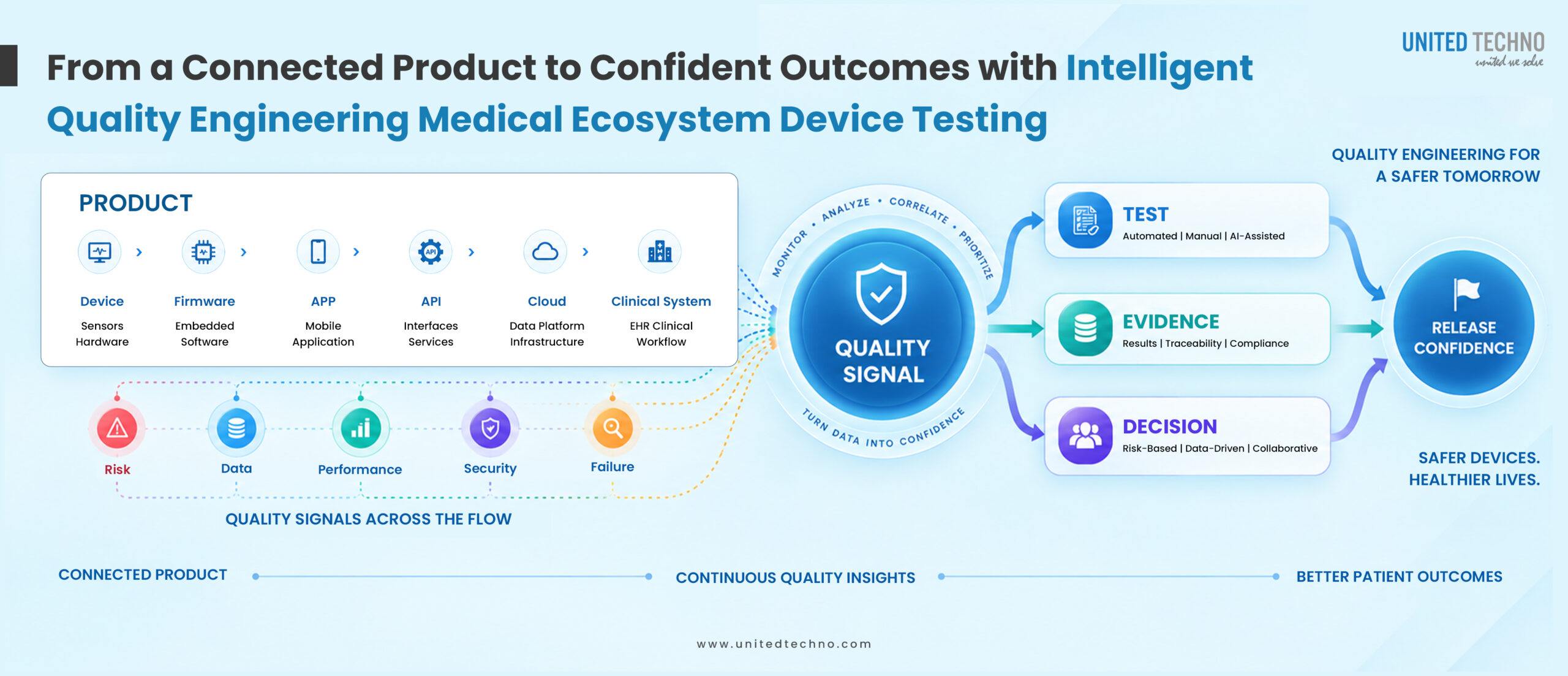
A connected medical solution can span firmware, sensors, mobile applications, APIs, cloud services, data platforms and clinical systems. A change in one layer can introduce an unexpected behavior somewhere else.
That has changed the testing equation.
The question is no longer simply “Did we test the device?”
It is:
“Can we demonstrate that the complete product ecosystem behaves safely, reliably and predictably?”
For MedTech organizations, this is where Quality Engineering moves beyond conventional test automation. Medical Device Software Testing Services help teams evaluate software behavior, validate system interactions and build confidence in the reliability of connected medical solutions.
The Medical Product Has Become an Ecosystem
Consider a connected monitoring solution:
DEVICE → FIRMWARE → MOBILE APP → API → CLOUD → DATA → CLINICAL WORKFLOW
Every connection creates another point that can affect product behavior.
A sensor may produce an unexpected value.
The device may transmit it correctly.
The API may transform it incorrectly.
The cloud may store it successfully.
The clinical application may then display the wrong interpretation.
Every individual component can appear healthy while the end-to-end product is not.
This is why Medical Device Software Testing must consider the complete product journey, including data flow, system interactions and end-to-end behavior.
At United Techno, we approach MedTech quality around the complete product journey, not isolated applications.
The 25% Automation Ceiling Is Being Challenged
For years, organizations have invested heavily in automated testing without seeing automation scale as far as expected.
Forrester’s recent research on autonomous testing platforms highlights a long-standing industry plateau of roughly 23–25% automated testing. Its 2026 customer research found organizations using newer autonomous testing approaches reporting 51–60% automation on average, while advanced teams exceeded 80%. Yet customers rated full testing autonomy at only 2.2 out of 5.
The distinction matters.
More automation does not mean less human involvement.
It means shifting human effort toward the parts of quality that require experience, risk judgment and product understanding.
In Medical Device Software Testing, this distinction is critical because software quality decisions must account for product behavior, patient safety, system interactions and the consequences of failure. Automation can accelerate repetitive validation, but human expertise remains essential for evaluating risks and interpreting results.
Automation Is Not the Strategy. Risk Is.
A medical device does not have 500 equally important behaviors.
Some functions affect patient safety. Others affect operational efficiency. Some represent regulatory obligations. Others may have limited business impact.
Testing effort should reflect those differences.
In Medical Device Software Testing, a risk-driven approach helps teams prioritize validation based on the potential impact of failure rather than simply the number of available test cases.
A United Techno risk-driven model
PRODUCT RISK
↓
CRITICAL FUNCTIONS
↓
FAILURE MODES
↓
TEST PRIORITY
↓
AUTOMATION
↓
EVIDENCE
↓
RELEASE CONFIDENCE
The result is a different way of measuring testing maturity.
Instead of asking:
How many tests have we automated?
ask:
How much of our critical product risk can we continuously validate?
That is a much more meaningful number.
Where MedTech Quality Gets Complicated
A modern testing program has to cover more than functional behavior.
| Quality dimension | What needs to be proven |
| Functional | The product performs its intended functions |
| Safety | Critical failures behave as designed |
| Performance | The system remains stable under expected conditions |
| Security | Devices, applications and data remain protected |
| Interoperability | Connected systems exchange information correctly |
| Data integrity | Information remains accurate across the transaction |
| Traceability | Requirements connect to testing and evidence |
| Release confidence | Product changes do not introduce unacceptable risk |
This is where traditional QA structures begin to show their limitations.
The testing organization is no longer validating a screen or a feature.
It is validating behavior across an ecosystem.
Follow the Data. Find the Risk.
Consider a laboratory result moving through a connected healthcare environment:
LAB SYSTEM → INTEGRATION → DATA PLATFORM → CLINICAL APPLICATION
A basic integration test might confirm that the message arrives.
A quality engineering approach asks more.
Was the correct patient context preserved?
Were required fields transformed correctly?
Was duplicate data handled correctly?
What happens if the receiving system is unavailable?
Does the transaction recover?
Can the result be reconciled?
Can the organization demonstrate what happened?
In Medical Device Software Testing, these questions are important when connected medical products exchange data with healthcare systems and depend on reliable end-to-end processing.
This is why United Techno brings together integration testing, data validation, API testing, automation and quality engineering rather than treating them as disconnected activities.
The Test Suite Is Not the Product
One of the easiest mistakes in enterprise testing is confusing test volume with quality.
A team can execute thousands of tests and still miss the failure that matters.
In Medical Device Software Testing, a stronger scorecard connects engineering activity with product impact.
| Traditional metric | Better quality question |
| Automation percentage | Are critical risks automated? |
| Tests executed | What important risks remain? |
| Pass rate | What evidence supports release? |
| Defects found | Which failures matter most? |
| Regression duration | How quickly can meaningful feedback arrive? |
| Test coverage | Which business and clinical paths are actually covered? |
| Production defects | What escaped earlier validation? |
Gartner’s 2025 research on software engineering metrics makes a similar point: quality cannot be understood through delivery and internal testing metrics alone. Its impact on productivity, engineering experience and user satisfaction matters.
For MedTech, there is another measure:
What happens if this defect reaches the field?
That question should influence testing priority.
AI Is Changing Testing. Accountability Stays Human.
AI is now entering almost every part of software engineering.
Testing is no exception.
In Medical Device Software Testing, AI-assisted quality engineering can support:
- Test generation
- Test-data creation
- Regression selection
- Failure analysis
- Defect clustering
- Script maintenance
- Test prioritization
- Test-case conversion
Forrester’s current research points toward autonomous testing platforms that combine traditional automation with generative AI and intelligent agents.
But autonomy has limits.
A generated test is not automatically good.
A self-healing script is not automatically safe.
A generated result is not automatically acceptable evidence.
For a medical product, engineers still need to understand why a test exists, what risk it covers and what its result means.
The opportunity is not to remove engineers from the quality process.
It is to give experienced engineers better tools.
Compliance Has to Become Part of Engineering
For regulated products, testing produces more than a pass or fail.
It produces evidence.
In Medical Device Software Testing, that evidence needs to connect requirements, risk, testing, results and change.
The FDA’s 2026 guidance on Computer Software Assurance reinforces a risk-based approach to establishing confidence in software used for medical-device production and quality-management systems. Its 2026 cybersecurity guidance also emphasizes cybersecurity considerations across device design and premarket documentation.
The direction is clear.
Quality evidence cannot be something assembled after development.
It needs to be part of the lifecycle.
Requirement → Risk → Test → Result → Evidence → Release
That chain becomes particularly important as devices become more connected and software updates become more frequent.
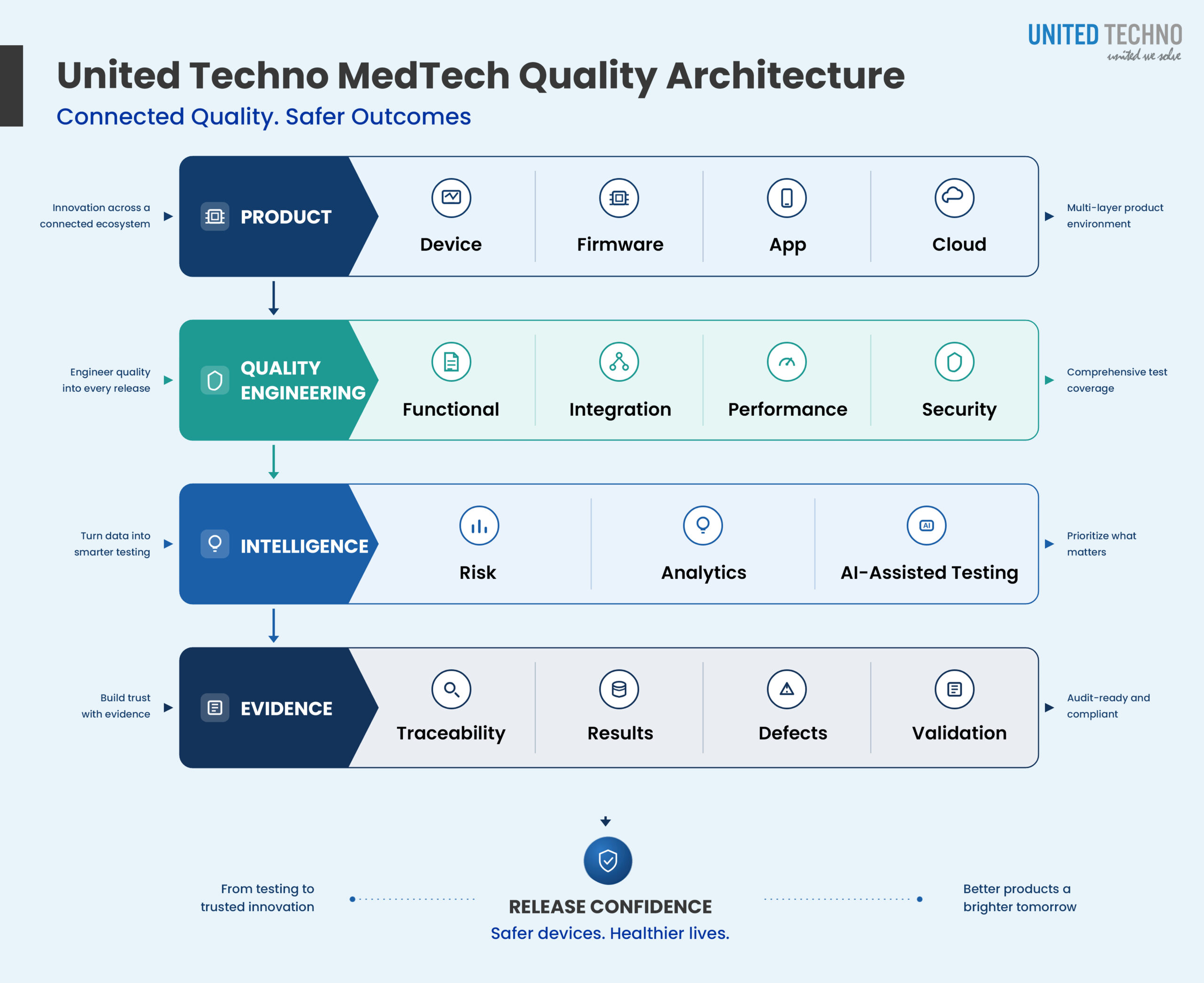
What a Modern MedTech Quality Architecture Looks Like
United Techno brings quality engineering together with healthcare and life sciences technology, data engineering, integration and AI capabilities.
Our approach to Medical Device Software Testing is deliberately practical.
DEFINE
Establish requirements, critical functions and risk.
VALIDATE
Build functional, integration, performance, security and data coverage.
AUTOMATE
Automate repeatable, high-value scenarios.
EVALUATE
Assess results, anomalies, failures and AI behavior.
TRACE
Connect requirements, tests, defects and evidence.
MONITOR
Feed production behavior back into the next validation cycle.
This creates something more valuable than a large test library:
A continuously improving picture of product quality.
United Techno MedTech Quality Architecture
The New Definition of Testing
Medical device software testing is moving beyond the question of whether software works.
It is becoming a discipline for understanding how a product behaves under change, stress, failure and real-world conditions.
That requires more than automation.
It requires risk engineering.
It requires data and integration testing.
It requires performance and security validation.
It requires traceability.
And increasingly, it requires intelligent testing capabilities that can keep pace with software development.
The strongest MedTech organizations will not be the ones with the largest number of automated scripts.
They will be the ones that can answer a more important question:
Can we release this product with evidence-backed confidence?
That is the shift from test execution to quality engineering.
Build a MedTech Quality Engineering Strategy With United Techno
United Techno helps healthcare and MedTech organizations strengthen quality across medical device software, connected products, clinical applications, APIs, data platforms and digital healthcare ecosystems.
From risk-driven test strategy and automation to integration, data validation, performance, security and AI-assisted testing, United Techno brings the engineering disciplines together around one objective:
Build, validate and release medical technology with confidence.
Talk to United Techno about your MedTech Quality Engineering roadmap →