A data warehouse is not simply where enterprise data goes. It is where enterprise data becomes usable.
Customer records sit in CRM systems. Orders live in ERP platforms. Finance maintains its own structures. Marketing has another view. Operations has another.
The problem is rarely a lack of data.
It is the difficulty of turning all those different representations into one trusted analytical view of the business.
That is where a well-designed Enterprise Data Warehouse earns its place.
Why the Data Warehouse Still Matters
Enterprise data architecture has changed considerably. Data lakes, lakehouses, streaming platforms and AI workloads now sit alongside traditional warehouse environments.
Yet the underlying business requirement has not changed:
People need reliable data to make decisions.
A finance leader wants one revenue number.
A supply-chain team wants a consistent inventory view.
A marketing team wants to understand customer behavior.
A data scientist needs dependable historical data.
An AI application needs relevant, governed context.
The architecture may differ, but the requirement remains the same:
Turn fragmented enterprise data into information that people and systems can trust.
A well-designed Enterprise Data Warehouse remains an important part of this foundation, providing structured, consistent and reliable data for analytics and business decision-making.
Gartner identifies data and analytics platform convergence, semantics and AI agents among the major data and analytics themes for 2026. That makes the quality and structure of the underlying enterprise data increasingly important, not less.
Start With the Business, Not the Warehouse
One of the most common mistakes in Enterprise Data Warehouse programs is beginning with tables.
The better starting point is the business question.
Consider a simple question:
“What was our customer revenue last quarter?”
It sounds straightforward.
But which customer?
Which transaction?
Gross or net revenue?
Which currency?
Which date?
Which returns?
Which business unit?
Which source system?
The technical challenge is often not writing the SQL.
It is agreeing on what the number actually means.
That is why United Techno places business definitions and data modeling early in the warehouse lifecycle.
The Canonical Data Model: Where Agreement Happens
Different departments often use different names and definitions for the same business entity.
A customer may be called a:
Buyer | Consumer | Client | Account | Shopper
Technically, these may all map to different structures.
From a business perspective, however, the organization may need a common definition.
A canonical data model establishes those shared entities, attributes and relationships before downstream analytical models are built. This is an important foundation for a reliable Enterprise Data Warehouse.
The sequence matters:
Business Definitions
→ Canonical Model
→ Source Mapping
→ Transformation
→ Warehouse Model
→ Analytics
This reduces one of the most expensive problems in enterprise analytics:
different teams producing different answers from the same business data.
A Modern Data Warehouse Is a Data Flow, Not a Database
The warehouse itself is only one part of the architecture.
A typical Enterprise Data Warehouse flow looks like:
SOURCE SYSTEMS
CRM | ERP | Finance | HR | APIs | Files | SaaS
↓
INGEST
Capture | Replicate | Stream | Batch
↓
REFINE
Clean | Standardize | Validate | Reconcile
↓
WAREHOUSE
Facts | Dimensions | Measures
↓
DATA MARTS
Finance | Sales | Operations | Customer
↓
CONSUMPTION
BI | Analytics | Data Science | AI
Each layer has a purpose.
The architecture becomes easier to govern because teams can understand where data came from, what happened to it and why it exists in its current form.
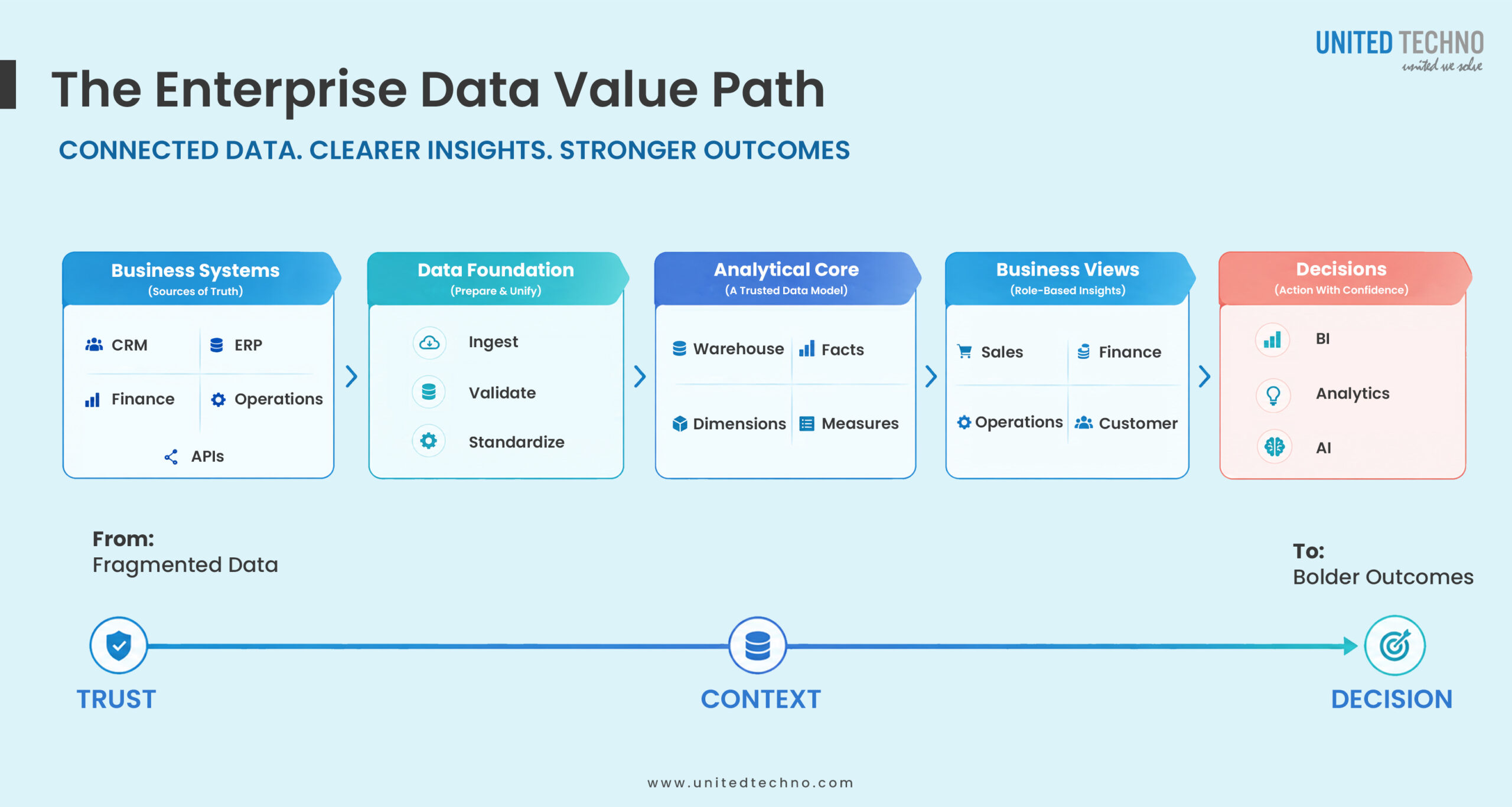
The Enterprise Data Value Path
Data Lake or Data Warehouse?
Choosing between a data lake and an Enterprise Data Warehouse should not become an ideological decision.
They solve different problems.
A data lake can provide a flexible landing and processing environment for raw, semi-structured and unstructured information.
A warehouse provides structured, curated data designed for analytical consumption.
For some enterprises, both make sense.
For others, a warehouse may be sufficient.
The right question is:
What does the workload require?
If the environment primarily contains structured enterprise data and the analytical requirements are well understood, introducing additional architectural components may create unnecessary complexity.
If the organization needs to process diverse data types, large volumes, streaming information or machine-learning workloads, a lake or lakehouse architecture may provide greater flexibility.
Architecture should follow workload, not fashion.
ETL Is Still About More Than Moving Data
ETL is often reduced to three words:
Extract → Transform → Load
In practice, enterprise ETL involves much more.
Data needs to be:
- Ingested reliably
- Validated
- Cleansed
- Deduplicated
- Standardized
- Mapped
- Reconciled
- Transformed
- Loaded
- Monitored
And every one of those steps can introduce data-quality problems.
A successful pipeline is therefore not simply one that finishes.
It is one that can answer:
Did we receive everything?
Did the transformation change the meaning?
Did the totals reconcile?
Can we trace the result back to the source?
Can the pipeline recover when something fails?
That is the difference between a data movement exercise and data engineering.
Design for Analytics, Not Transactions
Operational databases and analytical systems have different jobs.
An order-processing system needs to handle transactions efficiently.
An analytical platform needs to answer complex questions across large volumes of historical information.
Trying to make one system do both jobs can create unnecessary performance and governance challenges. A well-designed Enterprise Data Warehouse separates analytical workloads from operational transaction processing.
OLTP
Transactions
Orders | Payments | Updates | Returns
OLAP
Analysis
Trends | Aggregations | Forecasts | Business Intelligence
This is why warehouse models often use analytical structures such as fact tables and dimensions.
A fact table can capture measurable business events.
Dimensions provide the context around those events.
For example:
Sales Fact
| Date | Product | Customer | Store | Revenue |
| Jan 12 | Product A | Customer X | Store 14 | $420 |
| Jan 13 | Product B | Customer Y | Store 08 | $315 |
The model becomes useful because the organization can analyze the same business event by time, product, customer, geography or other dimensions.
Star Schema or Snowflake Schema?
The choice should follow analytical requirements.
| Consideration | Star Schema | Snowflake Schema |
| Model structure | Simpler | More normalized |
| Query simplicity | Generally easier | Can involve more joins |
| Business usability | Strong | More structured |
| Redundancy | Higher | Lower |
| Typical use | BI and analytical workloads | Complex dimensional environments |
Neither is universally better.
The real question is whether the model makes the data understandable, performant and maintainable for its intended consumers.
That is an architecture decision, not a template to apply automatically.
Where Data Warehouse Programs Usually Struggle
The technology is rarely the only challenge.
The harder problems tend to appear around the edges.
1. Conflicting definitions
Different departments calculate the same metric differently.
2. Poor source quality
Duplicate, incomplete or inconsistent source data enters the pipeline.
3. Weak ownership
Nobody clearly owns a business definition or data-quality rule.
4. Transformation complexity
Business logic becomes scattered across pipelines, reports and applications.
5. Limited lineage
Teams cannot easily explain where a number originated.
6.Warehouse performance
Poor modeling and inefficient transformations increase cost and query time.
A well-designed Enterprise Data Warehouse addresses these challenges through consistent business definitions, reliable data pipelines, clear ownership and optimized analytical models. The strongest warehouse programs address these concerns before they become production problems.
The United Techno Data Warehouse Blueprint
United Techno approaches data warehouse engineering as a combination of business modeling, data engineering, platform architecture and governance.
1 — DISCOVER
Identify sources, consumers, business questions and critical data domains.
2 — DEFINE
Establish common entities, metrics and business definitions.
3 — MODEL
Design canonical, dimensional and analytical models.
4 — ENGINEER
Build ingestion, transformation, validation and reconciliation pipelines.
5 — GOVERN
Introduce quality rules, lineage, security and controlled access.
6 — OPTIMIZE
Improve performance, scalability, reliability and operating cost.
7 — ENABLE
Expose trusted data to BI, analytics, data science and AI workloads.
The result is not simply a warehouse.
It is a decision-ready data foundation.
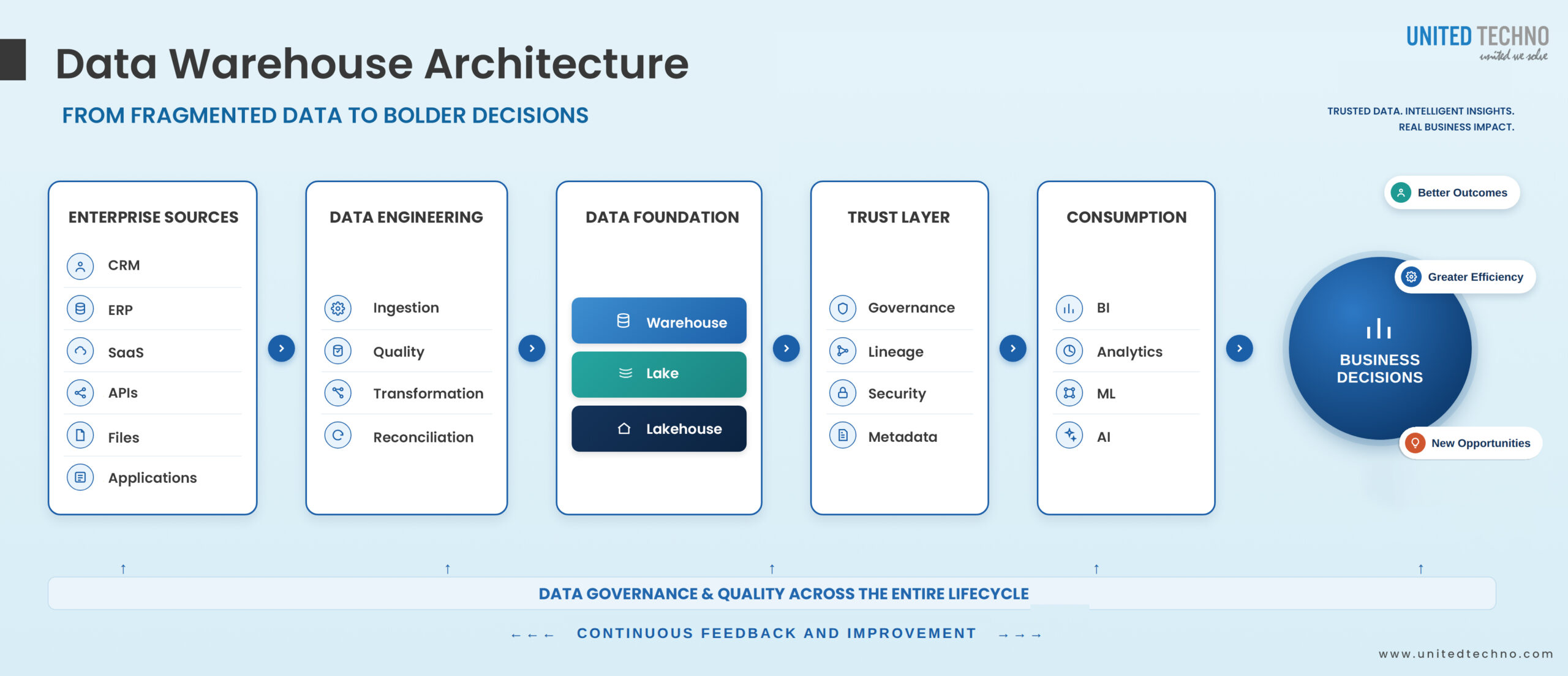
United Techno Data Warehouse Architecture
The Warehouse Is Becoming an AI Foundation
The data warehouse conversation is also changing because AI has changed what organizations expect from their data platforms.
AI applications need more than large quantities of information.
They need:
Relevant data.
Consistent definitions.
Current information.
Context.
Governed access.
Reliable lineage.
That makes warehouse architecture increasingly connected to the broader enterprise AI strategy.
The warehouse does not need to become an AI platform by itself.
But the data it provides must be trustworthy enough to support the systems that increasingly depend on it.
Five Questions Every Enterprise Should Ask
Before starting or redesigning a data warehouse, ask:
| Question | Why it matters |
| What decisions will this data support? | Keeps architecture tied to business value |
| Who owns the definitions? | Prevents conflicting metrics |
| Where does the data originate? | Establishes lineage and source accountability |
| How will quality be measured? | Makes trust measurable |
| What will consume the data next? | Prevents today’s architecture from becoming tomorrow’s constraint |
These questions often reveal more than a technology-selection exercise.
A Warehouse Is Only as Good as the Decisions It Enables
A data warehouse should disappear into the background.
An Enterprise Data Warehouse should disappear into the background.
Executives should not have to think about the pipeline when reviewing performance.
Analysts should not have to debate which revenue number is correct.
Data engineers should not spend every morning reconciling yesterday’s loads.
And AI teams should not discover six different definitions of the same customer after building a model.
That is the real measure of a mature data warehouse:
The organization trusts the data enough to act on it.
United Techno helps enterprises design and modernize data warehouse environments across data engineering, cloud platforms, data integration, governance, analytics and AI-ready data foundations.
Build a Data Foundation Your Business Can Trust
Whether the challenge is fragmented enterprise data, warehouse modernization, pipeline reliability, dimensional modeling or preparing existing data platforms for AI, United Techno brings architecture and engineering together to build a practical path from raw data to reliable decisions.
Talk to United Techno About Your Data Warehouse Strategy →