What data engineering leaders should rethink when building a platform for analytics, real-time intelligence, and AI.
For years, enterprise data modernization meant replacing aging warehouses, moving workloads to the cloud, rebuilding ETL pipelines, and giving analysts faster access to information.
That definition is no longer sufficient.
The modern enterprise data platform has another responsibility: it must prepare data for machines that increasingly interpret, reason over, and act on enterprise information.
That changes the architecture.
A well-designed Microsoft Fabric Architecture must support more than dashboards. While traditional data platforms can tolerate some duplication, delayed processing, and manually maintained data models, an AI-enabled platform requires greater consistency, reliability, and control.
AI needs consistent business definitions, reliable data lineage, usable context, controlled access, and predictable data freshness. The engineering challenge is therefore no longer just moving data faster.
It is creating a platform where the same trusted data foundation can support analytics, AI, real-time intelligence, and business applications.
This is where Microsoft Fabric becomes particularly relevant.
But Fabric should not be approached as another technology migration.
It should be treated as an opportunity to redesign how enterprise data is produced, governed, consumed, and reused.
The Problem Is Not the Data Lake. It Is the Data Estate Around It.
Most large organizations have accumulated data platforms one project at a time.
A CRM team builds its own pipelines.
Finance maintains another reporting environment.
Supply chain creates operational datasets.
The data warehouse has its own transformation layer.
The data lake contains another version of the same information.
AI teams create yet another copy because the original data is difficult to consume.
Eventually, the organization has plenty of data—and very little agreement about which data should be trusted.
The symptoms are predictable:
| Enterprise symptom | Engineering consequence |
| Multiple versions of customer data | Conflicting analytics |
| Repeated transformations | Higher maintenance |
| Separate analytical environments | Data movement |
| Business logic buried in pipelines | Difficult change management |
| Inconsistent definitions | Unreliable AI responses |
| Streaming isolated from historical data | Limited operational intelligence |
| AI projects preparing their own datasets | Repeated engineering effort |
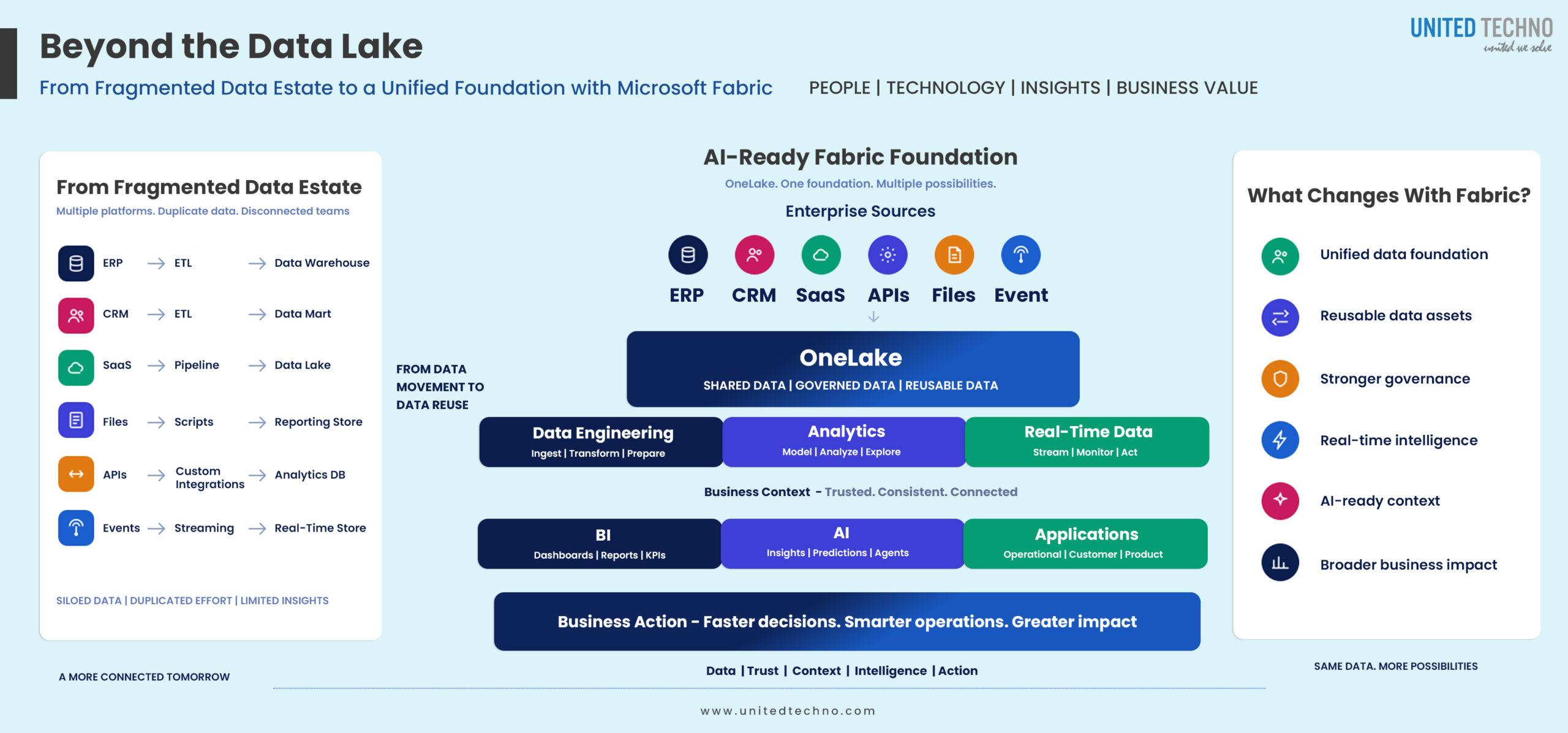
A well-planned Microsoft Fabric Architecture can help address these challenges by bringing data engineering, analytics, data integration, and AI workloads into a more unified environment.
The modernization problem is therefore bigger than replacing a warehouse.
The goal should be to reduce unnecessary movement, duplication, transformation, and interpretation of enterprise data.
Fabric Changes the Role of the Data Platform
The interesting part of Fabric is not that it brings multiple data workloads into one product family.
The more important architectural question is what happens when engineering, analytics, warehousing, real-time processing, semantic models, and AI operate against a common data foundation.
This is where Microsoft Fabric Architecture becomes important, changing how platform teams design, manage, and deliver enterprise data capabilities.
Instead of building isolated pipelines for every consumer, the team can begin designing reusable data assets.
A customer dataset should not exist primarily because one dashboard needs it.
It should become a governed enterprise asset that can support:
- Customer analytics
- Revenue analysis
- Personalization
- Service intelligence
- Forecasting
- AI applications
- Operational workflows
The difference is subtle but important.
The unit of modernization shifts from the pipeline to the reusable data capability.
OneLake Matters Because Reuse Matters
This is where OneLake becomes architecturally significant.
The value is not simply having a large enterprise data lake.
The value comes from creating a common data foundation that different workloads can consume without repeatedly rebuilding the underlying data estate. This is a key consideration in Microsoft Fabric Architecture, where a unified data foundation can help reduce unnecessary duplication and simplify data access across workloads.
Think about an enterprise customer record.
Today, it might exist in:
CRM → Data Warehouse → Reporting Store → AI Dataset → Application Cache
Each copy creates another opportunity for divergence.
A stronger model is:
Operational Sources → Governed Data Foundation → Multiple Consumers
The consumers can then include analytics, data science, AI applications, semantic models, operational intelligence, and business applications.
That is a more sustainable foundation for enterprise AI.
AI Readiness Begins With Data Engineering
There is a tendency to put AI at the top of the architecture diagram and assume everything underneath will somehow support it.
In enterprise environments, the opposite is closer to reality.
AI exposes weaknesses that already exist in the data platform.
If customer records are inconsistent, AI inherits the inconsistency.
If product hierarchies differ across systems, recommendations inherit the difference.
If historical data is poorly structured, forecasting becomes harder.
If business definitions are unclear, natural-language analytics produces ambiguous answers.
If permissions are fragmented, AI introduces another governance problem.
This is why Microsoft Fabric Architecture should be designed with AI readiness in mind, starting with a reliable and governed data foundation rather than treating AI as an isolated capability.
This means AI readiness depends heavily on the fundamentals:
Ingestion → Quality → Transformation → Governance → Context → Consumption
The model may be sophisticated.
The data foundation still determines what it can reliably do.
The Lakehouse Is Not the Destination
A modern data platform should not become a collection of fashionable architectural components.
Lakehouse, warehouse, streaming, notebooks, semantic models and AI services each solve different problems.
The central question in Microsoft Fabric Architecture is:
Which workload belongs where, and why?
For example:
| Requirement | Architectural consideration |
| Large-scale engineering | Lakehouse + Spark |
| Structured enterprise reporting | Warehouse |
| Interactive business analytics | Semantic model + BI |
| High-volume event processing | Real-time architecture |
| Machine learning | Curated analytical datasets |
| AI applications | Governed contextual data |
| Operational decisions | Data + events + action layer |
This is where enterprise architecture discipline becomes important.
Fabric does not remove the need for architectural decisions. It gives those decisions a more integrated environment in which to operate.
Real-Time Data Is Valuable Only When Time Changes the Decision
Not every enterprise workload needs real-time processing.
That distinction matters.
Suppose finance needs a monthly profitability report.
Real-time processing adds little value.
Now consider:
- A shipment approaching a service-level breach
- A payment showing suspicious behavior
- A manufacturing line developing an abnormal pattern
- Inventory falling below a replenishment threshold
- A digital transaction generating an operational exception
Here, the value of data declines as the response gets delayed.
Within Microsoft Fabric Architecture, the design should reflect these differences, aligning real-time processing capabilities with business scenarios where response speed directly affects outcomes.
The architecture changes accordingly:
Event → Detection → Context → Decision → Action
This is where Fabric’s real-time capabilities can become part of a broader operating architecture rather than simply another streaming environment.
The goal is not to make everything real-time.
The goal is to make time-sensitive decisions data-driven.
The Semantic Layer Becomes More Important in the AI Era
One of the less discussed problems in enterprise AI is business vocabulary.
What does “revenue” mean?
What qualifies as an “active customer”?
What is an “open order”?
Which inventory number should an AI assistant use?
Which date represents the actual shipment?
These questions are not model questions.
They are data architecture questions.
A strong semantic layer gives analytics and AI a consistent interpretation of the underlying data. Within Microsoft Fabric Architecture, establishing shared business definitions and reusable semantic models helps ensure that different consumers interpret enterprise information consistently.
That becomes increasingly important as organizations move from dashboards toward natural-language analytics and AI agents.
Without shared business meaning, the organization can end up with a technically unified platform that still produces fragmented answers.
What a Modern Fabric Architecture Should Optimize For
After years of working across data engineering and AI environments, I would evaluate a Fabric modernization against five practical outcomes.
1. Reusability
Can one engineered data asset serve multiple consumers?
2. Trust
Can engineers and business users determine where the data came from and whether it is reliable?
3. Context
Can AI and analytics understand the relationships between business entities and events?
4. Responsiveness
Can the platform support both historical analysis and time-sensitive decisions?
5. Controlled Change
Can teams introduce new use cases without rebuilding the data foundation every time?
These are more meaningful measures of modernization than the number of workloads migrated.
The United Techno Approach
We would not begin a Fabric program by asking which existing workloads should be moved first.
We would begin by understanding where the existing data architecture is creating friction.
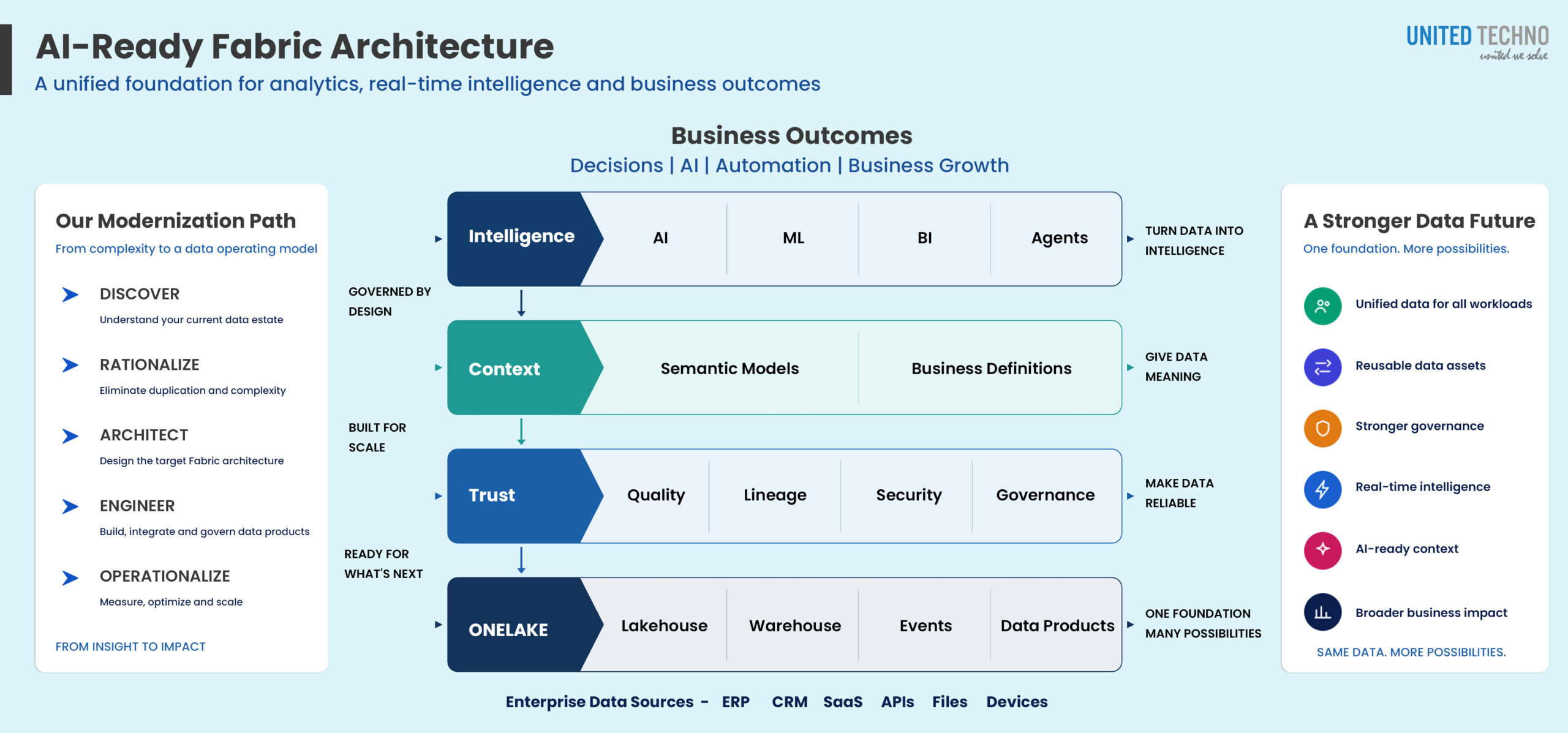
A structured Microsoft Fabric Architecture assessment typically moves through five stages:
Discover
Map sources, pipelines, warehouses, lakes, reports, integrations, data products and AI workloads.
Rationalize
Identify duplicated data, redundant pipelines, obsolete transformations and competing business definitions.
Architect
Define the target Fabric operating model across OneLake, lakehouse, warehouse, real-time workloads, semantic models and consumption layers.
Engineer
Build governed ingestion, transformation, quality controls, reusable data products and workload-specific processing.
Operationalize
Measure reliability, data freshness, consumption, cost, quality and business adoption—and continuously improve the platform.
The important part is the sequence.
Do not migrate complexity before understanding it.
Fabric Modernization Should Create a Data Operating Model
The biggest opportunity is not replacing one technology stack with another.
It is changing how the enterprise thinks about data.
A well-designed Microsoft Fabric Architecture supports this shift by creating a unified foundation for reusable, governed business data capabilities.
Data engineering becomes less about producing another dataset for another project.
It becomes about creating reusable, governed business data capabilities.
Analytics becomes less dependent on manually assembled extracts.
AI becomes less dependent on isolated project datasets.
Real-time intelligence becomes connected to historical context.
And the data platform becomes an operating foundation rather than a reporting back end.
That is the more meaningful definition of modernization.
United Techno Perspective
Microsoft Fabric can provide the technology foundation for this shift.
But the outcome depends on how the platform is engineered.
A successful Fabric program should leave the organization with fewer unnecessary copies, clearer ownership, reusable data products, consistent business definitions, stronger governance and a foundation that can support both today’s analytics and tomorrow’s AI workloads.
The objective is not to put the enterprise’s existing data estate into Fabric.
It is to redesign the estate through a well-planned Microsoft Fabric Architecture so that data can be engineered once, governed properly, understood consistently, and reused across analytics, AI and business operations.
That is what makes a data platform AI-ready.
Building an AI-ready data platform with Microsoft Fabric?
United Techno helps enterprises assess fragmented data estates, design Fabric architectures, modernize data engineering, establish governed OneLake foundations, and prepare enterprise data for analytics, AI and real-time decision-making.