Checklist for RAG Governance and Security
Moving a RAG Pilot to Production? Governance Is the Difference.
Retrieval-Augmented Generation (RAG) is rapidly becoming the foundation for enterprise AI applications, enabling organizations to generate responses from trusted internal knowledge instead of relying solely on pre-trained models. Most RAG implementations, however, begin as pilots, and pilots often take shortcuts.
Broad service-account access to the knowledge base, minimal logging, and limited policy enforcement may be acceptable during experimentation, but they quickly become concerns when the solution moves toward production. Most AI governance frameworks weren’t designed specifically for retrieval pipelines, leaving organizations with gaps that traditional security reviews often uncover.
Use this checklist as a pre-production governance gate, not a one-time review. Knowledge sources evolve, retrieval permissions change, and governance controls must keep pace.
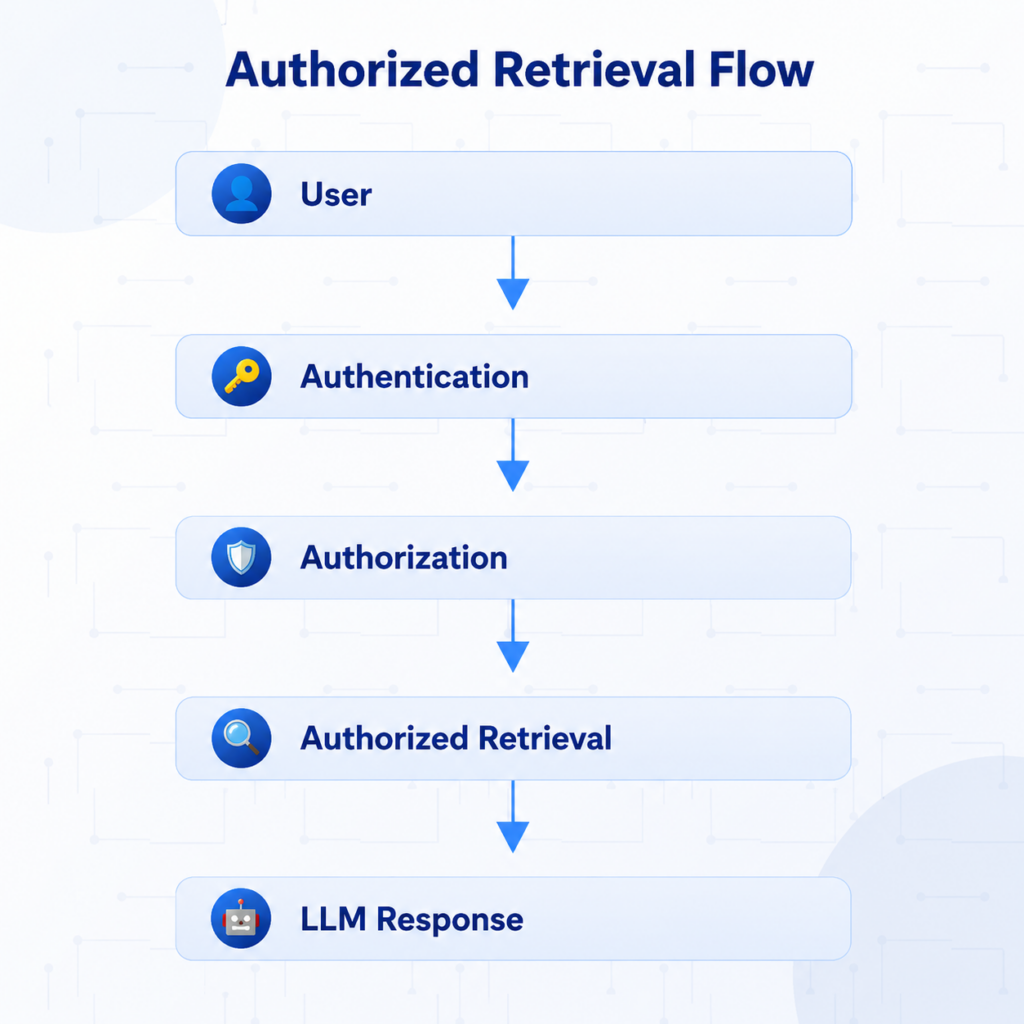
RAG Governance Flow
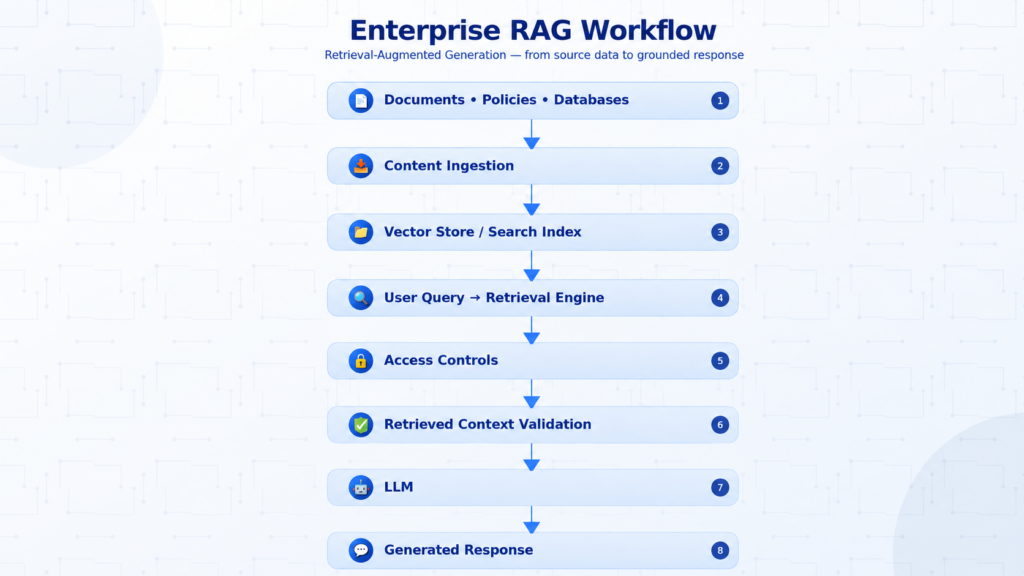
Key Principle: Every stage of the retrieval pipeline is a governance checkpoint, not just the chat interface.
The Production Governance Checklist
1. Enforce Access Control at Retrieval – Not Just at the Interface
This is one of the most common gaps between a RAG pilot and a production-ready system. If access is checked only at the chat interface, users may still receive responses generated from documents they were never authorized to access.
Production Checklist
✔ Apply document-level access controls with metadata defining who can access each document.
✔ Filter search results by user identity and attributes before retrieval, not after generation.
✔ Search only the data each user is authorized to access.
✔ Extend these controls to multi-tenant environments so one tenant’s data never appears in another tenant’s retrieval results.
2. Protect the Knowledge Source Itself
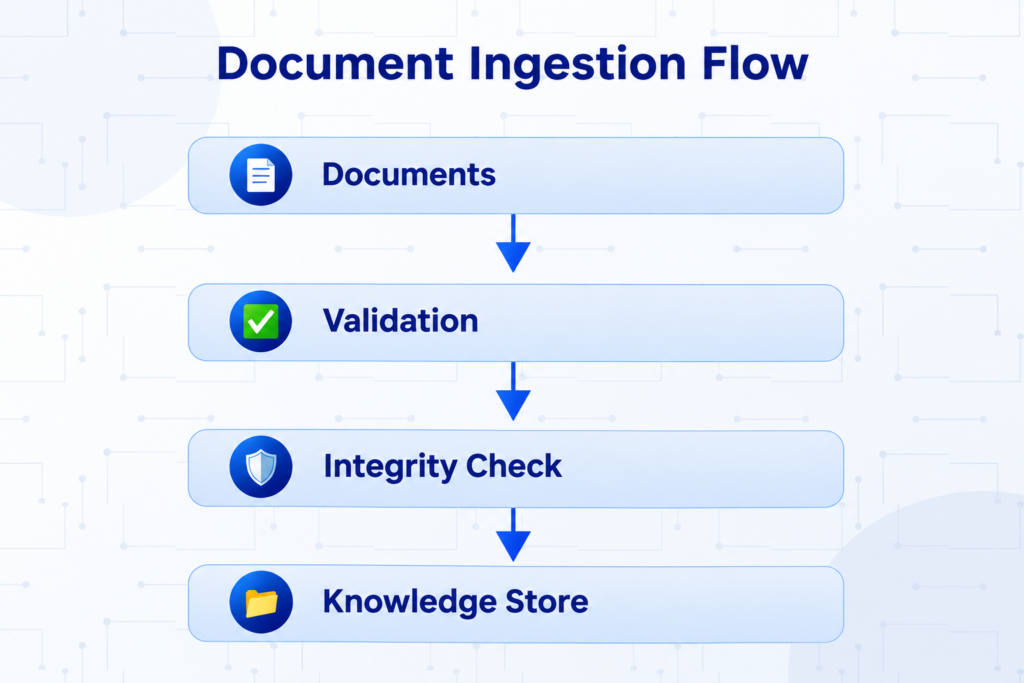
RAG is only as trustworthy as what it retrieves from. A poisoned or stale knowledge base produces confidently wrong or maliciously manipulated answers.
Production Checklist
✔ Establish ingestion hygiene.
✔ Remove duplicate, outdated, or conflicting content.
✔ Cryptographically hash, sign, or snapshot source content to detect tampering.
✔ Restrict who can add, edit, or remove documents from the knowledge store.
✔ Define content freshness policies so outdated documents don’t silently persist in retrieval results.
3. Sanitize Retrieved Content Before It Reaches the Model
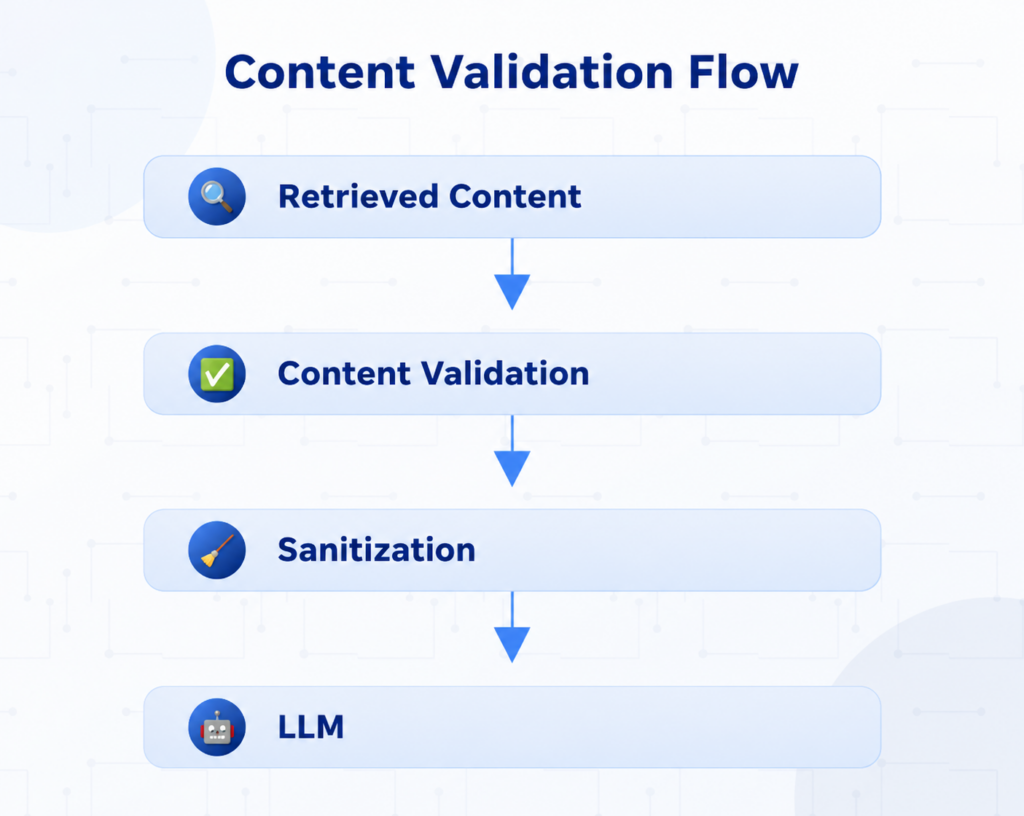
A malicious instruction hidden inside a retrieved document can hijack the model’s output, even without an external tool being called.
Production Checklist
✔ Filter and sanitize retrieved passages before they’re injected into the model’s context window.
✔ Treat prompt injection in retrieved content as seriously as direct user prompt injection.
✔ Don’t assume internal content is safe simply because it comes from an authorized source.
4. Log Every Retrieval with Full Attribution
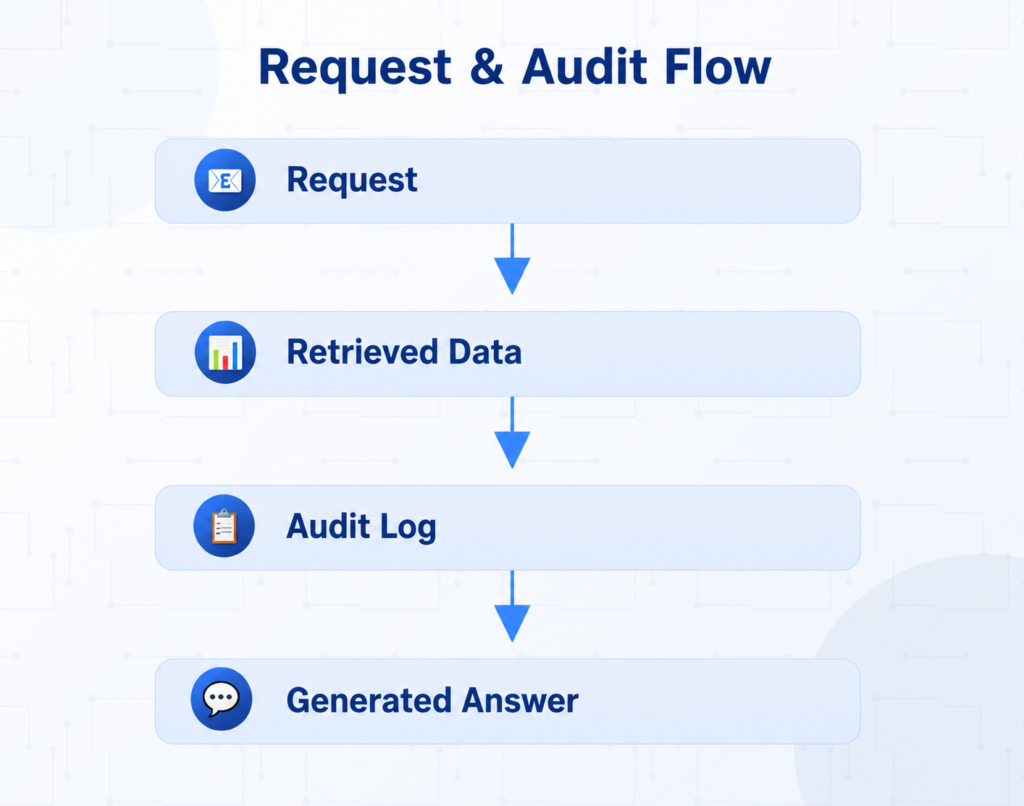
If you can’t answer who accessed what, when, and why, you can’t satisfy a security investigation or compliance review.
Production Checklist
✔ Log which system initiated the request.
✔ Record the authenticated user.
✔ Capture the exact documents retrieved.
✔ Record timestamps and downstream usage.
✔ Maintain tamper-evident audit logs.
✔ Preserve data lineage from source document to generated response.
5. Map Regulatory Exposure Before You Assume You’re Exempt
Internal-only RAG applications are not automatically outside the scope of regulation. Regulatory obligations depend on how the system is used, not whether it’s customer-facing.
Production Checklist
✔ Assess whether the use case falls under high-risk categories such as HR, healthcare, financial advice, or credit decisions.
✔ Involve legal and compliance teams early.
✔ Map RAG data flows against applicable governance frameworks, such as the NIST AI Risk Management Framework (AI RMF).
6. Set Evaluation Thresholds Before Go-Live
Single-pass retrieval with no verification is no longer considered enterprise-grade.
Production Checklist
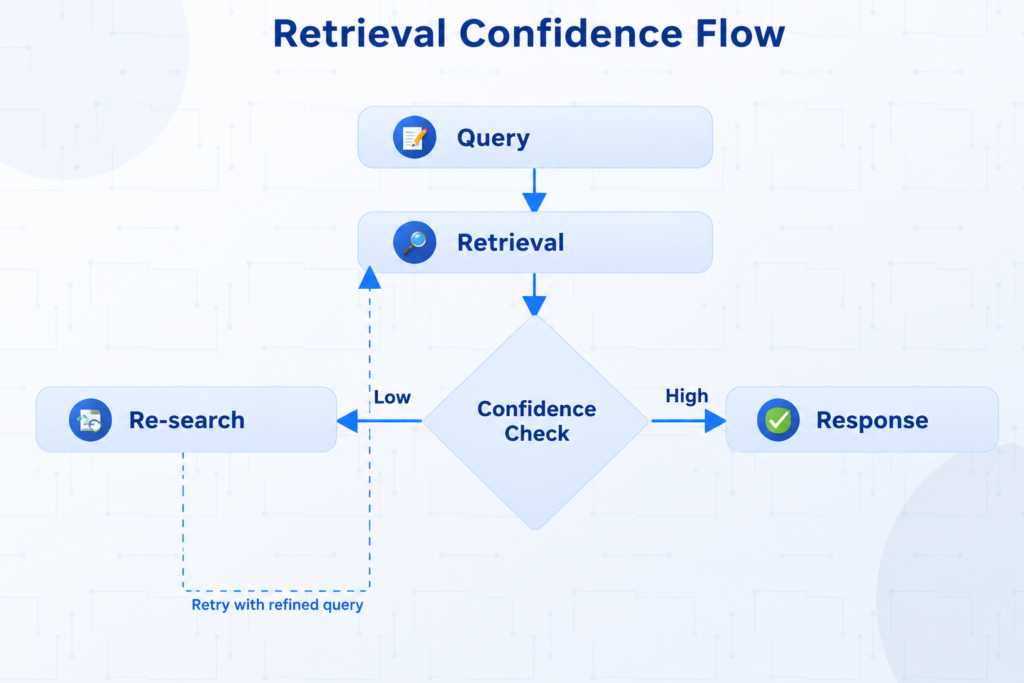
✔ Define measurable accuracy and groundedness thresholds.
✔ Cross-check retrieval using semantic and keyword search.
✔ Re-search or flag low-confidence responses instead of presenting guesses as facts.
✔ Cite source documents so users and auditors can verify generated responses.
7. Encrypt and Isolate the Data Layer
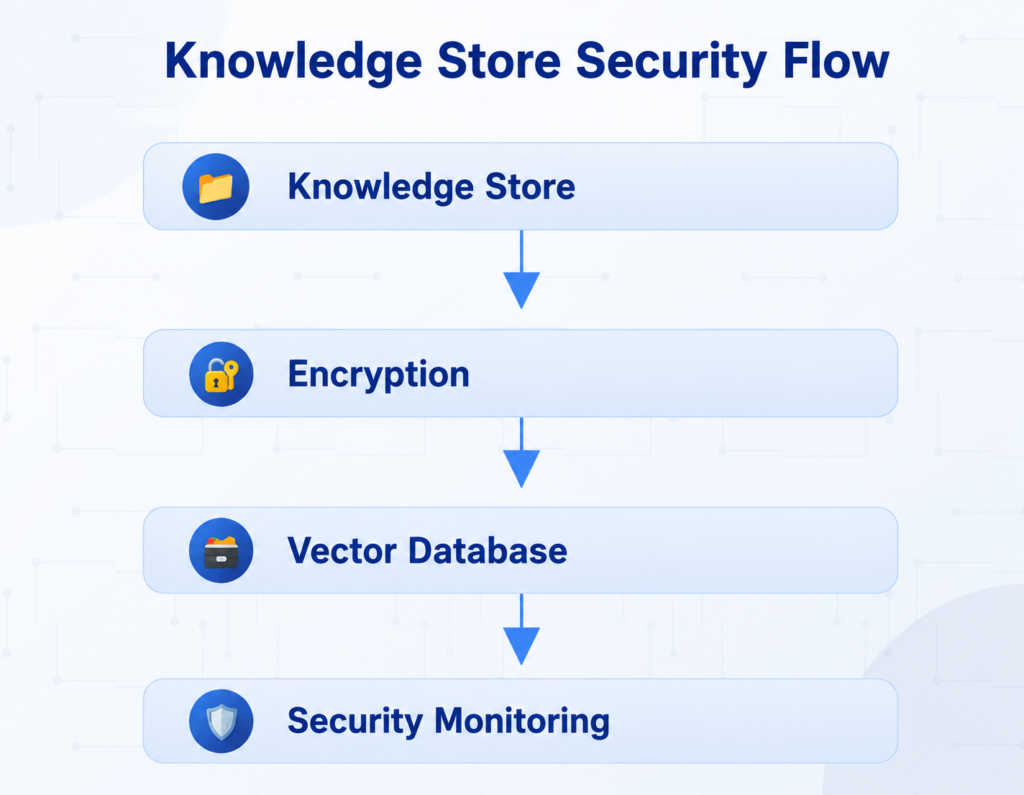
The vector database and document store are part of your sensitive-data attack surface, not just supporting infrastructure.
Production Checklist
✔ Encrypt data at rest and in transit, including embeddings.
✔ Apply zero-trust principles to the vector database.
✔ Include the RAG pipeline within existing DLP and SIEM monitoring instead of treating it as an isolated environment.
8. Treat Governance as Continuous – Not a One-Time Sign-Off
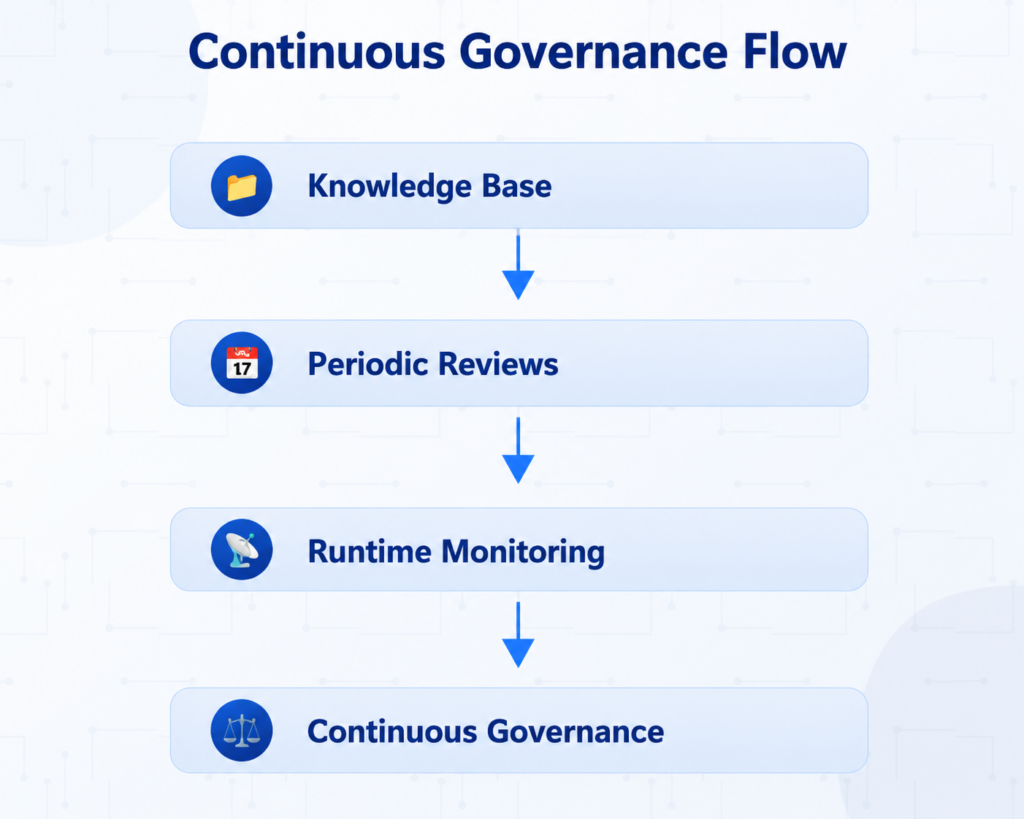
Knowledge bases change constantly. Governance must evolve with them.
Production Checklist
✔ Conduct periodic reviews of users and services that can query or modify the knowledge store.
✔ Monitor retrieval activity for unusual patterns.
✔ Periodically reassess regulatory obligations as governance frameworks continue to evolve.
RAG Production Readiness at a Glance
Conclusion
Moving a RAG application from pilot to production requires more than improving retrieval quality. It requires effective data governance across the entire retrieval pipeline, from access control and knowledge source integrity to auditability, regulatory readiness, evaluation, and continuous monitoring. Platforms such as QA Genie can further support enterprise governance initiatives by improving data visibility, policy management, and compliance across modern AI environments.
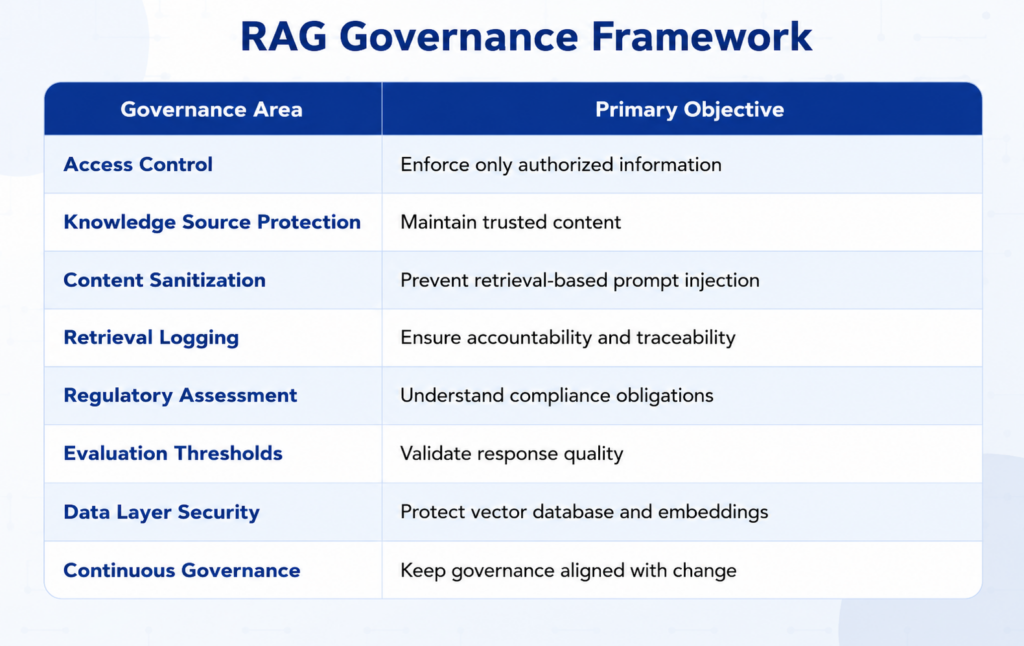
Treat these eight checkpoints as an operational governance framework rather than a deployment checklist. As knowledge repositories, user permissions, and regulatory expectations evolve, governance should evolve with them.
Planning to deploy a RAG-powered application in production?
Evaluate your retrieval pipeline against these eight governance checkpoints before go-live. Establishing strong controls around access, knowledge integrity, retrieval validation, auditability, compliance, and continuous governance helps build RAG applications that are secure, trustworthy, and enterprise-ready.