A United Techno perspective on designing an ERP landscape around industry processes, integration, data, and the next stage of growth
An ERP replacement is rarely just an ERP project.
The moment an enterprise changes its ERP, it touches finance, procurement, inventory, orders, suppliers, customers, warehouses, reporting, integrations and sometimes decades of accumulated business logic.
That is why Enterprise ERP Strategy decisions made from a product brochure often become expensive architecture decisions later.
The better starting point is different:
What should the ERP own, what should remain outside it, and how should the entire business operate as one system?
That question changes the conversation from ERP selection to ERP architecture.
The ERP Should Not Become the Center of Everything
One of the biggest mistakes in ERP programs is treating the new platform as the answer to every business requirement.
It isn’t.
A modern enterprise may have:
ERP | CRM | Commerce | WMS | TMS | Banking Systems | SaaS | Data Platforms | APIs | Partner Networks
A strong Enterprise ERP Strategy ensures the ERP provides the right operational backbone without forcing every specialized capability into the same platform.
For example:
- Commerce may own the customer shopping experience.
- WMS may control warehouse execution.
- TMS may manage transportation.
- CRM may manage customer relationships.
- A data platform may support enterprise analytics.
- Specialized banking systems may remain responsible for banking transactions.
- The ERP may provide financial control, procurement, core operations and enterprise records.
The architecture challenge is making those systems behave like one business.
That is where ERP selection becomes an architecture exercise.
Industry Changes the ERP Conversation
There is no meaningful ERP decision without understanding the business model behind it.
A strong Enterprise ERP Strategy must account for the operational requirements, data flows, integration dependencies, and industry-specific challenges that shape how each business operates.
Retail: The Inventory Problem
Retail ERP architecture revolves around the relationship between:
Product → Inventory → Store → Channel → Order → Fulfillment → Finance
The difficult part is rarely recording a sale.
It is keeping inventory, pricing, promotions, returns, purchasing and financial treatment aligned across physical stores, digital channels and fulfillment locations.
A retailer therefore needs to examine how the ERP interacts with:
- POS
- eCommerce
- WMS
- Suppliers
- Marketplaces
- Loyalty platforms
- Returns systems
- Finance
The ERP becomes valuable when it creates operational consistency across those moving parts.
eCommerce: The Order Problem
An eCommerce company can generate thousands of transactions without the ERP ever touching the customer-facing experience.
That is perfectly acceptable.
The important question is whether the order can travel cleanly through the enterprise.
Customer → Commerce → Order → Inventory → Fulfillment → Payment → Finance
Every handoff creates an opportunity for duplication, delay or reconciliation.
The ERP architecture should therefore be evaluated around order continuity, not simply around whether it contains an eCommerce module.
Logistics: The Exception Problem
Logistics runs on constant movement.
Shipments change.
Inventory moves.
Carriers miss schedules.
Orders are modified.
Warehouses receive partial quantities.
Customers change delivery requirements.
An ERP architecture for logistics therefore needs more than finance and procurement.
It needs to coexist with:
WMS + TMS + EDI + Carrier Systems + Customer Platforms + Real-Time Events
The important architectural question is:
How quickly can an operational event become a controlled business decision?
Manufacturing: The Synchronization Problem
Manufacturing brings physical operations into the ERP equation.
A single production process can involve:
Demand → Planning → Materials → Procurement → Production → Quality → Inventory → Shipment → Costing
The ERP must interact with shop-floor systems, suppliers, warehouse platforms and planning applications without creating competing versions of production truth.
The architecture should therefore define exactly where:
- Production planning lives
- Shop-floor execution lives
- Quality information lives
- Inventory is mastered
- Costing occurs
- Supplier information is governed
The objective is not to put everything into ERP.
It is to make the production ecosystem behave coherently.
Banking & Financial Services: The Control Problem
Banking has a different architecture altogether.
Specialized banking platforms may remain responsible for core financial transactions while ERP handles enterprise finance, procurement, workforce operations and corporate management.
That creates an ecosystem such as:
Banking Platforms → Enterprise Integration → ERP → Finance → Data → Reporting
Here, architecture has to emphasize:
- Control
- Auditability
- Data ownership
- Segregation of duties
- Reconciliation
- Regulatory reporting
- Multi-entity operations
- Secure integration
For financial institutions, the ERP decision is therefore less about replacing the core environment and more about strengthening the enterprise layer around it.
Healthcare & Life Sciences: The Traceability Problem
Healthcare and life sciences add another requirement: knowing where information came from and how it was used.
ERP may coexist with:
Clinical Systems | Laboratory Systems | Supply Chain | Manufacturing | Procurement | Finance | Data Platforms
In life sciences, product genealogy, batch information, quality processes and controlled inventory can influence the architecture.
In healthcare organizations, finance and supply operations may be far more central to ERP than clinical workflows.
The lesson is straightforward:
Industry determines what the ERP needs to connect to.
Stop Asking “Which ERP Is Best?”
A better evaluation begins with six questions.
01 — What must the ERP own?
Identify the business capabilities that genuinely require ERP control.
Finance?
Procurement?
Inventory?
Manufacturing?
Order management?
Projects?
Not every capability belongs inside the core.
02 — What must remain outside?
This is equally important.
A mature architecture deliberately preserves specialized systems where they provide meaningful operational depth.
The objective is not maximum consolidation.
It is controlled consolidation.
03 — Where does the data originate?
Customer data.
Product data.
Supplier data.
Inventory.
Orders.
Pricing.
Financial records.
The ERP may own some of these domains while consuming others.
Without explicit ownership, integration becomes reconciliation.
04 — What happens between systems?
This is where many ERP programs underestimate complexity.
Look at:
APIs | Events | EDI | Files | Batch | Integration Workflows
Then ask:
- Who owns the interface?
- What happens when it fails?
- How are duplicates handled?
- How is data validated?
- How is the transaction reconciled?
- Can the business trace it end to end?
An ERP with excellent functionality can still create a poor enterprise architecture if the surrounding integration model is weak.
05 — How will the business change?
ERP architecture should survive more than the first implementation.
Consider:
- New countries
- New entities
- Acquisitions
- New channels
- New warehouses
- New suppliers
- New regulations
- New products
- New digital experiences
- New AI applications
The right architecture makes these changes manageable.
06 — What will the ERP cost after implementation?
The real ERP cost is not the subscription.
It is the entire operating model:
Implementation + Integration + Migration + Extensions + Support + Upgrades + Data + Governance
An inexpensive ERP surrounded by dozens of fragile extensions may become an expensive enterprise.
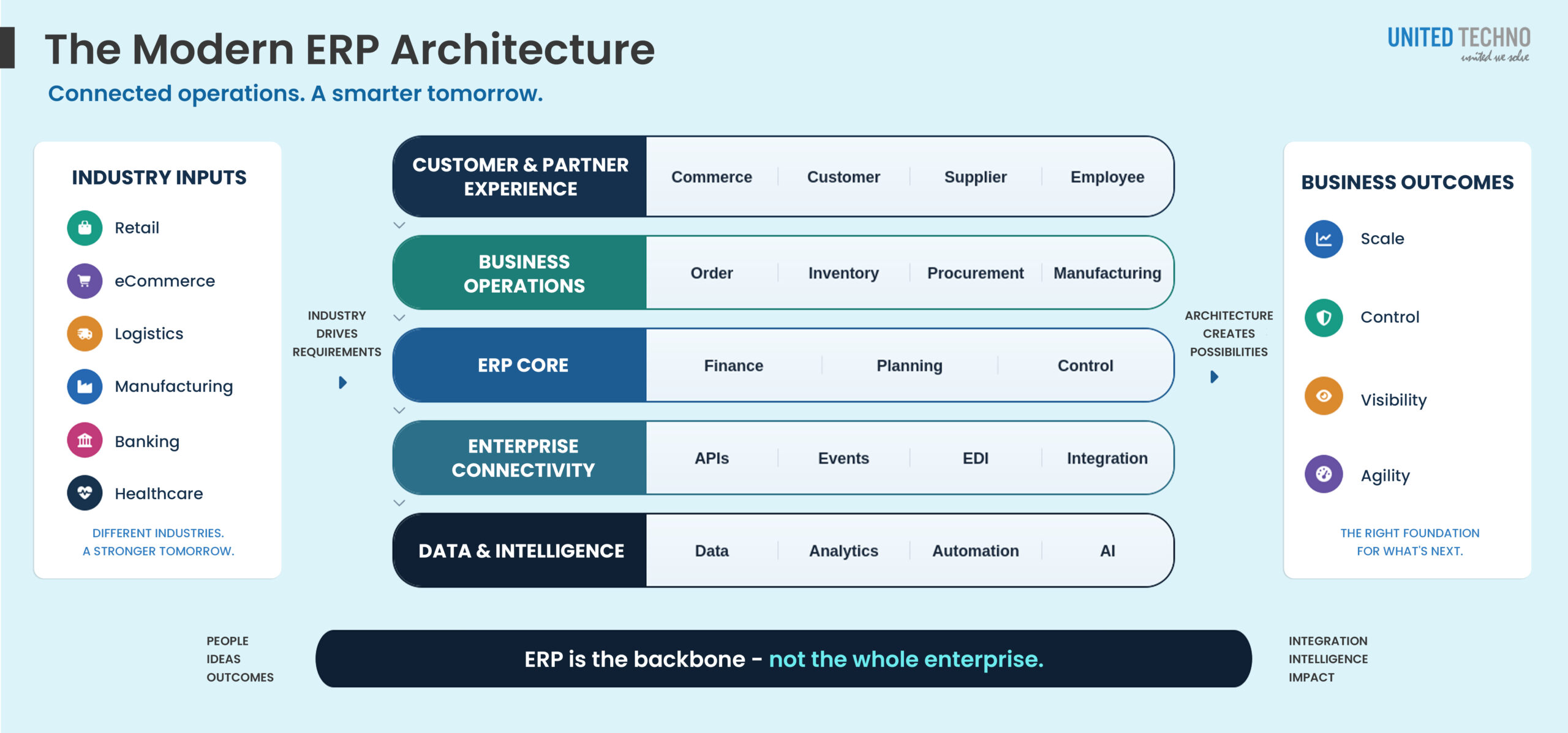
The New ERP Architecture Has Layers
A modern Enterprise ERP Strategy requires thinking beyond the core platform. A modern ERP environment can be thought of as five architectural zones.
BUSINESS EXPERIENCE
Commerce | Customers | Employees | Suppliers | Partners
↓
BUSINESS OPERATIONS
Orders | Procurement | Inventory | Manufacturing | Projects
↓
ERP CORE
Finance | Accounting | Planning | Enterprise Control
↓
CONNECTIVITY
APIs | Events | EDI | Integration | Workflow
↓
DATA & INTELLIGENCE
Analytics | Data Platform | Automation | AI
The ERP is important.
But it is only one layer.
That distinction matters because the enterprise should be able to modernize one layer without rebuilding everything around it.
The Modern ERP Architecture
AI Changes the ERP Question Again
AI adds another layer to ERP architecture.
The important question is no longer simply:
Can the ERP use AI?
The better question is:
Can enterprise AI safely understand and act on ERP-controlled business information?
Consider an AI-driven procurement workflow.
It may need to understand:
Supplier History + Purchase Orders + Inventory + Demand + Contracts + Finance
That information may exist across several systems.
AI therefore increases the importance of:
Data quality → Business context → Access control → Business rules → Action
A poorly integrated ERP landscape does not become intelligent simply because an AI assistant is placed on top of it.
The foundation still matters.
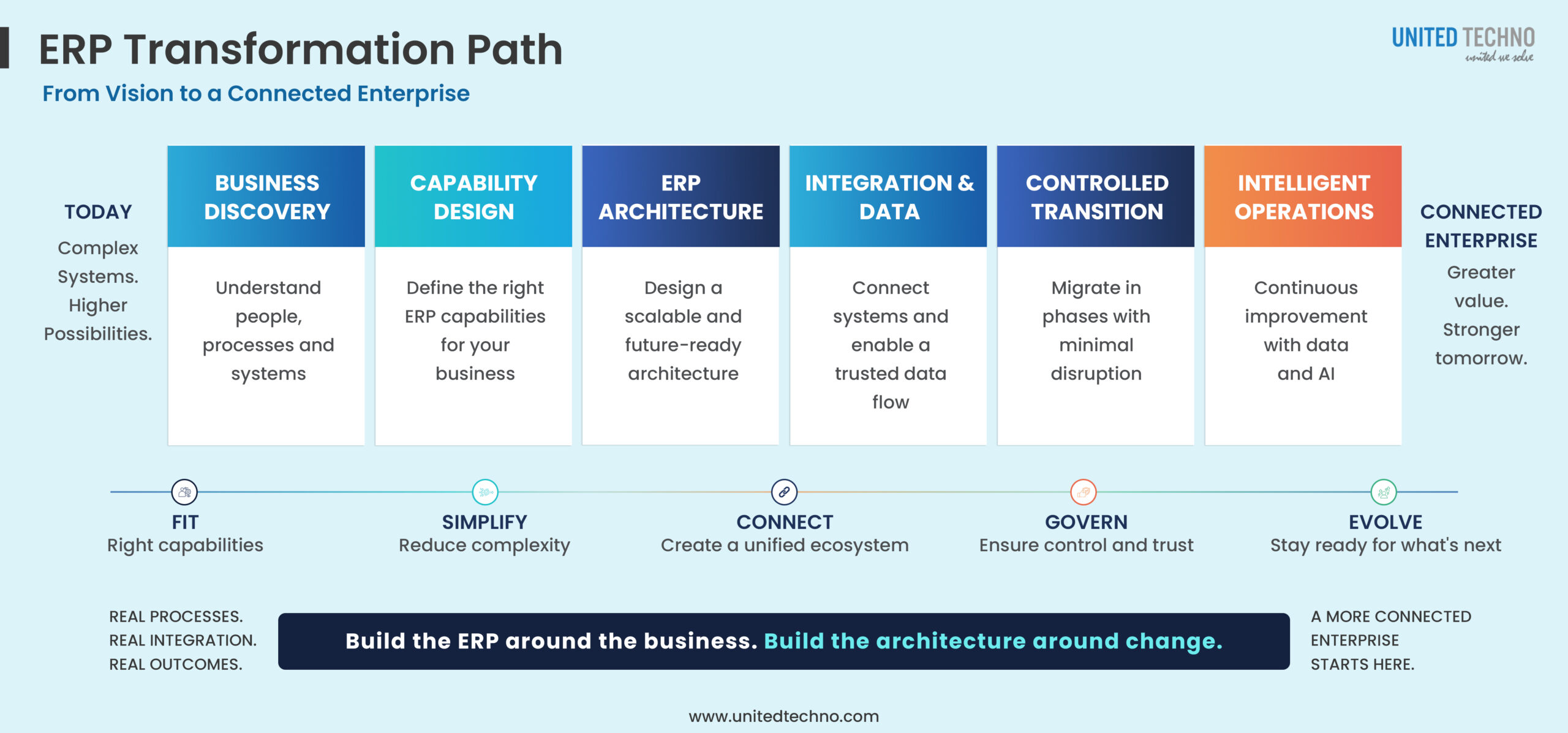
United Techno ERP Architecture Method
A practical ERP transformation should move through seven architectural decisions.
DISCOVER
Map applications, processes, data and dependencies.
DEFINE
Establish which business capabilities belong inside ERP.
DESIGN
Create the target ERP and surrounding application architecture.
CONNECT
Engineer APIs, events, EDI and integration workflows.
GOVERN
Establish ownership for data, interfaces, extensions and controls.
TRANSITION
Move business processes and data in controlled waves.
EVOLVE
Use analytics, automation and AI to improve the operating model.
This approach avoids one of the most common ERP mistakes:
designing the target system before understanding the current business.
United Techno ERP Transformation Path
The ERP Decision Should Survive the Next Five Years
A strong Enterprise ERP Strategy should look beyond immediate business requirements and establish an architecture that can support the organization’s next stage of growth.
A successful ERP program should not simply answer:
“What system do we need now?”
It should answer:
“What architecture can carry the business through its next stage of growth?”
For retail, that may mean handling more channels without losing inventory control.
For eCommerce, it may mean scaling order volume without multiplying reconciliation work.
For logistics, it may mean connecting operational events across warehouses and carriers.
For manufacturing, it may mean synchronizing production with demand and supply.
For banking, it may mean stronger enterprise control around specialized financial platforms.
For healthcare, it may mean traceability across operational and regulated environments.
The ERP product matters.
The architecture around it matters more.
United Techno Perspective
United Techno approaches ERP transformation as an enterprise architecture problem rather than a software replacement exercise.
Our Enterprise ERP Strategy begins by understanding:
Business → Processes → Capabilities → Data → Systems → Integration → ERP Role
From there, the target architecture can be designed around the organization’s industry, operating model and growth strategy.
Whether the environment involves legacy ERP, multiple ERPs, cloud migration, eCommerce integration, supply-chain modernization, financial transformation, or integration platforms such as Boomi, the objective remains the same:
Create an ERP landscape that can change without becoming the next legacy problem.
Start Your ERP Architecture Assessment with United Techno