
Sales teams rarely suffer from a lack of information.
They suffer from information arriving in pieces.
An account executive may know that a customer opened a proposal. A service manager may know that the same customer has an unresolved issue. Marketing may see increased engagement. Finance may know that a renewal is approaching. The CRM may show an opportunity that has not moved in three weeks.
All of those signals matter.
The problem is that they rarely arrive together.
The seller is left to assemble the picture manually and decide what it means.
That is where AI in Sales and AI-assisted CRM are becoming interesting.
The real opportunity with Copilot is not another tool for writing emails. It is the ability to reduce the distance between a customer signal and a useful sales decision.
The Hidden Cost in Modern Selling: Decision Latency
Consider a typical opportunity.
A prospect attends a product demonstration.
The seller receives an email asking about pricing.
A second stakeholder joins the buying process.
A support case is opened.
The opportunity remains unchanged in CRM.
Nothing is technically broken.
Yet the opportunity has changed.
A seller who notices those signals early may adjust the strategy. Another seller may discover them during the next pipeline review. By then, the buying conversation may already have moved elsewhere.
This creates a less obvious sales metric:
Decision latency
Customer signal → Seller awareness → Interpretation → Action
The longer that chain takes, the more opportunity can disappear between CRM updates.
AI in Sales can shorten that chain.
Not by making every sales decision automatically, but by bringing the relevant context forward when it matters.
CRM Has Historically Recorded the Past
Traditional CRM architecture is built around records:
Account
Contact
Lead
Opportunity
Activity
Case
That structure is useful.
But selling does not happen in records.
It happens in conversations, changes, commitments, objections, timing, relationships and decisions.
This is where AI changes the role of CRM.
This is where AI in Sales changes the role of CRM.
Instead of asking a seller to interpret dozens of fields, an AI layer can help answer questions such as:
- What changed in this account?
- Which opportunity deserves attention today?
- What happened after the last customer conversation?
- Which commitment is still open?
- What information is missing before the next meeting?
- Is there a reason this deal may be losing momentum?
- What should I investigate before contacting the customer?
The CRM remains the system of record.
AI becomes the interpretation layer.
That distinction is important for enterprise architecture.
Copilot Should Sit Between Information and Judgment
There is a temptation to think about AI as another automation layer.
For AI in Sales, I would frame it differently.
The architecture should look more like:
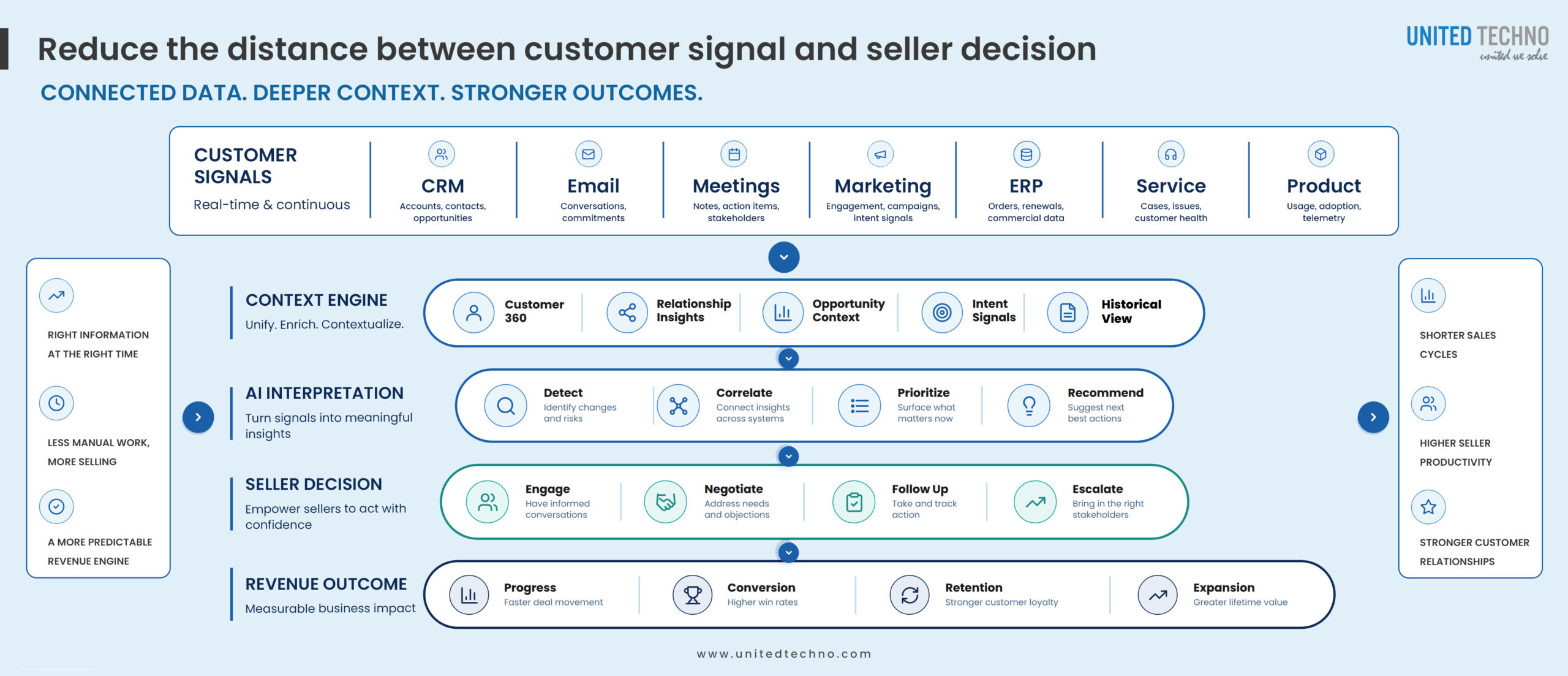
ENTERPRISE SIGNALS
CRM | Email | Meetings | Marketing | ERP | Service | Product
↓
CUSTOMER CONTEXT
Account | Relationship | Commercial History | Current Situation
↓
AI INTERPRETATION
Summarize | Correlate | Detect | Prioritize | Recommend
↓
SELLER JUDGMENT
Engage | Challenge | Negotiate | Approve | Escalate
↓
CUSTOMER ACTION
Meeting | Proposal | Renewal | Expansion | Resolution
The crucial component is the fourth layer.
Seller judgment should remain part of the architecture.
AI can surface a potential risk.
It should not automatically decide what the relationship means.
AI can draft a response.
The seller should decide whether that response is appropriate.
AI can identify the next step.
The seller should determine whether it is the right step.
That is a much safer and more useful model for enterprise sales.
The Best AI Use Cases Are Often Small
The biggest mistake in AI in Sales is trying to make AI “run sales.”
Start with moments where sellers repeatedly lose time.
Before the meeting –
Instead of opening CRM records, email threads and notes individually:
“Give me the five things I need to know before this meeting.”
The system should return only information relevant to the conversation.
After the meeting –
Instead of reconstructing the conversation from memory:
Conversation → Key decisions → Open questions → Commitments → CRM update
The seller reviews and confirms.
During pipeline review
Instead of examining every opportunity equally:
Portfolio → Changed signals → Potential risk → Seller attention
The seller decides which opportunities deserve investigation.
During account planning –
Instead of reviewing disconnected history:
Customer history + current activity + commercial position → account context
The seller starts with a picture rather than a blank page.
These are modest interventions.
Their cumulative effect can be substantial.
The Architecture Challenge Is Bigger Than the AI Model
A Copilot experience can only be as useful as the enterprise context behind it.
Imagine two CRM environments.
Environment A
- Duplicate accounts
- Outdated contacts
- Inconsistent opportunity stages
- Missing activity history
- Disconnected ERP information
- Unstructured notes
- Weak ownership rules
Environment B
- Governed customer identities
- Consistent sales processes
- Connected enterprise data
- Reliable activity capture
- Defined ownership
- Controlled access
- Traceable business events
Both can deploy AI.
They will not produce the same quality of sales intelligence.
This is why an AI sales initiative should begin with an architectural assessment of:
Data quality → Integration → Identity → Security → Process → AI
Not the other way around.
The CRM Is Only One Piece of the Customer Picture
For complex B2B sales, the most valuable context may not originate in CRM.
A customer’s ERP may reveal purchasing patterns.
A service platform may reveal unresolved issues.
A commerce platform may reveal buying behavior.
A product platform may reveal adoption.
Marketing may reveal engagement.
Contract systems may reveal renewal conditions.
The opportunity is to connect these signals without creating another giant data repository simply for AI.
The better question is:
What information does the seller need at the moment a decision has to be made?
That question produces a more focused architecture.
It also prevents the common mistake of integrating everything simply because it can be integrated.
The Sales Decision Signal
From Copilot to a Sales Operating Model
The long-term opportunity is not simply giving every salesperson an AI assistant.
It is redesigning selected parts of the sales operating model around AI.
That means identifying where:
- information is repeatedly gathered,
- decisions repeatedly stall,
- CRM updates repeatedly get postponed,
- important signals repeatedly get overlooked,
- managers repeatedly perform manual pipeline analysis.
Those are potential AI intervention points.
A useful progression is:
ASSIST
Help the seller complete a task.
INTERPRET
Explain what the available information may indicate.
RECOMMEND
Suggest possible actions.
ORCHESTRATE
Coordinate approved activities across systems.
EXECUTE
Perform clearly governed actions automatically.
Not every process should reach the final stage.
For high-value customer relationships, keeping a human decision-maker in the loop may be the better architecture.
The Human Role Does Not Become Smaller. It Becomes More Valuable.
There is a misconception that AI-enabled sales means fewer human interactions.
For complex enterprise selling, the opposite can be true.
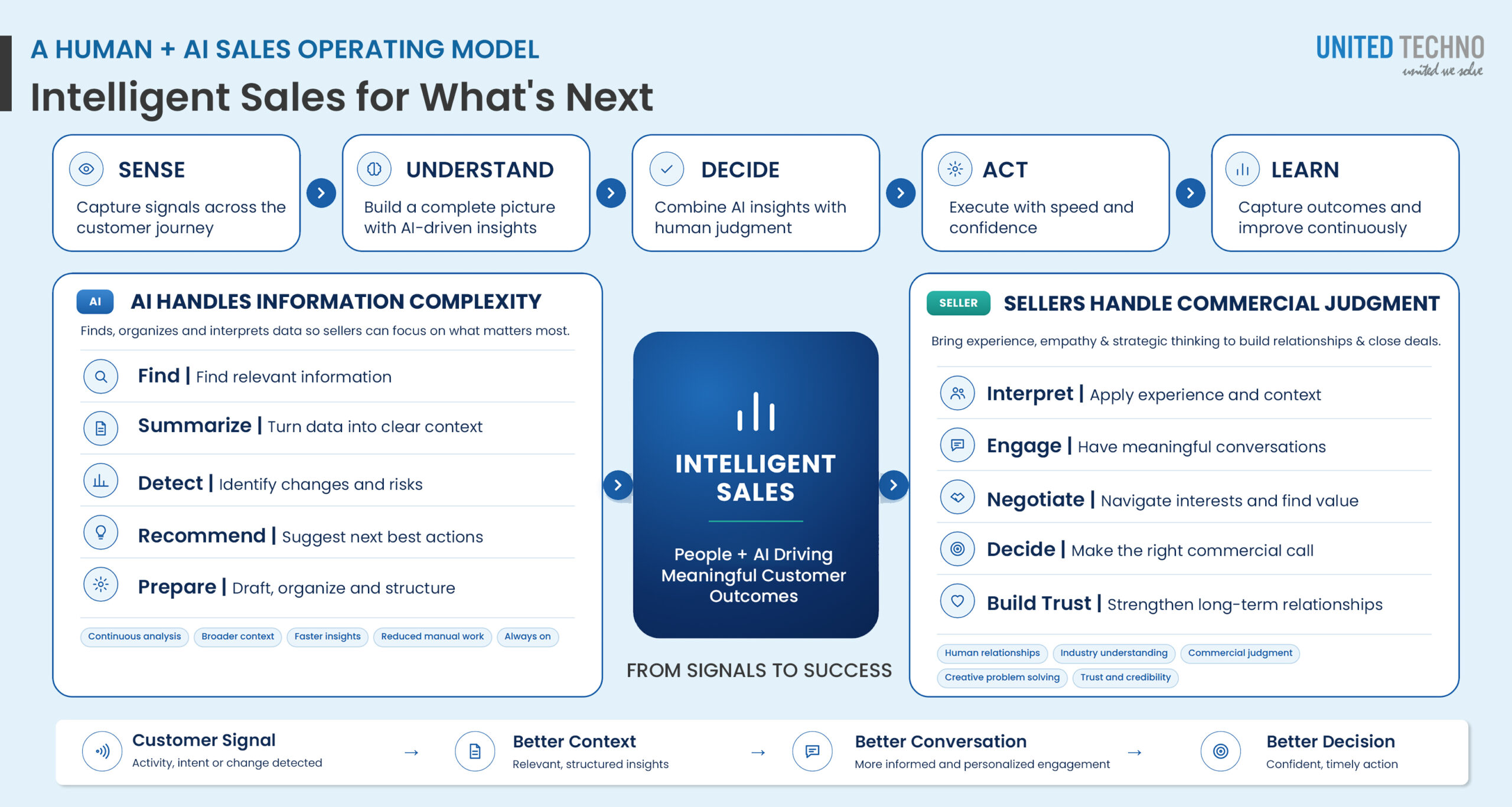
If AI handles:
- searching,
- summarizing,
- note preparation,
- record maintenance,
- signal detection,
- routine analysis,
the seller can spend more time on the work that cannot be reduced to a prompt:
Understanding the customer.
Building trust.
Handling disagreement.
Navigating internal politics.
Negotiating commercial terms.
Knowing when not to sell.
That is where experienced sellers create disproportionate value.
AI should remove administrative weight from the sales process—not remove the human relationship from it.
Human + AI Sales Operating Model
What Should the Enterprise Measure?
AI adoption should not be celebrated because employees generated a certain number of prompts.
The better question is whether the sales organization is becoming faster and more decisive.
Measure:
| Metric | What It Tells You |
| Seller preparation time | Administrative friction |
| CRM update time | Process burden |
| Lead response time | Speed to engagement |
| Opportunity stagnation | Pipeline friction |
| Follow-up cycle time | Execution speed |
| Forecast variance | Decision quality |
| Recommendation acceptance | AI usefulness |
| Seller adoption | Workflow fit |
| Conversion rate | Commercial impact |
| Revenue per seller | Overall productivity |
One metric deserves particular attention:
Time from signal to action
If a meaningful customer event occurs on Monday and the seller discovers it during Friday’s pipeline review, the CRM has recorded the event but failed the seller.
The goal of AI-enabled CRM is to narrow that gap.
United Techno Perspective
We see Copilot-enabled sales transformation as a CRM architecture problem before it becomes an AI implementation problem.
The sequence matters:
Understand the sales process.
Identify the decisions that matter.
Connect the information required to make them.
Establish data and security controls.
Introduce AI where it removes meaningful friction.
Keep sellers accountable for consequential decisions.
Measure the effect on the revenue process.
This approach avoids deploying AI simply because it is available.
Instead, it puts AI where it can change how sales actually operates.
The future CRM will not simply tell salespeople what happened.
It will increasingly help them understand what matters now.
And the strongest implementations will not be the ones with the most automation.
They will be the ones that give sellers better context at the exact moment judgment matters.
Ready to make your CRM work harder for your sales organization?
United Techno helps enterprises modernize CRM architecture, connect customer and operational data, implement AI-assisted sales workflows, and build governed revenue processes across Salesforce, Microsoft Dynamics 365, and the broader enterprise technology landscape.
Talk to United Techno about identifying the sales decisions worth augmenting with AI, and building the architecture to support them. →