Multi-Agent AI in Enterprise Is Not About Adding More Agents
The enterprise conversation around AI agents is moving beyond individual assistants.
A finance agent can review an invoice. A service agent can interpret a customer request. A supply-chain agent can assess inventory conditions. A sales agent can evaluate an opportunity.
The architectural challenge begins when those capabilities must participate in the same business process.
Consider an order exception.
A customer order arrives with an unusual discount. Inventory is available, but the requested delivery date conflicts with warehouse capacity. The customer also has an outstanding balance, and the order exceeds a predefined approval threshold.
Several forms of intelligence may be required:
- An Order Agent understands the transaction.
- A Pricing Agent evaluates the discount.
- An Inventory Agent checks availability.
- A Credit Agent assesses the customer’s financial position.
- A Fulfillment Agent evaluates delivery feasibility.
But none of those agents should independently decide what happens next.
That is the architectural distinction that matters.
An enterprise does not simply need multiple agents. It needs explicit boundaries around what each agent can understand, recommend, initiate, execute, and escalate.
Multi-agent AI therefore becomes an enterprise architecture challenge involving:
Decision-Making + Authority + Integration + Execution + Verification
The model is only one part of that system.
1. The Agent Is Not the Architecture
An AI agent can interpret information, reason through a problem, and select an appropriate next step. That is useful, but it is not the full architecture.
Enterprise architecture has a broader responsibility. It must define:
- What information the agent can access
- Which systems the agent can interact with
- What actions the agent is allowed to initiate
- Which decisions remain deterministic
- Which actions require approval
- What happens when information is incomplete
- How each transaction is verified
- How the activity is recorded and audited
This distinction becomes critical as soon as an agent moves beyond generating an answer.
There is a major difference between:
“The order appears eligible for a refund.”
and:
“Issue a $4,800 refund to the customer’s payment method.”
The first is a recommendation.
The second changes the enterprise state.
The architecture must treat them differently.
This is why multi-agent AI should not be designed as a collection of prompts connected through APIs. The enterprise needs an execution model around the agents—one that governs how insight becomes action.
2. Give Each Agent a Job – Not a Department
A common design mistake is creating broad agent labels such as:
- Finance Agent
- Sales Agent
- Operations Agent
- Customer Service Agent
These descriptions are too broad to establish clear responsibility or meaningful control boundaries.
A more useful approach defines agents around specific decisions or activities.
| Agent | Primary responsibility | Typical output |
| Request Agent | Interprets an incoming business event | Classified request |
| Context Agent | Assembles relevant enterprise information | Business context |
| Policy Agent | Evaluates rules and eligibility | Policy result |
| Decision Agent | Assesses available actions | Recommended action |
| Transaction Agent | Executes an authorized operation | Transaction result |
| Verification Agent | Confirms the intended outcome | Validation result |
| Exception Agent | Identifies unresolved conditions | Escalation |
This structure creates an important separation.
The agent that understands the situation does not automatically become the agent that changes the system.
For example, an Inventory Agent may determine that 340 units are available. That does not mean it should be permitted to modify inventory.
A Policy Agent may conclude that a refund is permitted. That does not mean it should be allowed to issue the refund.
An Execution Agent may hold that permission, but only after the relevant policy checks and approval conditions have been met.
This is how agent boundaries become enforceable architecture rather than instructions buried inside prompts.
3. Separate Decision From Execution
This is one of the most important principles in enterprise multi-agent AI architecture.
A practical model is:
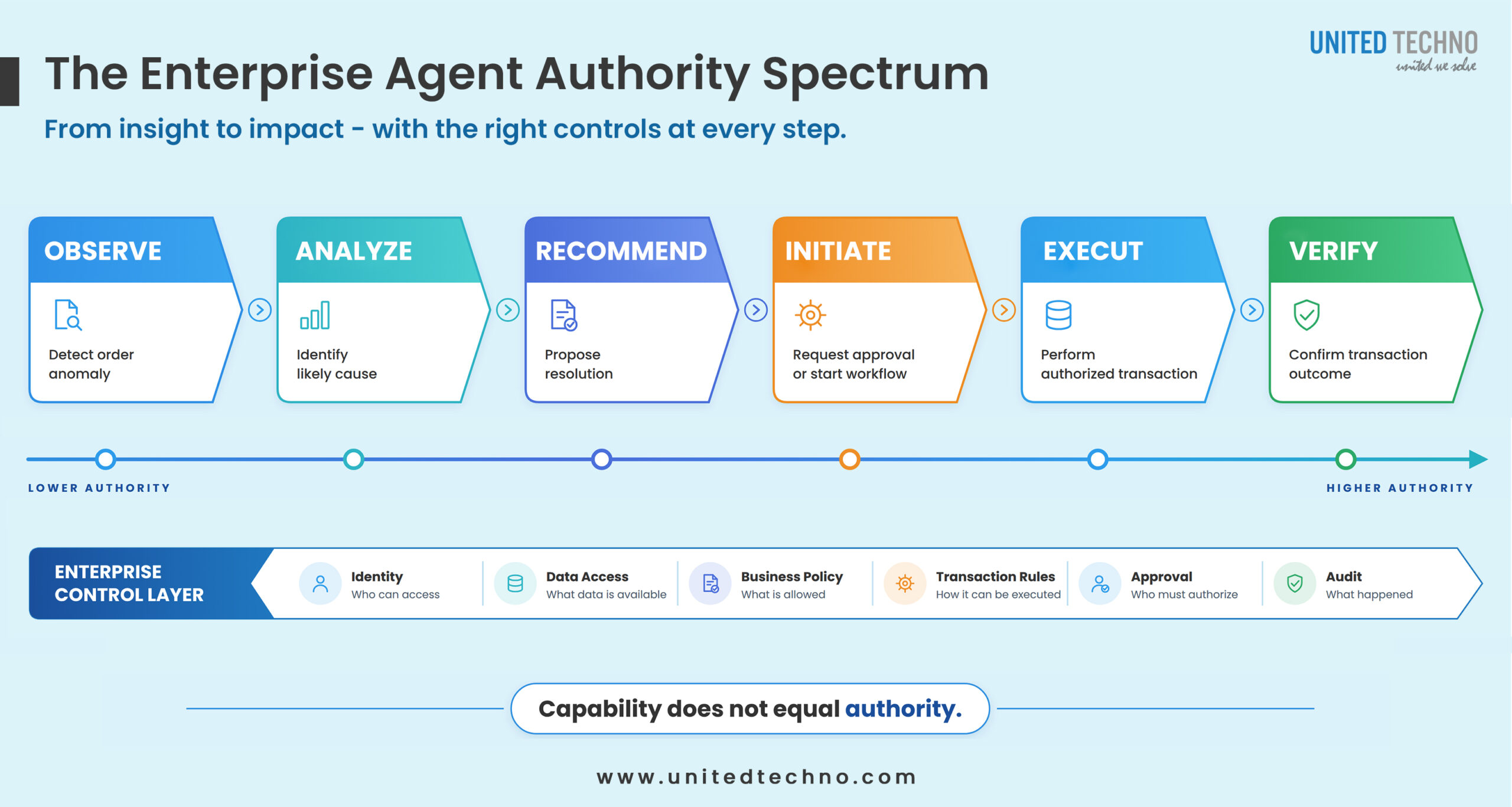
Understand → Decide → Authorize → Execute → Verify
Each stage answers a different question.
Understand
What is happening?
The system gathers the event, customer information, transaction history, policies, and relevant operational data.
Decide
What should happen?
An agent evaluates alternatives and produces a recommendation.
Authorize
Is that action permitted?
Business policies, transaction limits, user permissions, risk thresholds, and approval requirements are evaluated.
Execute
Perform the approved action.
The execution layer calls the appropriate enterprise system, workflow, API, or transaction service.
Verify
Did the intended result actually occur?
The system confirms the downstream outcome rather than assuming that a successful API call automatically means a successful business result.
This separation is particularly important for high-impact actions, including:
- Creating or cancelling financial transactions
- Changing customer master data
- Modifying pricing
- Approving suppliers
- Updating employee records
- Issuing high-value refunds
- Altering inventory balances
- Changing contractual terms
The agent can participate in the reasoning. The enterprise architecture determines the authority.
4. Not Every Decision Should Be Autonomous
Multi-agent architecture becomes more practical when autonomy is treated as a spectrum, not a binary choice.
Some activities can operate with a high degree of autonomy. Others require deterministic rules, approvals, or direct human involvement.
Lower-risk activities
- Classification
- Data extraction
- Information retrieval
- Summarization
- Anomaly identification
- Recommendation generation
Moderate-risk activities
- Creating a draft transaction
- Preparing a purchase request
- Initiating a workflow
- Updating non-critical workflow fields
- Selecting the next operational step
Higher-risk activities
- Financial posting
- Large refunds
- Contract changes
- Privileged access changes
- Regulatory decisions
- Sensitive employee actions
- Irreversible transactions
The architecture should make these boundaries explicit.
For example:
Agent identifies → Policy evaluates → Approval is obtained → System executes
Not:
Agent identifies → Agent executes
That distinction allows organizations to introduce agentic capabilities without treating every business process as an autonomous system.
5. The Real Complexity Appears Between Systems
An agent can operate inside a controlled environment. Enterprise processes rarely do.
A single business transaction may cross:
CRM → Commerce → ERP → WMS → Payment → Data Platform
Each system has its own:
- Authentication model
- Data structure
- API behavior
- Transaction rules
- Error-handling pattern
- Availability profile
- Security requirements
- Record identifiers
An agent does not remove those differences. It must operate within them.
Consider a customer order.
The commerce platform may show the order as paid. The ERP may still be waiting for financial posting. The warehouse may have reserved inventory. A 3PL may have already created a shipment. The data platform may not yet contain the latest transaction.
A useful AI agent architecture requires more than access to a model. It needs a dependable enterprise action layer that handles:
- API connectivity
- Event processing
- Data transformation
- Authentication
- Authorization
- Idempotency
- Transaction state
- Retry behavior
- Error handling
- Auditability
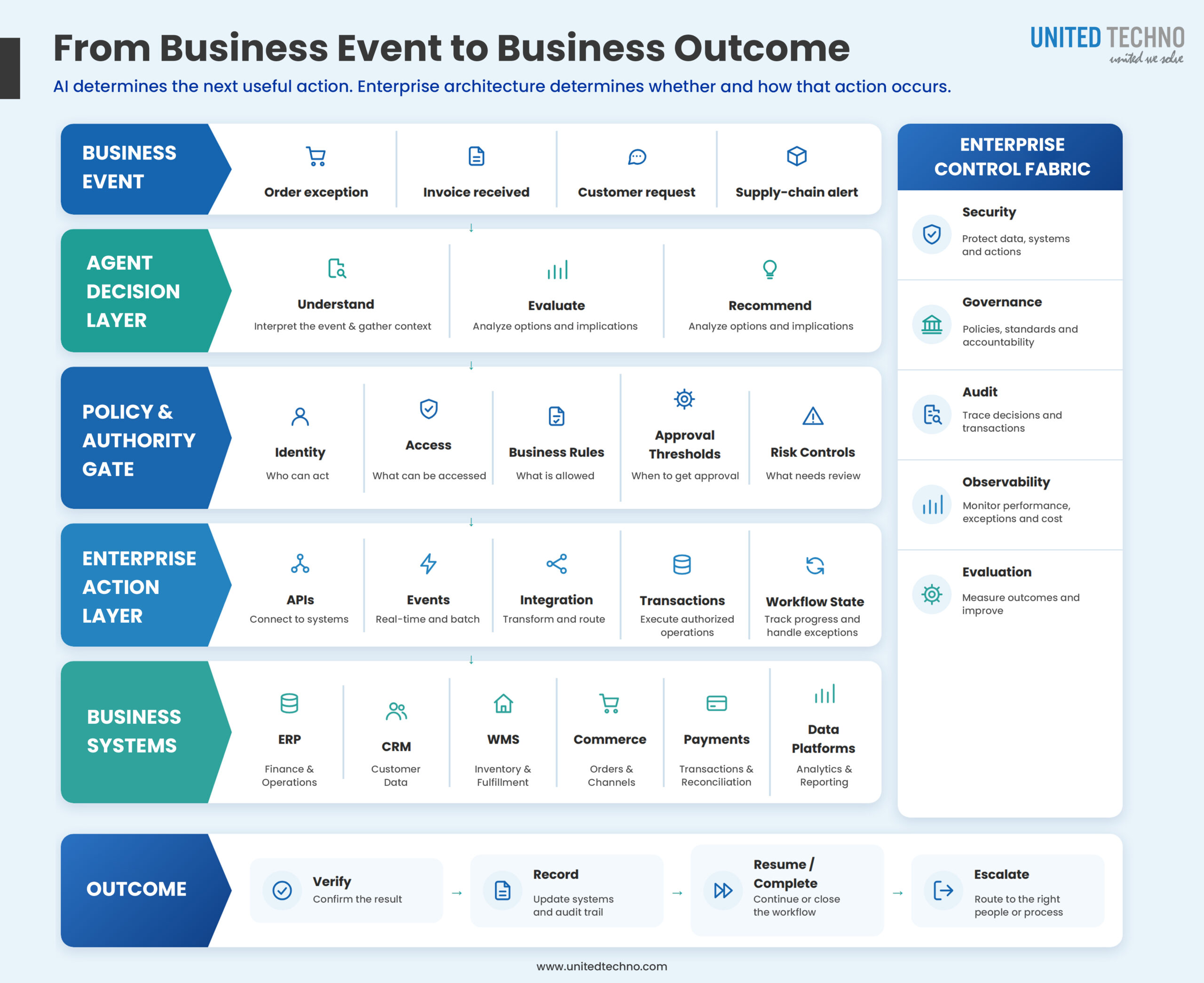
The AI layer determines what should happen.
The integration and execution layers determine how that decision safely reaches enterprise systems.
6. Context Should Be Deliberately Assembled
Giving every agent access to everything is not enterprise architecture.
It creates unnecessary exposure, increases context noise, and makes decision behavior harder to understand and govern.
Instead, context should be assembled based on the task.
For a customer-order exception, relevant context may include:
Customer
→ Account status
→ Purchase history
→ Service history
Order
→ Products
→ Price
→ Payment status
→ Delivery commitment
Operations
→ Inventory
→ Warehouse capacity
→ Shipment status
Policy
→ Return rules
→ Discount thresholds
→ Credit policy
→ Approval limits
The agent should receive the information needed to make its decision, not an uncontrolled export of enterprise data.
This also creates a clearer basis for evaluating agent behavior.
If an agent makes an incorrect recommendation, the investigation can ask:
- Was the required context available?
- Was the information current?
- Was the right policy retrieved?
- Was conflicting information present?
- Did the agent use data outside its intended scope?
That is far more useful than asking whether the model produced a generally good answer.
7. Multi-Agent Workflows Need Business State
A conversation has messages.
A business process has state.
Those are not the same thing.
Consider this order-management sequence:
Order received → Customer validated → Pricing reviewed → Inventory confirmed → Approval requested → Fulfillment initiated → Shipment confirmed → Finance reconciled
If the process stops after approval, the system must know exactly where it stopped. It cannot depend on an agent remembering the previous conversation.
The workflow state should capture items such as:
| State information | Example |
| Business identifier | Order #48271 |
| Completed activity | Pricing validated |
| Pending activity | Finance approval |
| Decision | Discount accepted |
| Approval | Regional manager approved |
| Transaction status | Fulfillment not initiated |
| Exception | Inventory confirmation delayed |
| Next permitted action | Recheck warehouse status |
This becomes especially important for long-running processes.
An agent may be unavailable. A model version may change. A session may expire. A human user may take over. The business process must still continue from a known, controlled state.
8. Design for Escalation Before Designing for Autonomy
Enterprise AI discussions often begin with:
“What can the agent automate?”
A better architectural question is:
“What happens when the agent should not act?”
Every production workflow needs defined escalation paths.
| Situation | Required response |
| Clear decision | Agent recommendation satisfies policy → Continue automatically |
| Missing information | Required customer or transaction data is unavailable → Request additional information |
| Policy conflict | Two applicable rules produce different outcomes → Route to a designated reviewer |
| Transaction failure | A downstream system rejects the action → Apply recovery procedure or escalate |
| Authority exceeded | The requested action exceeds the agent’s permitted threshold → Request human approval |
| Uncertain recommendation | Confidence or evaluation falls below the required threshold → Do not execute |
This makes escalation a normal part of the architecture rather than a fallback added after deployment.
9. Multi-Agent Does Not Automatically Mean Better
Adding agents introduces additional coordination. That can create value when responsibilities genuinely differ. It can also add unnecessary complexity.
For example, a simple request such as:
“Show all unpaid invoices for this customer.”
may not require multiple agents.
A single controlled agent with access to the appropriate system may be enough.
A more complex request such as:
“Investigate this disputed invoice, determine whether the charge is contractually valid, compare shipment evidence, identify the responsible business unit, calculate the financial adjustment, and prepare the resolution.”
may benefit from several specialized capabilities.
The architecture should begin with the business process, not an arbitrary target number of agents.
A practical decision sequence looks like this:
| Approach | Use when |
| One model call | The task is straightforward and does not require tool orchestration |
| Single agent | The task requires flexible reasoning and several tools within a bounded domain |
| Multiple agents | Distinct responsibilities, knowledge boundaries, security boundaries, or specialized capabilities justify separation |
| Human-controlled workflow | The consequences of autonomous execution exceed the acceptable risk threshold |
This avoids turning multi-agent AI into an architectural requirement when simpler automation would deliver better results.
10. What Enterprise Architecture Looks Like After Agents Enter the Process
Traditional enterprise automation usually follows predefined paths:
Event → Rule → System Action
Agent-enabled architecture introduces another layer:
Event → Context → Reasoning → Policy → Action → Verification
The difference is significant.
| Traditional automation | Agent-enabled enterprise process |
| Fixed workflow | Context-dependent workflow |
| Predefined conditions | Conditions interpreted at runtime |
| Rule-driven routing | Rules plus agent-assisted routing |
| Static inputs | Dynamically assembled context |
| Application-centric | Business-process-centric |
| Humans handle many exceptions | Agents classify and route exceptions |
| Application logs | Decision, tool, and transaction evidence |
| Fixed permissions | Explicit agent authority boundaries |
The objective is not to replace deterministic automation.
It is to introduce reasoning where deterministic logic becomes difficult to maintain.
Rules should continue to handle rules.
Agents should handle situations where interpretation, classification, and contextual reasoning add value.
11. A Practical Enterprise Model for Multi-Agent AI in Enterprise
A controlled multi-agent AI implementation can be structured around six decisions.
1. Identify the business outcome
Do not begin with:
“Where can an agent be used?”
Begin with:
“Which business process has a measurable problem?”
Examples include:
- Excessive invoice exceptions
- Slow order resolution
- Manual supplier validation
- High customer-service escalation volume
- Delayed operational decisions
2. Identify the decisions inside the process
Break the process into actual decisions.
Ask:
- Which activities require interpretation?
- Which activities are deterministic?
- Which decisions require human judgment?
- Which steps create enterprise transactions?
3. Assign bounded responsibilities
Define what each agent is responsible for, and, equally important, what it is not responsible for.
4. Define authority
For every meaningful action, establish the permitted level of authority:
Read → Recommend → Initiate → Execute → Approve
Do not grant execution authority simply because an agent can technically access an API.
5. Build the enterprise action layer
Connect the required:
- APIs
- Applications
- Events
- Data sources
- Workflow systems
- Transaction services
Then apply identity, authorization, state management, monitoring, and recovery controls.
6. Measure the complete process
Agent accuracy alone is not enough.
Useful enterprise measures include:
- Process completion rate
- Exception rate
- Human intervention rate
- Decision-to-action time
- Transaction failure rate
- Recovery rate
- Cost per completed process
- Business-cycle time
- Financial impact
- Customer or operational outcome
The final measure should always return to the business process.
12. The Enterprise Control Model Matters More Than Agent Count
A multi-agent AI in enterprise environment can contain two agents or twenty.
Agent count is not the primary architectural measure.
The more important questions are:
- Who can access the data?
- Who can make the decision?
- Who can authorize the action?
- Who can execute the transaction?
- Who verifies the result?
- Who handles exceptions?
- Who can reconstruct what happened?
That produces a more useful enterprise control model:
Identity → Context → Decision → Authority → Execution → Verification → Audit
Each stage has a distinct responsibility.
This also makes the architecture easier to govern. The organization is not attempting to govern an abstract concept of “AI.” It is governing specific decisions and actions inside specific business processes.
Where United Techno Fits
United Techno approaches multi-agent AI in enterprise in as an extension of enterprise architecture, not as an isolated AI development exercise.
The focus is on designing the complete path from business event to business outcome:
Business Process → Enterprise Context → Agent Reasoning → Policy → Integration → Execution → Verification
This can include:
- Multi-agent solution architecture
- Agent responsibility and authority design
- Enterprise context engineering
- Knowledge and data integration
- API and event architecture
- ERP, CRM, WMS, and ITSM integration
- Agent identity and access controls
- Human approval workflows
- Transaction safeguards
- Workflow state management
- Exception and recovery design
- Agent evaluation
- Production observability
- Audit and governance
- Cost and performance monitoring
The objective is not to maximize autonomy.
It is to make autonomy useful, bounded, and accountable.
The Architecture Comes Before the Agents
Multi-agent AI in Enterprise introduces an important shift in enterprise application design.
The question is no longer simply whether an AI model can perform a task.
The more important question is:
Where should intelligence participate in the process, and where should the enterprise retain deterministic control?
That leads to a practical architecture:
- Agents reason.
- Policies constrain.
- Integration layers execute.
- Enterprise systems remain authoritative.
- Verification confirms the outcome.
- People handle decisions that should not be delegated.
The strongest multi-agent implementations will not be the ones with the largest number of autonomous agents.
They will be the ones where every agent has a defined responsibility, every action has an appropriate authority boundary, and the full business process remains observable from decision to outcome.
Build Enterprise AI That Knows Where to Act
Design the business process. Define the decision boundaries. Then determine where agents belong.
Talk to United Techno about enterprise AI architecture, multi-agent workflows, and controlled agentic execution.