Oracle Cloud Infrastructure (OCI) and Amazon Web Services (AWS) can both support enterprise-scale applications. But choosing between them is not a technology popularity contest.
For an enterprise architect evaluating Oracle Cloud vs AWS, the more important question is:
Which cloud gives this workload the right combination of performance, resilience, cost, integration and room to evolve?
A retail ERP, a logistics event platform, a hospital data environment and a digital banking application can all have very different answers.
At United Techno, we approach the decision from the workload outward, rather than starting with the cloud provider.
Cloud Selection Starts With the Workload
When evaluating Oracle Cloud vs AWS, it is important to recognize that a large enterprise rarely has one homogeneous technology landscape.
It may have Oracle databases, SAP, Salesforce, legacy applications, SaaS platforms, custom applications, data platforms and digital channels operating together.
Moving everything to one cloud may sound simple.
It is not always the most practical architecture.
A better starting point is to understand what each workload needs.
| Consideration | OCI may be a strong fit when… | AWS may be a strong fit when… |
| Oracle estate | Oracle databases and applications are central | Oracle is one part of a broader technology estate |
| Application modernization | Existing Oracle workloads are being modernized | Applications are being redesigned for cloud-native operation |
| Data & analytics | Oracle data platforms are core to the architecture | Diverse analytics, data and application services are required |
| Integration | Oracle applications dominate the integration landscape | Distributed APIs, events and services drive the architecture |
| Global operations | Oracle-centric workloads need consistent cloud infrastructure | Applications require a broad cloud service ecosystem |
| Existing skills | Oracle expertise is already strong | AWS engineering capability is already established |
| Hybrid strategy | Oracle workloads need close alignment with OCI | AWS already forms a major part of the enterprise landscape |
There is no universal winner.
The workload determines the winner.
OCI and AWS: The Architectural Difference
At the infrastructure level, both platforms provide the familiar building blocks of enterprise cloud:
Compute → Storage → Networking → Databases → Containers → Security → Integration → Analytics
When evaluating Oracle Cloud vs AWS, the distinction becomes clearer when you look at how those capabilities fit into the existing enterprise architecture.
For an Oracle-heavy environment, OCI can offer a natural extension of an existing Oracle estate.
For an enterprise building distributed digital applications, AWS can provide a broad collection of cloud services around the application.
The question is therefore not:
“Which cloud has more services?”
It is:
“Which services do we actually need, and how well do they fit together?”
When OCI Becomes Particularly Interesting
Consider a retailer operating:
Oracle ERP + Oracle Database + Supply Chain + Finance + Store Systems + E-commerce
The database is not an isolated component.
It is deeply connected to applications, integrations, reporting and business processes.
In such an environment, the cloud decision needs to consider the entire Oracle dependency chain, not just the infrastructure hosting the database.
OCI can be particularly relevant where Oracle databases and enterprise applications represent a significant portion of the workload.
United Techno view
When evaluating Oracle Cloud vs AWS, if Oracle is the center of gravity of the workload, OCI should be part of the architecture assessment from the beginning.
That does not mean every Oracle workload belongs on OCI.
It means the Oracle dependency should not be treated as an afterthought.
When AWS Becomes Particularly Interesting
Now consider a logistics platform:
Orders → APIs → Events → Shipment Tracking → Warehouse → Analytics → Customer Notifications
When evaluating Oracle Cloud vs AWS for this type of workload, the application may need distributed services, APIs, event processing, containers, databases, monitoring and analytics.
Here, the cloud is not simply hosting an application.
It is becoming part of the application’s operating model.
AWS can be a strong option when the architecture is built around distributed, cloud-native and event-driven services, particularly where the enterprise already has substantial AWS engineering capability.
The important consideration is not the number of services available.
It is how effectively the services support the business transaction.
Retail: One Enterprise, Several Cloud Decisions
Retail is a good example of why enterprise cloud decisions should not be made with a single-provider mindset.
When evaluating Oracle Cloud vs AWS, a retailer may operate:
- ERP and finance
- Point of sale
- E-commerce
- Warehouse management
- CRM
- Loyalty
- Supply chain
- Analytics
- AI applications
The underlying workloads have different characteristics.
An Oracle-centric financial system may have one optimal deployment model.
A customer-facing commerce platform may have another.
An analytics environment may require a third.
A practical architecture could therefore look like:
Oracle Enterprise Workloads
↓
OCI
Digital Commerce
↓
AWS
Enterprise Integration
↓
Shared Integration & API Layer
Data & Analytics
↓
Workload-Specific Data Platform
The objective is not to create more clouds.
It is to avoid forcing fundamentally different workloads into the same architectural model.
Logistics: Follow the Transaction
Logistics systems are built around movement.
Orders move.
Inventory moves.
Shipments move.
Events arrive continuously.
Exceptions need immediate attention.
When evaluating Oracle Cloud vs AWS for logistics systems, a modern logistics architecture may therefore depend heavily on:
APIs | Events | Real-Time Processing | Integration | Analytics
A cloud decision should consider how effectively the platform supports those transaction patterns.
An Oracle-heavy logistics organization may have strong reasons to keep core enterprise workloads close to its Oracle estate.
A digitally native logistics platform may prioritize a distributed cloud architecture.
Again, the answer comes from the workload.
Healthcare: Cloud Choice Meets Data Responsibility
Healthcare introduces another dimension when evaluating Oracle Cloud vs AWS.
The architecture may connect:
EHR → Clinical Applications → Imaging → Labs → Claims → Analytics → AI
Here, cloud selection needs to account for more than compute and storage.
Security, governance, interoperability, availability, data management and operational resilience become architectural requirements.
An Oracle-centric healthcare environment may naturally lead toward an OCI assessment.
A healthcare technology company building new digital applications may have a stronger case for AWS.
In both cases, the cloud should support the data and application architecture, rather than dictate it.
Hospitality and Financial Services Need the Same Discipline
Hospitality
A hotel group may connect:
Reservations → Property Management → Payments → Loyalty → Customer Experience
The architecture must support both core enterprise systems and customer-facing digital experiences.
Financial Services
A financial institution may prioritize:
Resilience → Security → Data Governance → Performance → Regulatory Controls
When evaluating Oracle Cloud vs AWS, these industry-specific requirements highlight why cloud selection should be based on individual workload needs.
That is why United Techno evaluates the workload portfolio, rather than making the cloud decision at the enterprise level alone.
Cloud Cost Is More Than the Cloud Bill
A common mistake when evaluating Oracle Cloud vs AWS is comparing infrastructure prices without considering the cost of getting there.
United Techno looks at cloud economics across five areas:
Infrastructure
Compute • Storage • Network
Engineering
Migration • Development • Testing
Operations
Monitoring • Support • FinOps
Architecture
Refactoring • Integration • Resilience
Business
Downtime • Performance • Time to Market
A workload that appears cheaper to host may become expensive if it requires extensive redevelopment.
Likewise, a platform with a slightly higher infrastructure cost may prove more economical if it reduces operational complexity and migration effort.
The objective is not the lowest cloud bill. It is the lowest sustainable cost for the required business outcome.
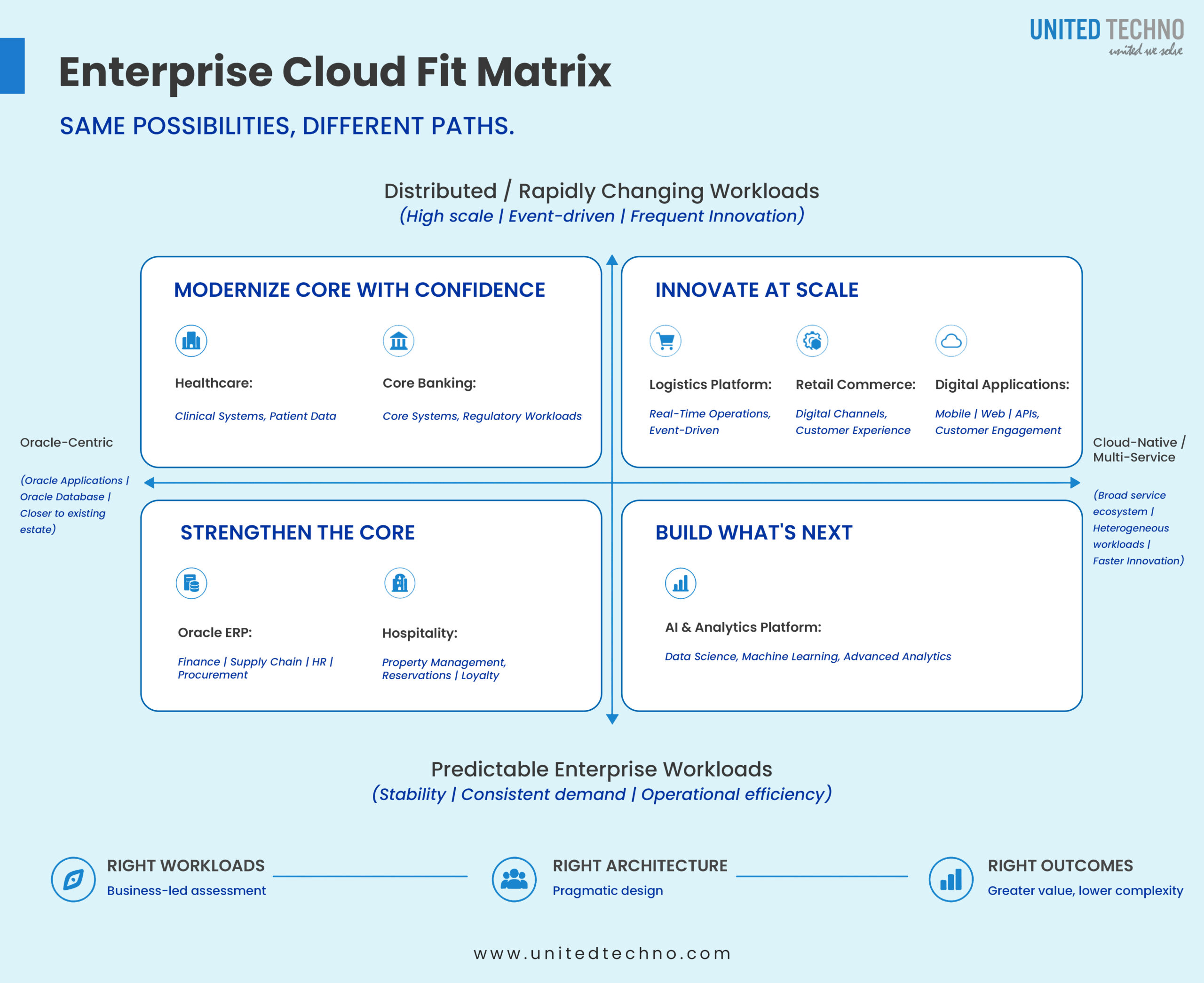
The Enterprise Cloud Fit Matrix
The Hidden Cost of Choosing the Wrong Cloud
The biggest cloud mistake is often not choosing the “wrong” provider.
It is choosing a provider without understanding the workload.
That can lead to:
- Unnecessary application changes
- Complex data movement
- Additional integration layers
- Skill gaps
- Higher operational overhead
- Longer migration programs
- Difficult testing cycles
- Unexpected performance issues
This is particularly important when modernizing older enterprise estates.
A cloud migration should reduce complexity.
It should not simply move complexity somewhere else.
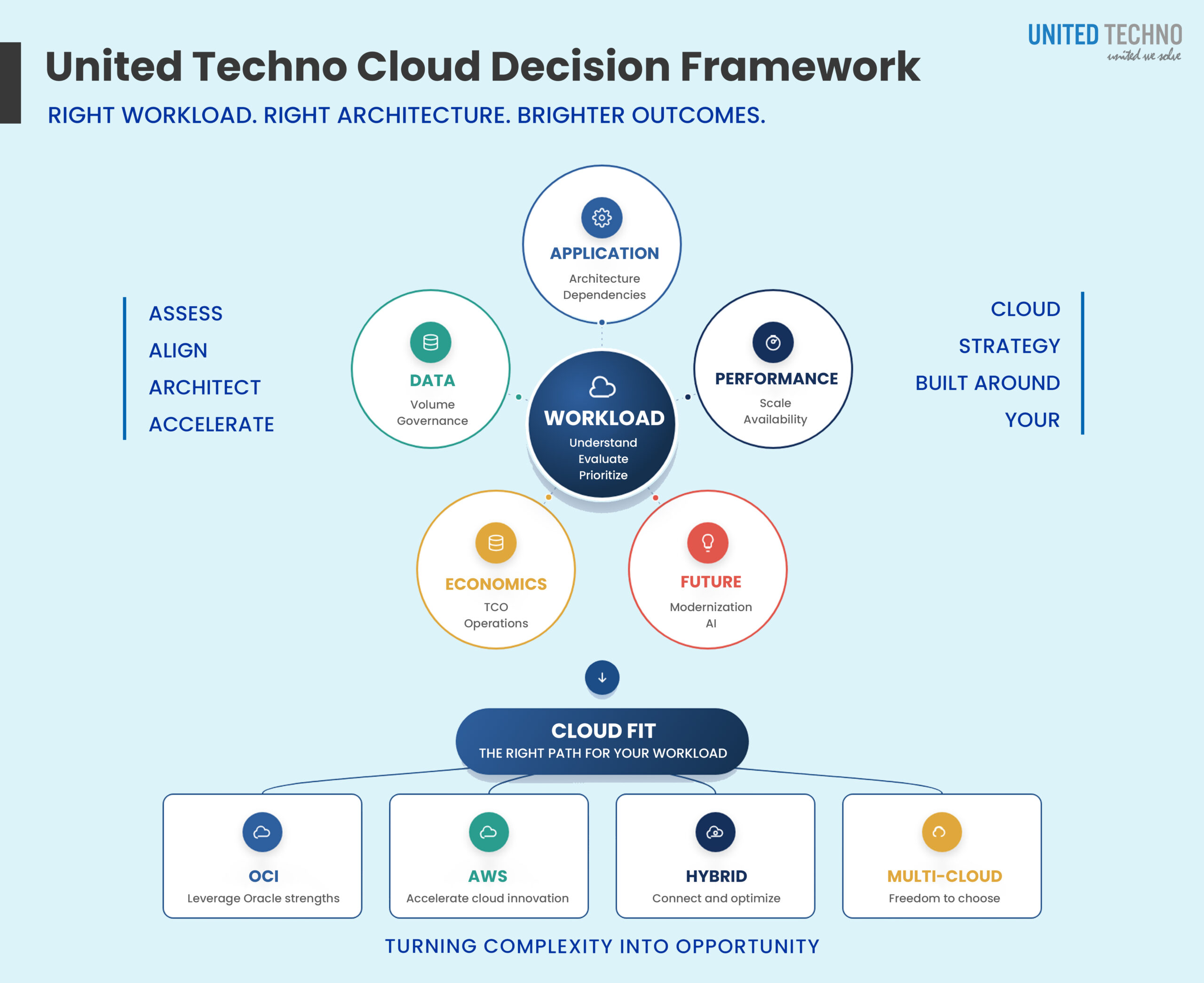
OCI, AWS or Hybrid? A Better Decision Framework
United Techno evaluates cloud fit across five dimensions.
01 — APPLICATION
Architecture, dependencies and modernization requirements.
02 — DATA
Volume, sensitivity, movement, governance and location.
03 — PERFORMANCE
Latency, scalability, availability and workload behavior.
04 — ECONOMICS
Infrastructure, migration, operations, licensing and skills.
05 — FUTURE
Modernization, analytics, automation and AI requirements.
These dimensions converge on one question:
CLOUD FIT
The answer can be OCI, AWS, hybrid or multi-cloud.
The important part is that the architecture earns that answer.
So, Which One Should You Choose?
There is a simple way to approach the decision.
Choose OCI for consideration when:
Oracle workloads are central to the business and the existing Oracle estate strongly influences the architecture.
Choose AWS for consideration when:
The organization is building or operating distributed cloud-native workloads and has strong AWS capabilities around them.
Consider hybrid when:
Different workloads have fundamentally different architectural requirements.
And if both clouds are already present, do not create another migration simply to achieve theoretical consistency.
Make the existing architecture work harder.
The United Techno Approach
United Techno starts with the business and workload landscape, not with a provider preference.
Our assessment considers:
Application portfolio
Oracle dependencies
Data architecture
Integration landscape
Performance requirements
Security and governance
Migration complexity
Total cost of ownership
Modernization opportunities
Analytics and AI requirements
The outcome is a cloud strategy based on where each workload performs best, what it costs to operate and how easily it can evolve.
Cloud Architecture Should Follow the Business
OCI and AWS are both capable enterprise cloud platforms.
But capability alone does not determine fit.
When evaluating Oracle Cloud vs AWS, a retailer’s ERP is different from its commerce platform.
A retailer’s ERP is different from its commerce platform.
A hospital’s clinical environment is different from its patient application.
A logistics platform is different from a warehouse system.
A bank’s core platform is different from its digital channel.
That is why enterprise cloud strategy should not end with a feature comparison.
It should begin with the workload.
The right cloud is the one that fits the way your business actually operates.
United Techno helps enterprises assess and modernize Oracle and AWS environments, enterprise applications, integration landscapes, data platforms and AI-ready architectures.
Planning Your Next Cloud Move?
Talk to United Techno about building a workload-led cloud strategy.