Why AI Success in Retail Depends on More Than Technology
Artificial Intelligence has rapidly moved from innovation labs to boardroom discussions, making an AI Readiness Framework essential for organizations seeking to assess capabilities, address gaps, and prepare for successful AI adoption.
Retail executives are under growing pressure to leverage AI for:
- Demand forecasting
- Inventory optimization
- Customer personalization
- Supply chain intelligence
- Dynamic pricing
- Store operations
- Customer service automation
The expectations are high.
Boards expect measurable returns.
Business leaders expect operational improvements.
Customers expect better experiences.
Yet despite increasing investments, many retail organizations struggle to move beyond pilot projects and isolated use cases.
The reason is simple.
Most retailers focus on implementing AI before they are prepared to support it.
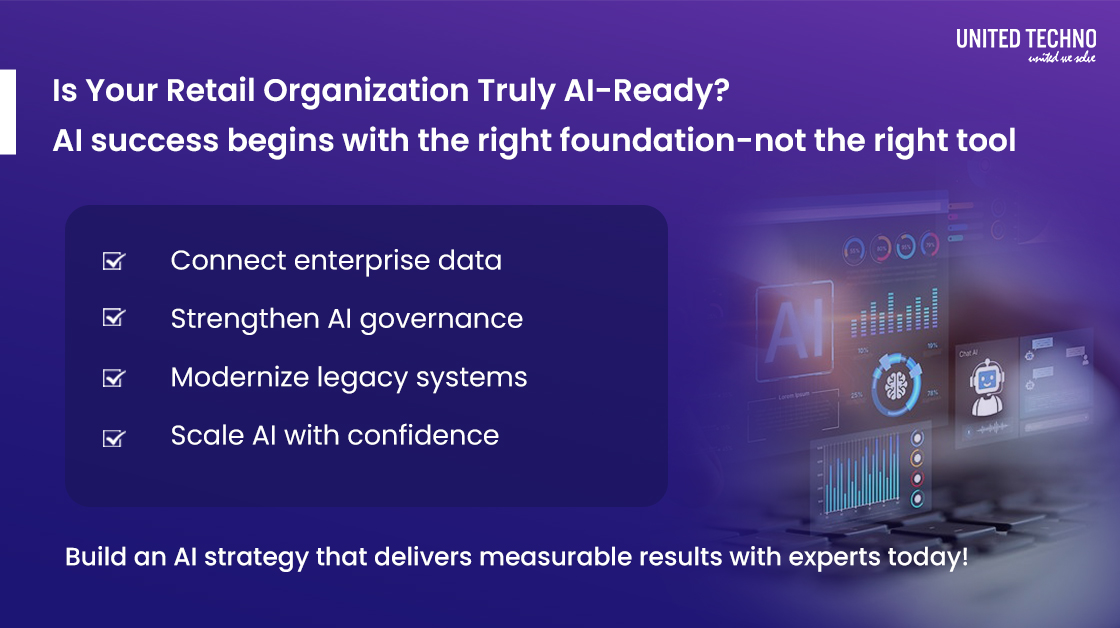
AI readiness is not about selecting a platform, purchasing a model, or hiring data scientists.
AI readiness is about building the organizational, operational, and data foundation required for AI to generate sustainable business value.
For retail CIOs, the question is no longer whether AI should be adopted.
The question is whether the organization is ready for it.
The Reality of AI in Retail
Many retailers begin their AI journey by evaluating technology solutions.
They explore:
- Generative AI platforms
- AI-powered analytics tools
- Forecasting solutions
- Intelligent automation platforms
- Conversational AI applications
While these technologies offer significant potential, they often expose deeper challenges.
Retail organizations commonly encounter:
- Fragmented data sources
- Inconsistent business definitions
- Limited data governance
- Legacy system dependencies
- Poor data quality
- Lack of operational alignment
As a result, AI initiatives frequently deliver inconsistent outcomes.
Technology becomes the focus, while foundational readiness remains overlooked.
Successful retailers take a different approach.
They establish an AI readiness framework before scaling AI investments.
Why Retail CIOs Need an AI Readiness Framework
AI introduces new levels of complexity across the enterprise.
Unlike traditional applications, AI depends on:
- Continuous data availability
- Accurate information
- Cross-functional collaboration
- Governance controls
- Ongoing monitoring
Without these capabilities, even the most sophisticated AI solution can fail to produce business value.
An AI readiness framework provides a structured approach for evaluating and strengthening the organization’s ability to support AI at scale.
It helps CIOs answer critical questions:
- Is our data trustworthy?
- Can our systems support AI workloads?
- Do we have sufficient governance?
- Are business teams aligned around AI objectives?
- Can AI outputs be trusted for decision-making?
- Are we prepared to scale beyond pilot projects?
Organizations that answer these questions early reduce risk and improve the likelihood of successful AI adoption.
Pillar 1: Data Readiness
Data is the foundation of every AI initiative.
Unfortunately, it is also where many retail organizations face their greatest challenges.
Common issues include:
- Data silos
- Duplicate records
- Missing information
- Delayed reporting
- Inconsistent product data
- Incomplete customer profiles
AI systems amplify data quality issues rather than eliminate them.
If the underlying data is unreliable, AI recommendations become unreliable.
Retail CIOs should evaluate:
Data Integration
Can data move seamlessly across ERP, POS, CRM, WMS, eCommerce, and supplier systems?
Data Quality
Are validation processes in place to ensure accuracy and consistency?
Data Accessibility
Can business users and AI applications access the information they need?
Data Governance
Are ownership, lineage, and compliance standards clearly defined?
Without a strong data foundation, AI readiness remains out of reach.
Pillar 2: Technology Readiness
Many retailers operate a combination of modern cloud applications and legacy systems.
Technology readiness involves assessing whether the current architecture can support AI initiatives.
Key considerations include:
Integration Capabilities
Can systems exchange information in real time?
Scalability
Can infrastructure support growing data volumes and AI workloads?
Cloud Readiness
Can the organization leverage modern data and analytics platforms effectively?
Legacy Modernization
Can mission-critical systems such as ERP and AS400 environments participate in AI-driven processes?
Technology readiness is not about replacing everything.
It is about ensuring that existing investments can support future innovation.
Pillar 3: Governance Readiness
As AI becomes more influential in business decisions, governance becomes increasingly important.
Retail organizations must establish clear controls around:
Data Security
Protecting customer and business information.
Compliance
Supporting privacy regulations and industry standards.
Model Transparency
Understanding how AI-generated recommendations are produced.
Accountability
Defining ownership for AI-driven outcomes.
Governance builds trust across the organization and reduces operational risk.
Without governance, AI adoption often encounters resistance from both business and technology stakeholders.
Pillar 4: Operational Readiness
AI initiatives succeed when they are integrated into business operations.
Many organizations focus heavily on technology while overlooking operational change.
Retail CIOs should assess:
Process Alignment
Can business processes effectively leverage AI insights?
Cross-Functional Collaboration
Are business and technology teams working toward shared objectives?
Change Management
Are employees prepared to adopt new ways of working?
Decision-Making Frameworks
How will AI recommendations be incorporated into operational decisions?
AI should enhance business processes rather than operate separately from them.
Pillar 5: Business Value Readiness
One of the most common reasons AI projects fail is the absence of clearly defined business outcomes.
Successful retailers prioritize use cases that align with strategic objectives.
Examples include:
Inventory Optimization
Reducing stockouts and excess inventory.
Demand Forecasting
Improving planning accuracy.
Customer Personalization
Increasing engagement and conversion.
Supply Chain Visibility
Improving operational responsiveness.
Fulfillment Optimization
Reducing costs while improving service levels.
Retail CIOs should focus on measurable outcomes rather than technology features.
The goal is not to implement AI.
The goal is to create business value.
The AI Readiness Maturity Model
Retail organizations typically progress through four stages.
Stage 1: Exploration
Experimenting with AI tools and concepts.
Stage 2: Foundation
Establishing data, integration, and governance capabilities.
Stage 3: Operationalization
Deploying AI within business processes.
Stage 4: Scale
Expanding AI across multiple business functions.
Many organizations attempt to jump directly from exploration to scale.
The most successful retailers progress methodically through each stage.
Common AI Readiness Mistakes Retail CIOs Should Avoid
Several patterns consistently appear across unsuccessful AI initiatives.
Mistake #1
Prioritizing AI tools before addressing data challenges.
Mistake #2
Treating AI as an IT project rather than a business transformation initiative.
Mistake #3
Ignoring governance requirements.
Mistake #4
Attempting too many use cases simultaneously.
Mistake #5
Underestimating the impact of legacy systems and integration challenges.
Avoiding these mistakes significantly improves the likelihood of long-term success.
What an AI-Ready Retail Organization Looks Like
An AI-ready retailer is not defined by the number of AI tools it owns.
It is defined by its ability to consistently transform trusted data into intelligent action.
In an AI-ready organization:
- Data is connected across systems.
- Information is trusted and governed.
- Business and technology teams are aligned.
- AI supports operational decisions.
- Use cases are tied to measurable outcomes.
- Innovation can scale without disruption.
Most importantly, AI becomes part of everyday operations rather than a standalone initiative.
The CIO’s Role in Retail AI Success
The future of retail will be shaped by organizations that successfully combine data, technology, governance, and business strategy.
For CIOs, AI readiness has become a strategic responsibility.
The organizations that generate the greatest value from AI will not necessarily be those that invest the most.
They will be the organizations that prepare the most.
By establishing a structured AI readiness framework, retail CIOs can reduce risk, accelerate adoption, and create a foundation for sustainable innovation.
AI success begins long before the first model is deployed.
It begins with readiness.
Ready to Transform Your Retail Business?
Meet United Techno — Your One Integration Partner with Endless Possibilities.
Streamline your retail operations with seamless integrations across Boomi, MuleSoft, Workato, Celigo, and advanced cloud & data integration services — all working together to power your growth.