Why Most Retail AI Initiatives Struggle Before They Scale
Artificial Intelligence has become the centerpiece of retail transformation conversations.
Retail executives are exploring AI-powered forecasting, personalized promotions, dynamic pricing, inventory optimization, supply chain intelligence, customer service automation, and increasingly, autonomous AI agents capable of executing operational decisions. To effectively support these innovations, organizations are developing a Retail Data Modernization Roadmap that creates a scalable, unified data foundation for advanced analytics, AI adoption, and intelligent decision-making.
Yet despite significant investment, many retail organizations remain stuck in pilot mode.
The reason is surprisingly simple.
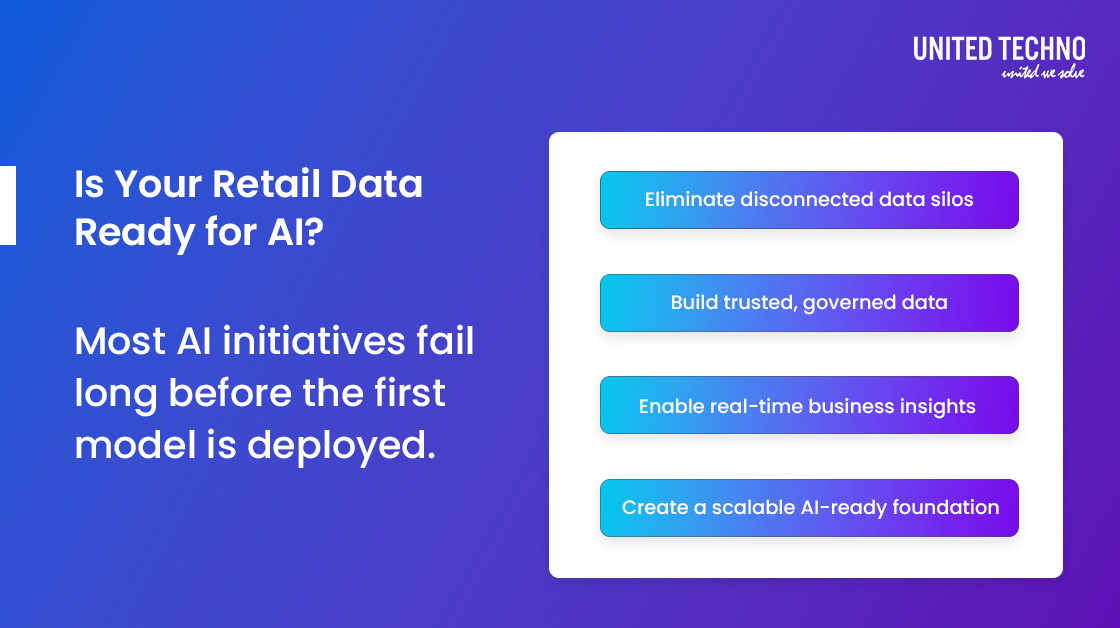
Most retailers do not have an AI problem.
They have a data foundation problem.
AI can only be as effective as the data ecosystem that supports it. When inventory data resides in one system, customer data in another, supplier information in a third, and eCommerce transactions in multiple disconnected platforms, AI becomes another layer of complexity rather than a driver of business value.
Before retailers can operationalize AI at scale, they must modernize the way data is collected, integrated, governed, and consumed across the enterprise.
This is where a structured Retail Data Modernization Roadmap becomes critical.
The Current State of Retail Data
Most mid-market and enterprise retailers have accumulated technology over decades.
A typical retail landscape includes:
- ERP systems
- POS platforms
- Warehouse Management Systems
- Transportation Management Systems
- CRM applications
- Loyalty platforms
- eCommerce platforms
- Marketplace integrations
- Supplier portals
- Financial systems
- Business intelligence tools
Each system was implemented to solve a specific business problem.
Very few were designed to operate as a unified ecosystem.
The result is a fragmented environment where:
- Inventory counts vary across channels
- Customer profiles remain incomplete
- Sales reporting is delayed
- Forecasting accuracy suffers
- Operational teams work from different versions of truth
Adding AI to this environment often magnifies existing inefficiencies instead of solving them.
Organizations frequently discover that AI exposes weaknesses in data quality, ownership, governance, and operational processes that were previously hidden beneath manual workflows.
Why AI Readiness Starts with Data Readiness
Many retailers mistakenly define AI readiness as selecting a platform or purchasing an AI solution.
True AI readiness is achieved when an organization can consistently provide trusted, governed, accessible, and contextual data to intelligent systems.
An AI-ready retail enterprise demonstrates five characteristics:
Unified Enterprise Data
Critical business information can be accessed across channels and departments.
Trusted Data Quality
Data is accurate, complete, timely, and validated.
Real-Time Data Availability
Operational decisions are based on current business conditions rather than yesterday’s reports.
Strong Governance
Ownership, lineage, security, and compliance policies are clearly defined.
Scalable Data Architecture
New data sources and AI use cases can be integrated without extensive redevelopment.
Without these foundations, AI initiatives often produce inconsistent results, limited adoption, and disappointing ROI.
The Retail Data Modernization Roadmap
Successful retailers typically progress through five distinct modernization phases.
Skipping phases often creates technical debt that later slows AI adoption.
Phase 1: Assess the Retail Data Landscape
Before modernization begins, retailers must understand their current environment.
This assessment should identify:
Data Sources
- ERP
- POS
- CRM
- eCommerce
- Marketplace data
- Supplier systems
- Inventory systems
- Marketing platforms
Data Silos
Where information exists in isolation.
Integration Gaps
Where manual processes are bridging disconnected systems.
Data Quality Issues
Duplicate, incomplete, or inconsistent records.
Reporting Dependencies
Critical reports relying on spreadsheets and manual reconciliation.
At this stage, many organizations discover hundreds of undocumented integrations and data flows supporting daily operations.
Understanding these dependencies prevents costly surprises later.
Phase 2: Build a Connected Data Foundation
The second phase focuses on eliminating fragmented data movement.
Historically, retailers relied on point-to-point integrations.
While these approaches solved immediate challenges, they often created highly complex ecosystems that became difficult to maintain.
A modern retail architecture emphasizes:
Centralized Data Integration
Data moves through governed pipelines rather than isolated connections.
Standardized Data Models
Common definitions for customers, products, inventory, suppliers, and orders.
Automated Data Ingestion
Real-time or near-real-time movement of operational data.
Metadata Management
Clear understanding of data origins and transformations.
The objective is to establish a single, connected retail data ecosystem capable of supporting enterprise-wide analytics and AI initiatives.
Phase 3: Establish Retail Data Governance
Governance is frequently viewed as an administrative exercise.
In reality, governance determines whether AI outputs can be trusted.
Retail organizations should establish:
Data Ownership
Every critical dataset should have a designated business owner.
Data Quality Monitoring
Automated validation rules for key business metrics.
Security Controls
Role-based access and data protection policies.
Compliance Frameworks
Support for privacy regulations and customer data protection.
Data Lineage
Visibility into how data moves across systems.
As AI adoption accelerates, governance becomes even more important because AI systems amplify inconsistencies and inaccuracies when foundational controls are absent.
Phase 4: Enable Real-Time Retail Intelligence
Traditional retail reporting focuses on historical analysis.
AI requires operational intelligence.
Retailers must transition from:
Historical Reporting
“What happened?”
to
Operational Intelligence
“What is happening right now?”
This requires:
- Event-driven architecture
- Streaming data pipelines
- Real-time inventory visibility
- Instant order tracking
- Live customer behavior monitoring
Real-time intelligence enables AI to support dynamic pricing, replenishment optimization, fraud detection, fulfillment routing, and personalized customer experiences.
Organizations lacking real-time capabilities often struggle to move AI beyond experimentation.
Phase 5: Operationalize AI Across Retail Functions
Only after foundational modernization should retailers focus on large-scale AI deployment.
At this stage, organizations can confidently support advanced use cases such as:
Demand Forecasting
Predicting demand patterns across channels.
Inventory Optimization
Reducing stockouts and excess inventory.
Customer Personalization
Delivering relevant offers and experiences.
Supply Chain Intelligence
Improving supplier performance and logistics planning.
Dynamic Pricing
Responding to market conditions in real time.
AI-Powered Merchandising
Optimizing assortments and category performance.
Agentic Retail Operations
Enabling AI agents to assist or automate operational decisions.
Organizations attempting these initiatives without modernized data foundations frequently encounter governance issues, inconsistent outputs, and scalability limitations.
Common Retail Data Modernization Mistakes
Across modernization programs, several recurring mistakes emerge.
Treating AI as a Technology Project
AI readiness is an enterprise transformation initiative involving data, processes, governance, and organizational alignment.
Ignoring Legacy Systems
ERP, AS400, warehouse, and supply chain platforms often contain mission-critical information.
Modernization should connect and evolve these systems rather than simply replace them.
Prioritizing Dashboards Over Data Quality
Sophisticated analytics built on poor-quality data create misleading insights.
Underestimating Governance
Data governance must be established before AI scales.
Pursuing Too Many Use Cases
Successful retailers typically focus on a small number of high-value use cases before expanding.
What an AI-Ready Retail Enterprise Looks Like
An AI-ready retailer is not defined by the number of AI tools it owns.
It is defined by its ability to deliver trusted information to decision-makers, applications, and intelligent systems in real time.
In an AI-ready environment:
- Inventory data is synchronized across channels.
- Customer data is unified across touchpoints.
- Supply chain visibility extends across partners.
- Data governance is embedded into operations.
- Business users trust the information they consume.
- AI solutions can scale without constant intervention.
Most importantly, AI becomes a business capability rather than a technology experiment.
The Path Forward
The retail industry is entering a period where competitive advantage will increasingly depend on how effectively organizations transform data into intelligence.
The winners will not necessarily be the retailers that adopt AI first.
They will be the retailers that modernize their data foundations first.
Retailers that invest in connected architectures, trusted governance, real-time intelligence, and scalable data platforms today will be positioned to operationalize AI faster, generate higher returns, and adapt more effectively to future market shifts.
AI readiness is ultimately not an AI journey.
It is a data modernization journey.
And for retail organizations planning the next phase of digital transformation, that journey starts now.
Ready to Transform Your Retail Business?
Meet United Techno — Your One Integration Partner with Endless Possibilities.
Streamline your retail operations with seamless integrations across Boomi, MuleSoft, Workato, Celigo, and advanced cloud & data integration services — all working together to power your growth.