Why Retailers Are Rethinking Supply Chain Visibility in 2026
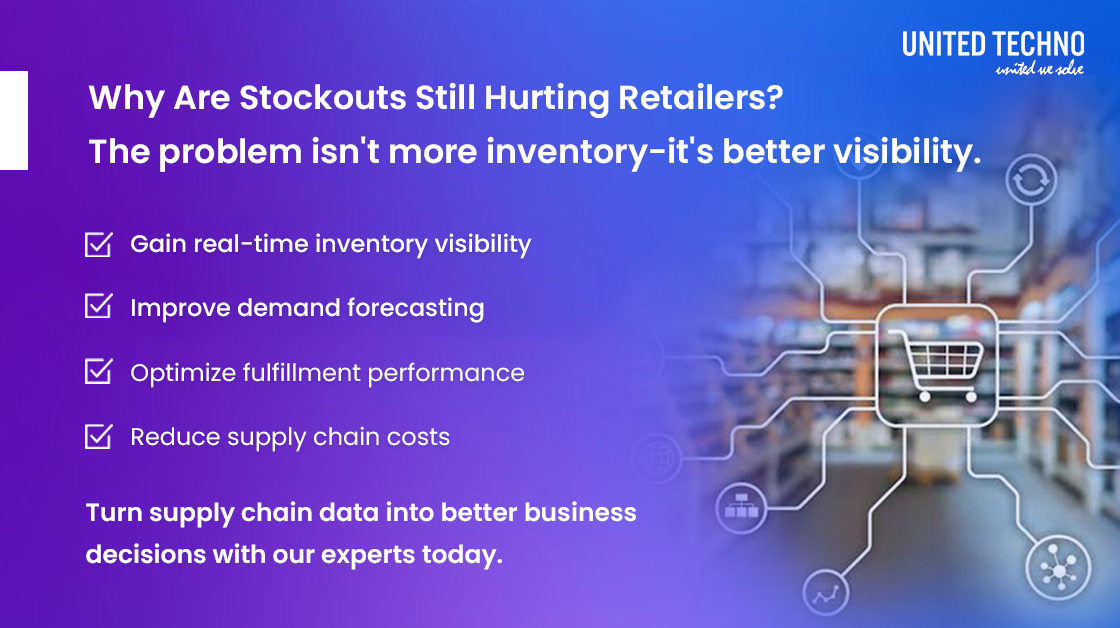
For many retailers, supply chain performance has become one of the most significant drivers of profitability.
In response, retailers have invested heavily in ERP systems, Warehouse Management Systems (WMS), Transportation Management Systems (TMS), demand planning tools, and analytics platforms.
Yet many organizations continue to struggle with:
- Excess inventory in some locations
- Stockouts in others
- Rising fulfillment costs
- Delayed replenishment decisions
- Poor inventory visibility
- Inaccurate forecasting
- Inconsistent customer experiences
The issue is rarely a lack of data.
The issue is an inability to transform operational data into actionable supply chain intelligence.
This is where Retail Supply Chain Analytics becomes a strategic advantage.
Modern supply chain analytics enables retailers to move beyond historical reporting and toward predictive, real-time decision-making that improves inventory performance, fulfillment efficiency, and customer satisfaction.
The Hidden Cost of Supply Chain Inefficiencies
Many retail organizations underestimate how much operational inefficiencies affect profitability.
A stockout is not simply a missed sale.
It can result in:
- Lost customer loyalty
- Reduced lifetime value
- Increased customer acquisition costs
- Negative brand perception
Similarly, excess inventory creates challenges that extend beyond storage costs.
Retailers face:
- Working capital constraints
- Higher warehousing expenses
- Increased markdowns
- Product obsolescence risks
When multiplied across thousands of SKUs, stores, fulfillment centers, and distribution channels, these inefficiencies can cost millions annually.
The challenge becomes even greater in omnichannel environments where inventory must support:
- Physical stores
- eCommerce
- Marketplace sales
- Buy Online Pick Up In Store (BOPIS)
- Ship-from-store
- Curbside fulfillment
- Third-party logistics operations
Without accurate, timely analytics, managing these operations becomes increasingly difficult.
Why Traditional Reporting Is No Longer Enough
Historically, retailers relied on reports generated from ERP systems and operational databases.
These reports answered questions such as:
- What sold yesterday?
- How much inventory remains?
- Which stores exceeded sales targets?
While useful, these reports focus on historical events.
Modern retail operations require answers to different questions:
- Which products are likely to experience stockouts next week?
- Which suppliers present fulfillment risks?
- Where should inventory be repositioned?
- Which distribution center is creating bottlenecks?
- Which orders are likely to miss delivery commitments?
- How will promotions impact replenishment requirements?
Answering these questions requires advanced analytics capabilities that combine operational data, predictive models, and real-time visibility.
What Is Retail Supply Chain Analytics?
Retail Supply Chain Analytics refers to the collection, integration, analysis, and visualization of data across the entire supply chain ecosystem.
The goal is to provide decision-makers with actionable insights that improve planning, execution, and operational performance.
A comprehensive supply chain analytics framework typically integrates data from:
ERP Systems
Purchase orders, procurement activities, financial data, and inventory transactions.
Warehouse Management Systems
Receiving, put-away, picking, packing, shipping, and warehouse productivity metrics.
Transportation Management Systems
Carrier performance, shipment tracking, freight costs, and delivery timelines.
Point-of-Sale Systems
Sales activity and demand signals.
eCommerce Platforms
Customer orders, digital demand trends, and fulfillment requirements.
Supplier Systems
Lead times, order accuracy, vendor performance, and inventory availability.
When these data sources are connected, retailers gain a unified view of supply chain operations.
The Five Analytics Capabilities Modern Retailers Need
Leading retailers are moving beyond descriptive reporting and building advanced supply chain analytics capabilities.
1. Inventory Visibility Analytics
Inventory visibility remains one of the largest challenges in retail.
Many organizations still operate with fragmented inventory information spread across stores, warehouses, marketplaces, and fulfillment centers.
Analytics provides:
- Real-time inventory availability
- SKU-level visibility
- Inventory aging analysis
- Safety stock monitoring
- Inventory turnover insights
The result is improved inventory accuracy and more informed replenishment decisions.
2. Demand Forecasting Analytics
Forecasting errors create both stockouts and excess inventory.
Traditional forecasting methods often struggle with:
- Seasonal fluctuations
- Regional demand variations
- Promotional events
- Omnichannel demand shifts
Modern analytics incorporates:
- Historical sales patterns
- Customer behavior
- Market trends
- Promotional calendars
- External demand drivers
This enables more accurate forecasting and inventory planning.
3. Fulfillment Performance Analytics
Customers increasingly expect fast, reliable delivery.
Retailers need visibility into every stage of the fulfillment process.
Analytics helps measure:
- Order cycle time
- Pick-and-pack efficiency
- Shipment accuracy
- Delivery performance
- Carrier effectiveness
- Fulfillment cost per order
Organizations can identify operational bottlenecks before they impact customer experience.
4. Supplier Performance Analytics
Supplier reliability directly affects inventory availability.
Analytics enables retailers to monitor:
- Lead time variability
- Fill rates
- On-time delivery performance
- Order accuracy
- Supplier risk indicators
This visibility supports stronger supplier relationships and proactive risk management.
5. Predictive Supply Chain Analytics
Predictive analytics represents the next evolution of supply chain intelligence.
Instead of identifying issues after they occur, retailers can anticipate disruptions before they affect operations.
Predictive models help forecast:
- Potential stockouts
- Inventory imbalances
- Supplier delays
- Fulfillment bottlenecks
- Demand spikes
- Transportation disruptions
Organizations gain the ability to act proactively rather than reactively.
The Role of Data Integration in Supply Chain Analytics
Analytics is only as effective as the underlying data foundation.
Many retailers continue to face challenges because critical supply chain data resides in disconnected systems.
Common challenges include:
- Multiple inventory systems
- Siloed warehouse data
- Separate transportation platforms
- Manual spreadsheets
- Inconsistent product master data
As a result, analytics teams spend significant time preparing data rather than generating insights.
Successful retailers establish integrated data ecosystems that connect:
- ERP
- POS
- WMS
- TMS
- CRM
- eCommerce platforms
- Supplier networks
This unified architecture creates a trusted foundation for analytics, automation, and AI initiatives.
How AI Is Transforming Supply Chain Analytics
Artificial Intelligence is expanding the capabilities of supply chain analytics.
Rather than replacing analytics, AI enhances it.
AI-driven supply chain analytics can support:
Intelligent Demand Forecasting
Analyzing hundreds of variables simultaneously.
Dynamic Replenishment Planning
Adjusting inventory strategies based on changing demand.
Automated Exception Detection
Identifying unusual supply chain behavior in real time.
Fulfillment Optimization
Selecting the most efficient fulfillment location.
Supply Chain Risk Monitoring
Detecting potential disruptions before they escalate.
However, successful AI adoption depends on accurate, integrated, and governed data.
Without a modern data foundation, AI initiatives often struggle to produce reliable outcomes.
Key Metrics Retail Leaders Should Monitor
While every retailer operates differently, several metrics consistently influence supply chain performance.
Inventory Metrics
- Inventory Turnover
- Days of Inventory on Hand
- Stockout Rate
- Inventory Accuracy
- Carrying Cost
Fulfillment Metrics
- Perfect Order Rate
- Order Cycle Time
- Fill Rate
- On-Time Delivery
- Cost Per Shipment
Supplier Metrics
- Supplier Lead Time
- On-Time Delivery Performance
- Vendor Fill Rate
- Purchase Order Accuracy
Customer Metrics
- Order Satisfaction Rate
- Delivery Experience Score
- Repeat Purchase Rate
Monitoring these metrics through integrated analytics enables faster and more informed decisions.
Building a Data-Driven Supply Chain Organization
Technology alone does not improve supply chain performance.
Organizations must combine:
- Connected systems
- Reliable data
- Strong governance
- Operational expertise
- Analytics-driven decision-making
Leading retailers are creating supply chain control towers that provide a unified view of inventory, fulfillment, transportation, supplier performance, and customer demand.
This level of visibility allows teams to respond quickly to changing conditions and continuously optimize operations.
The Future of Retail Supply Chains
Retail supply chains are becoming more interconnected, data-driven, and intelligent.
As AI, automation, and predictive analytics continue to evolve, competitive advantage will increasingly depend on an organization’s ability to transform operational data into actionable insights.
The retailers that outperform their competitors will not simply collect more data.
They will be the organizations that connect data across the enterprise, generate meaningful intelligence, and empower teams to make faster, more informed decisions.
Supply chain analytics is no longer a reporting function.
It has become a critical capability for improving inventory performance, reducing fulfillment costs, enhancing customer experience, and driving profitable growth.
For retailers navigating increasingly complex supply chain environments, analytics has become the foundation for operational excellence.
Ready to Transform Your Retail Business?
Meet United Techno — Your One Integration Partner with Endless Possibilities.
Streamline your retail operations with seamless integrations across Boomi, MuleSoft, Workato, Celigo, and advanced cloud & data integration services — all working together to power your growth.