Why Retailers Still Struggle to Understand Their Customers
Retailers have more customer data today than at any point in history.
Every transaction, website visit, mobile interaction, loyalty activity, customer service conversation, email click, and store purchase generates valuable information. Customer 360 helps bring these data points together into a unified view, enabling organizations to better understand customer behavior, personalize experiences, and make more informed business decisions.
In theory, retailers should have an unprecedented understanding of their customers.
In reality, many organizations still struggle to answer basic questions:
- Who are our most valuable customers?
- What products are they most likely to buy next?
- Why do customers abandon purchases?
- Which promotions drive long-term loyalty?
- How do customers behave across channels?
The challenge is not a lack of customer data.
The challenge is that customer data remains fragmented across systems.
As a result, many retailers operate with multiple versions of the customer rather than a single trusted view.
This fragmentation affects everything from personalization and marketing effectiveness to inventory planning and customer retention.
For modern retailers, building a Customer 360 capability has become one of the most important investments for sustainable growth.
The Retail Customer Has Changed
Today’s customers interact with retailers through multiple touchpoints.
A typical customer journey may include:
- Browsing products online
- Reading reviews
- Visiting a physical store
- Using a mobile app
- Participating in a loyalty program
- Engaging with customer support
- Purchasing through a marketplace
Customers move seamlessly across channels.
Unfortunately, retail systems often do not.
Information collected during one interaction frequently remains isolated from the rest of the organization.
The result is a disconnected customer experience.
Customers expect retailers to recognize them regardless of where or how they engage.
When that expectation is not met, loyalty suffers.
What Is Customer 360?
Customer 360 is the process of creating a unified, comprehensive view of each customer across all channels, systems, and interactions.
Instead of maintaining separate customer records across departments, organizations create a trusted profile that combines information from multiple sources.
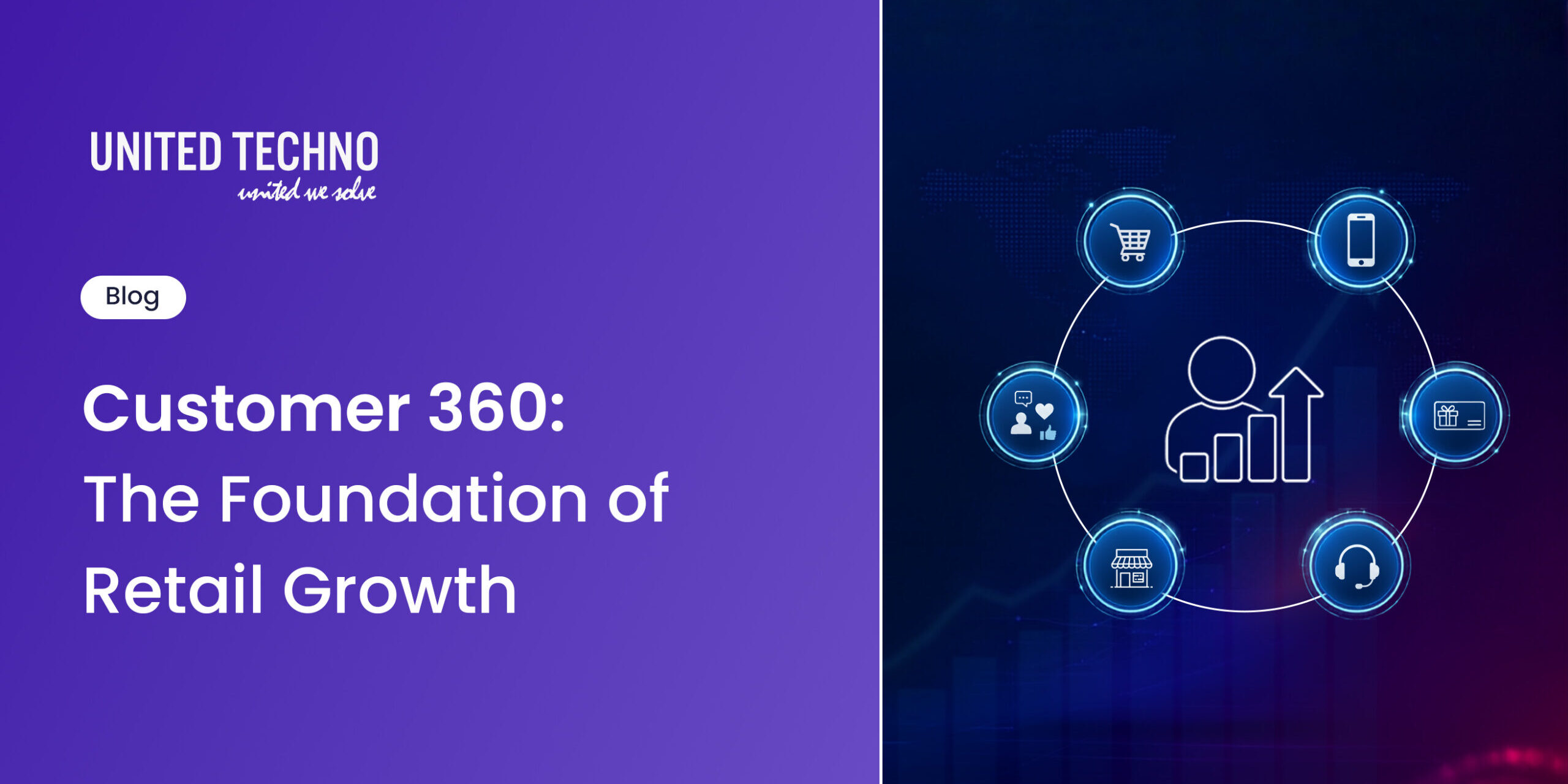
A Customer 360 framework typically brings together data from:
Point-of-Sale Systems
In-store purchase history and transaction behavior.
eCommerce Platforms
Online shopping activity and digital engagement.
CRM Systems
Customer relationships, communications, and preferences.
Loyalty Programs
Rewards participation, purchase frequency, and customer value.
Marketing Platforms
Campaign engagement and promotional response.
Customer Service Systems
Support interactions, complaints, and satisfaction history.
The objective is simple.
Create one trusted customer profile that reflects the complete relationship between the customer and the brand.
The Business Cost of Fragmented Customer Data
Many retailers underestimate how much disconnected customer information impacts business performance.
Inconsistent Customer Experiences
A customer who regularly shops online may receive promotions designed for first-time buyers.
A loyalty member may not be recognized across channels.
Service representatives may lack visibility into previous interactions.
These inconsistencies create friction and reduce trust.
Ineffective Personalization
Personalization depends on understanding customer behavior.
When customer data is fragmented, recommendations become less relevant and less effective.
Retailers often invest heavily in personalization tools while overlooking the quality of the customer data driving them.
Lost Revenue Opportunities
Disconnected data limits the ability to identify:
- Cross-sell opportunities
- Upsell opportunities
- Customer lifetime value
- Churn risks
- High-value customer segments
Without a complete customer view, revenue opportunities remain hidden.
Inefficient Marketing Spend
Marketing teams frequently target customers using incomplete information.
This results in:
- Lower campaign effectiveness
- Higher acquisition costs
- Reduced engagement
- Poor return on marketing investment
A unified customer view improves targeting accuracy and campaign performance.
Why Customer 360 Has Become a Strategic Priority
Customer expectations continue to evolve.
Customers increasingly expect:
- Personalized recommendations
- Consistent experiences
- Faster service
- Relevant promotions
- Seamless channel transitions
Meeting these expectations requires more than customer data collection.
It requires customer data unification.
Leading retailers recognize that Customer 360 is no longer a marketing initiative.
It is an enterprise capability that supports growth, retention, operational efficiency, and AI-driven decision-making.
The Five Pillars of a Successful Customer 360 Strategy
Organizations that succeed with Customer 360 typically focus on five foundational areas.
1. Data Integration
Customer information must be connected across systems.
This includes:
- POS
- CRM
- eCommerce
- Loyalty
- Marketing platforms
- Customer service applications
Without integration, Customer 360 cannot exist.
2. Identity Resolution
Customers often appear differently across systems.
A single individual may have:
- Multiple email addresses
- Multiple accounts
- Different shopping channels
- Separate loyalty records
Identity resolution helps retailers accurately connect these interactions into a unified profile.
3. Data Quality and Governance
Customer trust depends on data accuracy.
Organizations must establish:
- Data ownership
- Quality controls
- Security policies
- Privacy compliance standards
Trusted customer data produces trusted business decisions.
4. Real-Time Customer Visibility
Customer behavior changes quickly.
Retailers need the ability to understand customer activity as it occurs.
Real-time visibility enables:
- Timely promotions
- Better service interactions
- Faster decision-making
- Improved customer engagement
5. Actionable Insights
Customer 360 should not become another reporting project.
The objective is to generate insights that drive action.
Examples include:
- Next-best-offer recommendations
- Customer retention strategies
- Loyalty optimization
- Customer segmentation
- Personalized experiences
Insights create value only when they influence business outcomes.
Customer 360 and Retail AI
Many retailers are exploring AI-driven customer engagement initiatives.
These include:
- Product recommendations
- Predictive customer analytics
- Personalized promotions
- Customer service automation
- Loyalty optimization
However, AI depends on trusted customer data.
If customer profiles are fragmented, AI recommendations become less effective.
Customer 360 provides the foundation required for scalable AI initiatives.
Organizations that establish a unified customer view are significantly better positioned to leverage AI for growth.
Measuring Customer 360 Success
Retail leaders should evaluate Customer 360 initiatives using business outcomes rather than technology metrics.
Key indicators include:
Customer Metrics
- Customer Lifetime Value
- Repeat Purchase Rate
- Customer Retention
- Loyalty Participation
Marketing Metrics
- Campaign Conversion Rate
- Return on Marketing Investment
- Customer Acquisition Cost
Experience Metrics
- Customer Satisfaction
- Net Promoter Score
- Service Resolution Time
Revenue Metrics
- Average Order Value
- Cross-Sell Revenue
- Upsell Revenue
Successful Customer 360 programs improve performance across all four areas.
What a Customer-Centric Retail Organization Looks Like
Retailers that successfully implement Customer 360 operate differently.
They no longer view customer information as isolated records stored in separate systems.
Instead, they view customer data as a strategic business asset.
In these organizations:
- Customer interactions are connected across channels.
- Business teams work from a shared customer view.
- Personalization becomes more effective.
- Marketing becomes more efficient.
- Customer service becomes more responsive.
- AI initiatives become more successful.
Most importantly, customer relationships become stronger.
The Future of Retail Growth Starts with Customer Understanding
The retail industry has invested heavily in collecting customer data.
The next competitive advantage will come from connecting it.
The retailers that outperform their competitors will not necessarily be those with the most customer information.
They will be the retailers that understand their customers best.
Customer 360 provides the foundation for that understanding.
It transforms fragmented interactions into meaningful insights, enabling retailers to deliver better experiences, strengthen loyalty, increase revenue, and build long-term customer relationships.
For organizations focused on sustainable growth, Customer 360 is no longer optional.
It has become a foundational capability for modern retail success.
Ready to Transform Your Retail Business?
Meet United Techno — Your One Integration Partner with Endless Possibilities.
Streamline your retail operations with seamless integrations across Boomi, MuleSoft, Workato, Celigo, and advanced cloud & data integration services — all working together to power your growth.