Why the Wrong Pipeline Architecture Can Cost More Than the Wrong Cloud Platform
Your Data Platform Isn’t Slow.
Your Integration Strategy Might Be.
Organizations spend millions modernizing to Snowflake, Databricks, Microsoft Fabric, and cloud data warehouses. Yet many still experience delayed dashboards, rising compute costs, and engineering bottlenecks.
The root cause is often overlooked.
It’s not the platform.
It’s whether the organization has chosen the right data integration architecture.
For today’s enterprise, ETL vs ELT Pipelines are no longer just a technical debate—they determine scalability, governance, operational efficiency, and long-term business agility.
Executive Takeaway: Selecting the right ETL vs ELT Pipelines strategy can reduce engineering complexity, improve analytics delivery, and accelerate AI initiatives.
Book a Data Integration Strategy Assessment
Data Integration Is the Foundation of Every Analytics Initiative
Enterprise Applications
ERP │ CRM │ POS │ EDI │ APIs │ IoT
│
▼
ETL or ELT Decision
│
▼
Cloud Data Platform
│
▼
Business Intelligence
│
▼
Advanced Analytics
│
▼
Enterprise AI
One architectural decision influences every downstream analytics capability.
The Enterprise Shift Is Already Underway
Enterprise data ecosystems have evolved dramatically over the last decade.
Instead of processing structured ERP data alone, organizations now manage streaming events, SaaS applications, IoT devices, partner ecosystems, and AI workloads.
This shift has fundamentally changed how data should move across the enterprise.
Industry Trends
| Enterprise Trend | Industry Observation |
| Enterprise data growth | 30–40% annually across many organizations (IDC) |
| Data preparation effort | Up to 80% of analytics effort is still spent on preparing and validating data (IBM/industry benchmark) |
| Cloud data platform adoption | Rapid growth in Snowflake, Databricks, Microsoft Fabric, and cloud-native analytics platforms (Gartner/IDC) |
| AI initiatives | Organizations increasingly require governed, scalable, and near real-time data pipelines to support AI workloads |
Key Insight
The ETL versus ELT discussion has shifted from a development decision to a business strategy decision.
Executive Dashboard
Where Organizations Lose Time
Analytics Project Timeline
Business Questions
████
Dashboard Development
██████
Visualization
███
Pipeline Engineering
██████████████████
Data Validation
██████████████
Decision Making
██
The largest portion of most analytics initiatives is still consumed by data movement and preparation, not reporting.
ETL vs ELT: The Business Perspective
Forget technical definitions.
The better question is:
Which architecture best supports your business objectives?
Traditional ETL
Applications
│
▼
Transform
│
▼
Load
│
▼
Warehouse
Typically Preferred When
- Strict regulatory controls require transformation before storage
- Legacy on-premises environments dominate
- Data volumes remain predictable
- Transformation logic changes infrequently
Modern ELT
Applications
│
▼
Load
│
▼
Cloud Platform
│
▼
Transform
│
▼
Analytics
Typically Preferred When
- Cloud-native analytics platforms are in place
- Data volumes scale rapidly
- AI and machine learning workloads are expanding
- Business users require faster access to raw and curated data
- Elastic compute resources are available
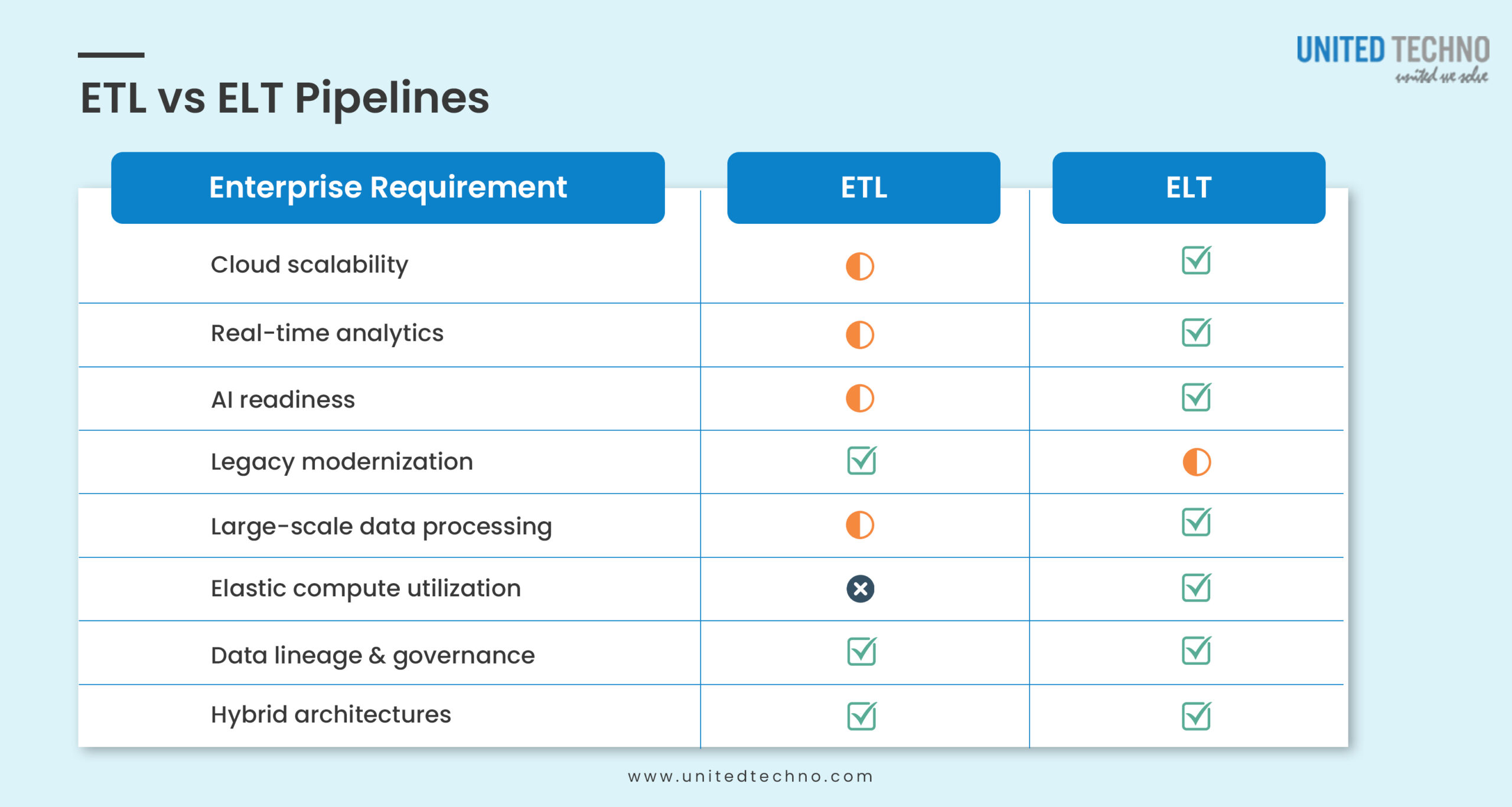
Comparison Dashboard
| Enterprise Requirement | ETL | ELT |
| Cloud scalability | ◐ | ✅ |
| Real-time analytics | ◐ | ✅ |
| AI readiness | ◐ | ✅ |
| Legacy modernization | ✅ | ◐ |
| Large-scale data processing | ◐ | ✅ |
| Elastic compute utilization | ❌ | ✅ |
| Data lineage & governance | ✅ | ✅ |
| Hybrid architectures | ✅ | ✅ |
Bottom Line: For many enterprises, the answer is not ETL or ELT. It is a hybrid strategy aligned to workload characteristics.
Architecture Decision Matrix
Data Volume
HIGH
▲
│
ELT │ ELT
│
─────|──────────────────► Complexity
ETL │ Hybrid
│
LOW
Practical Guidance
- ETL remains effective for controlled operational workloads.
- ELT excels for cloud analytics and AI.
- Hybrid architectures are increasingly common in large enterprises with diverse data estates.
What High-Performing Enterprises Prioritize
Regardless of architecture, successful organizations focus on engineering capabilities rather than tooling alone.
Metadata-Driven Development
Reduce repetitive coding through standardized pipeline templates.
Incremental Processing
Process only changed records to optimize performance and cloud spend.
Automated Data Quality
Embed validation, schema checks, and business rules into every pipeline.
Pipeline Observability
Monitor execution, lineage, SLAs, and downstream business impact.
Cloud-Native Orchestration
Design pipelines that scale independently of storage and compute.
Analytics KPI Dashboard
| KPI | Enterprise Benchmark |
| Pipeline Success Rate | >99.5% |
| Automated Data Quality Checks | >95% of pipelines |
| New Source Onboarding | <3 days |
| Pipeline Monitoring Coverage | 100% |
| Metadata-Driven Automation | >80% of new integrations |
| Data Lineage Visibility | End-to-end |
These metrics provide a more meaningful measure of integration maturity than simply counting the number of pipelines deployed.
Where United Techno Creates Value
Many organizations already have modern cloud platforms.
What they often lack is a standardized integration engineering methodology for ETL vs ELT Pipelines.
United Techno addresses this through DataAccel, a metadata-driven engineering framework that accelerates both ETL modernization and cloud-native ELT implementations.
Instead of creating pipelines independently for every project, DataAccel standardizes ingestion, transformation, validation, orchestration, and monitoring across enterprise environments.
This enables organizations to modernize legacy ETL processes, optimize ETL vs ELT Pipelines, and build scalable ELT architectures for advanced analytics and AI.
DataAccel Engineering Flow
Enterprise Sources
│
▼
Metadata Configuration
│
▼
Automated Pipeline Generation
│
▼
Validation & Quality
│
▼
Incremental Processing
│
▼
Monitoring & Lineage
│
▼
Snowflake │ Databricks │ Microsoft Fabric
│
▼
Analytics & AI
Representative Outcomes
Organizations adopting standardized, metadata-driven integration engineering commonly achieve:
| Business Outcome | Typical Result |
| Source onboarding | Days instead of weeks |
| Engineering productivity | Higher through reusable templates |
| Pipeline consistency | Improved governance and operational standards |
| Issue resolution | Faster through centralized monitoring and lineage |
| Analytics delivery | More reliable and scalable data pipelines |
Representative outcomes from United Techno projects leveraging DataAccel include:
- 150+ enterprise tables orchestrated
- 10+ heterogeneous enterprise systems integrated
- 80+ incremental pipelines deployed
- 70+ historical load pipelines automated
- Production-ready delivery in approximately 45 days for suitable modernization initiatives
Executive Decision Checklist
Before choosing ETL, ELT, or a hybrid approach, ask:
- Will data volumes increase significantly over the next three years?
- Does the business require near real-time analytics?
- Are AI and machine learning initiatives part of the roadmap?
- Can current pipelines scale without major redesign?
- Is cloud compute being fully utilized?
- Are governance, lineage, and observability built into every pipeline?
- Can new data sources be onboarded in days instead of weeks?
If several answers are “no,” the challenge is likely architectural rather than technological.
Final Perspective
The ETL vs ELT Pipelines conversation has evolved.
The question is no longer which approach is better.
The question is which ETL vs ELT Pipelines strategy best aligns with your enterprise architecture, analytics goals, and future AI ambitions.
Organizations that adopt the right mix of ETL, ELT, automation, and governance build data platforms that are resilient, scalable, and ready for continuous innovation.
The organizations that view ETL vs ELT Pipelines as competing technologies risk optimizing for today’s workloads while limiting tomorrow’s opportunities.
Ready to Build the Right Data Integration Strategy?
Whether you’re modernizing legacy ETL workflows, implementing cloud-native ELT pipelines, or designing a hybrid integration architecture, United Techno helps enterprises build scalable, governed, and future-ready data platforms.
Request a Complimentary ETL/ELT Strategy Assessment →
Our integration specialists will evaluate your current architecture, identify modernization opportunities, and provide a practical roadmap aligned with your analytics, cloud, and AI objectives.