Why Successful Snowflake Programs Are Defined by Architecture – Not Just Technology
Snowflake Doesn’t Solve Data Problems.
It amplifies the quality of your ETL and ELT with Snowflake strategy.
Many organizations migrate to Snowflake expecting immediate improvements in analytics performance, scalability, and operational efficiency.
Most achieve those goals.
Some do not.
The difference is rarely the platform.
It is how enterprise data is engineered, governed, and operationalized through ETL and ELT with Snowflake once it reaches Snowflake.
The highest-performing organizations don’t simply migrate workloads to the cloud. They redesign how data flows across the enterprise, creating a foundation for trusted analytics, AI, and continuous innovation.
Executive Perspective: A successful Snowflake program begins with a scalable ETL and ELT with Snowflake operating model, not with pipeline development.
The Enterprise Data Journey
Business Applications
ERP │ CRM │ E-Commerce │ APIs │ EDI │ IoT
│
▼
Metadata-Driven Data Pipelines
│
▼
Data Quality & Governance
│
▼
Snowflake
│
▼
Curated Data Products
│
▼
BI │ AI │ Advanced Analytics
The objective is not simply loading data into Snowflake. It is enabling faster, trusted business decisions.
Why Snowflake Initiatives Lose Momentum
Organizations often encounter similar challenges as adoption expands.
| Business Challenge | Enterprise Impact |
| Multiple ingestion patterns | Higher engineering effort |
| Inconsistent transformation logic | Conflicting business metrics |
| Limited data quality controls | Reduced trust in analytics |
| Poor workload optimization | Higher cloud consumption |
| Minimal operational visibility | Longer issue resolution cycles |
These are not platform limitations.
They are architecture decisions.
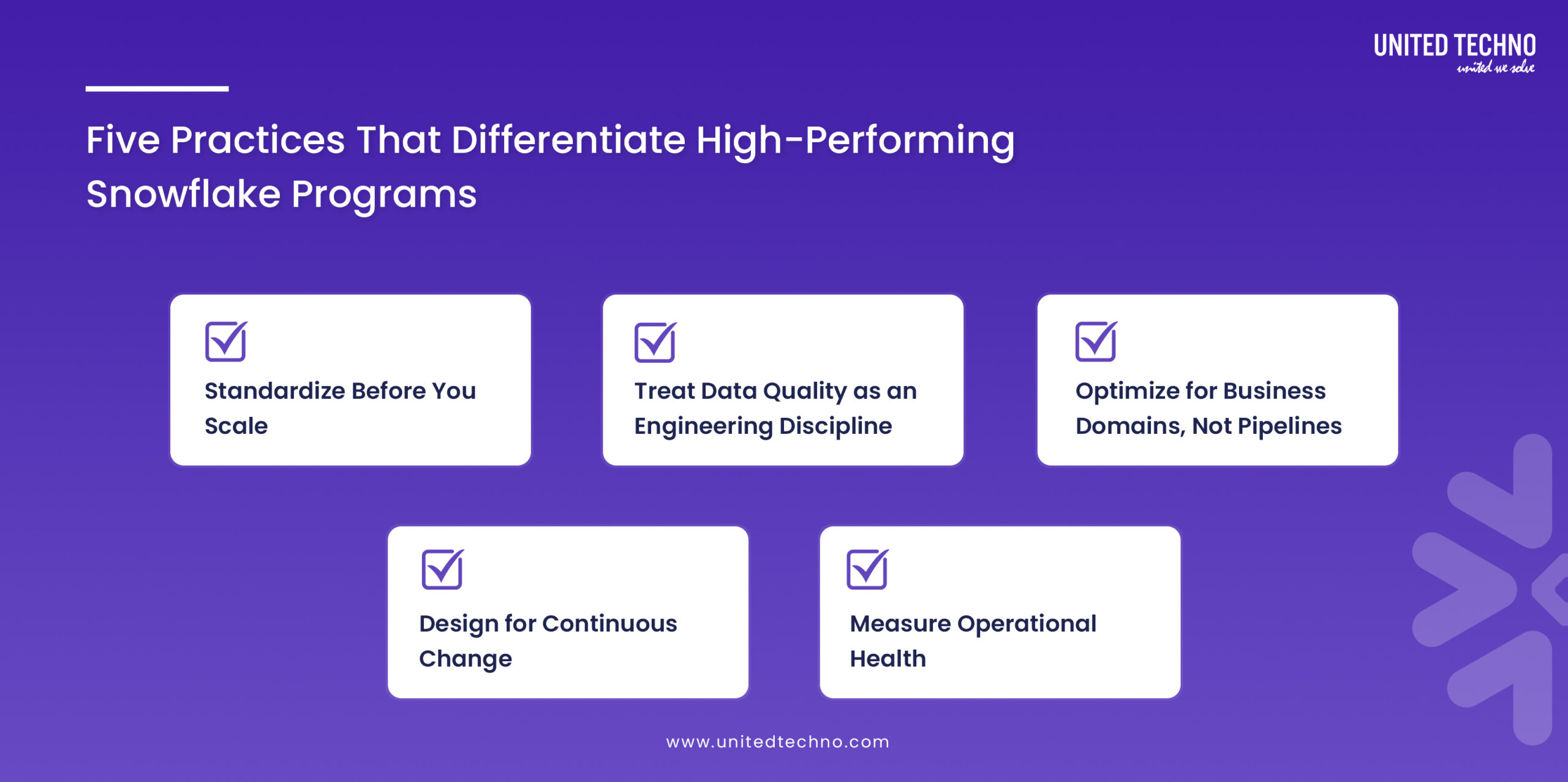
Five Practices That Differentiate High-Performing Snowflake Programs
1. Standardize Before You Scale
Avoid building pipelines independently for every business unit.
Reusable engineering patterns improve consistency, governance, and long-term maintainability.
2. Treat Data Quality as an Engineering Discipline
Validation should occur throughout the data lifecycle,not after reports fail.
Schema validation, business rules, lineage, and metadata management should be embedded into every pipeline.
3. Optimize for Business Domains, Not Pipelines
Successful organizations organize data around business capabilities such as Customer, Orders, Inventory, Finance, and Supply Chain rather than individual integrations.
This improves reuse and accelerates analytics delivery.
4. Design for Continuous Change
Enterprise ecosystems evolve continuously.
Modern architectures accommodate new applications, acquisitions, and cloud services without extensive redesign.
5. Measure Operational Health
Technology success should be evaluated through business-focused operational metrics.
| Executive KPI | Why It Matters |
|---|---|
| Data Freshness SLA | Timely business decisions |
| Data Quality Compliance | Trusted reporting |
| Pipeline Observability | Faster issue resolution |
| Source Onboarding Time | Delivery agility |
| Reusable Engineering Assets | Reduced implementation effort |
A Consulting Perspective
Organizations frequently ask:
“Which ETL or ELT tool works best with Snowflake?”
A more valuable question is:
“What operating model allows Snowflake to support our business over the next five years?”
The answer depends on business priorities, governance requirements, data volumes, cloud strategy, and engineering maturity, not on selecting a single integration technology.
How United Techno Approaches Snowflake Modernization
At United Techno, Snowflake modernization begins with architecture—not implementation. Our advisory engagements assess:
- Enterprise data flows
- Integration patterns
- Governance maturity
- Operational bottlenecks
- Analytics priorities
- AI readiness
Once the target operating model is defined, we apply our DataAccel framework to standardize metadata-driven pipeline engineering, automate ingestion patterns, embed data quality controls, and improve operational visibility across the data lifecycle.
Current Landscape
│
▼
Architecture Assessment
│
▼
DataAccel Framework
│
▼
Standardized ELT Engineering
│
▼
Snowflake Data Platform
│
▼
Trusted Analytics & AI
Rather than creating isolated pipelines, the focus is on building a scalable engineering foundation that supports continuous business growth.
Final Perspective
Snowflake is one of the most capable cloud data platforms available today.
Its long-term value, however, depends less on the technology itself and more on the engineering practices that support ETL and ELT with Snowflake.
Organizations that standardize data integration, establish governance early, and adopt repeatable engineering patterns for ETL and ELT with Snowflake are better positioned to deliver trusted analytics, reduce operational complexity, and scale AI initiatives with confidence.
The question is no longer whether to modernize with Snowflake.
It is whether your data engineering strategy is ready to unlock its full potential.
Ready to Maximize Your Snowflake Investment?
Whether you’re planning a migration, modernizing existing ETL processes, or scaling enterprise analytics, United Techno helps organizations design ETL and ELT with Snowflake architectures that are resilient, governed, and built for long-term growth.
Schedule a Snowflake Data Architecture Assessment →
We’ll evaluate your current integration landscape, identify scalability opportunities, and develop a practical roadmap for building a high-performance Snowflake data platform.