Building Production-Ready Data Pipelines Is Less About the Tool—and More About the Data Engineering Strategy
Databricks Is Only One Part of the Data Engineering Equation
Databricks has become a strategic platform for organizations building modern analytics, AI, and large-scale data engineering capabilities. Yet many enterprises discover that implementing Databricks is only the beginning.
The real challenge lies in designing production-ready pipelines that remain scalable, governed, observable, and cost-efficient as business applications, data volumes, and analytics demands continue to grow using the right ETL and ELT Tools with Databricks.
The question enterprise leaders should be asking is no longer:
“Which ETL tool works with Databricks?”
It is:
“What data engineering strategy and ETL and ELT Tools with Databricks will help us build production-ready pipelines that support our business for years to come?”
That distinction is where successful modernization begins.
Executive Perspective
Organizations realize the greatest value from Databricks when they standardize data engineering practices—not when they standardize on a single platform. Choosing the right ETL and ELT Tools with Databricks is part of a broader strategy that supports scalable, governed, and long-term data engineering success.
Why Production Pipelines Become Complex
Enterprise data rarely originates from a single source. It flows continuously from ERP systems, CRM platforms, eCommerce applications, partner networks, APIs, IoT devices, SaaS applications, and streaming services.
As organizations modernize, production pipelines become increasingly difficult to manage without a standardized engineering approach.
Common challenges include:
- Multiple ingestion frameworks across business units
- Inconsistent transformation logic and duplicated engineering effort
- Limited data quality validation across pipelines
- Minimal operational visibility into pipeline health
- Rising cloud processing costs
- Longer onboarding cycles for new data sources
- Governance and compliance gaps
These challenges are rarely technology issues.
More often, they are symptoms of fragmented data engineering practices.
What Successful Databricks Implementations Do Differently
High-performing organizations treat data engineering as an enterprise capability rather than a collection of individual integration projects.
They establish standardized engineering practices that improve consistency, simplify operations, and support long-term scalability when implementing ETL and ELT Tools with Databricks.
Their production environments are built around five principles:
- Standardized pipeline engineering using reusable design patterns instead of one-off implementations.
- Metadata-driven development that accelerates onboarding while reducing manual effort.
- Embedded data quality with validation, lineage, and business rules integrated throughout the pipeline lifecycle.
- Operational observability that continuously monitors pipeline health, SLA compliance, workload performance, and failures.
- Business-aligned data products organized around domains such as Customer, Finance, Supply Chain, Inventory, and Sales instead of isolated technical integrations.
These practices enable organizations to scale analytics initiatives without continuously increasing engineering complexity.
Choosing the Right ETL & ELT Approach for Databricks
There is no universal ETL or ELT platform that fits every Databricks implementation. Selecting the right ETL and ELT Tools with Databricks depends on your architecture, business goals, and operational requirements.
Production environments often combine multiple technologies, each serving a different purpose within the architecture.
Enterprise integration platforms help connect complex operational systems and hybrid environments. Cloud-native ELT solutions accelerate SaaS connectivity and modern analytics. Workflow orchestration platforms automate scheduling, monitoring, and dependency management, while Databricks provides the foundation for large-scale transformations, advanced analytics, and AI workloads.
The objective is not to standardize on one product.
It is to build an architecture where every component—including the appropriate ETL and ELT tools with databricks—contributes to a resilient, scalable, and governed data platform.
A Consulting Perspective
One of the most common questions organizations ask during modernization initiatives is: “Which ETL tool integrates best with Databricks?”
A more valuable question is:
“What operating model will allow Databricks to support our business over the next five years?”
The answer depends on business priorities, integration complexity, governance requirements, engineering maturity, and long-term cloud strategy—not on selecting a single integration technology.
Organizations that approach modernization from this perspective are typically better positioned to support analytics, regulatory reporting, AI initiatives, and future business growth.
How United Techno Helps Organizations Build Production-Ready Data Pipelines
At United Techno, production pipeline engineering begins with understanding the business, not simply implementing technology.
Our advisory-led engagements evaluate enterprise data architecture, integration patterns, governance maturity, operational bottlenecks, and analytics priorities before defining a scalable modernization roadmap.
To accelerate delivery, we apply our DataAccel Framework, a metadata-driven engineering methodology that standardizes ingestion, transformation, validation, orchestration, monitoring, and governance across enterprise data platforms.
Rather than building isolated pipelines, the focus is on creating a repeatable engineering model that enables organizations to onboard new data sources faster, improve operational visibility, strengthen governance, and scale analytics with confidence using the right ETL and ELT tools with databricks.
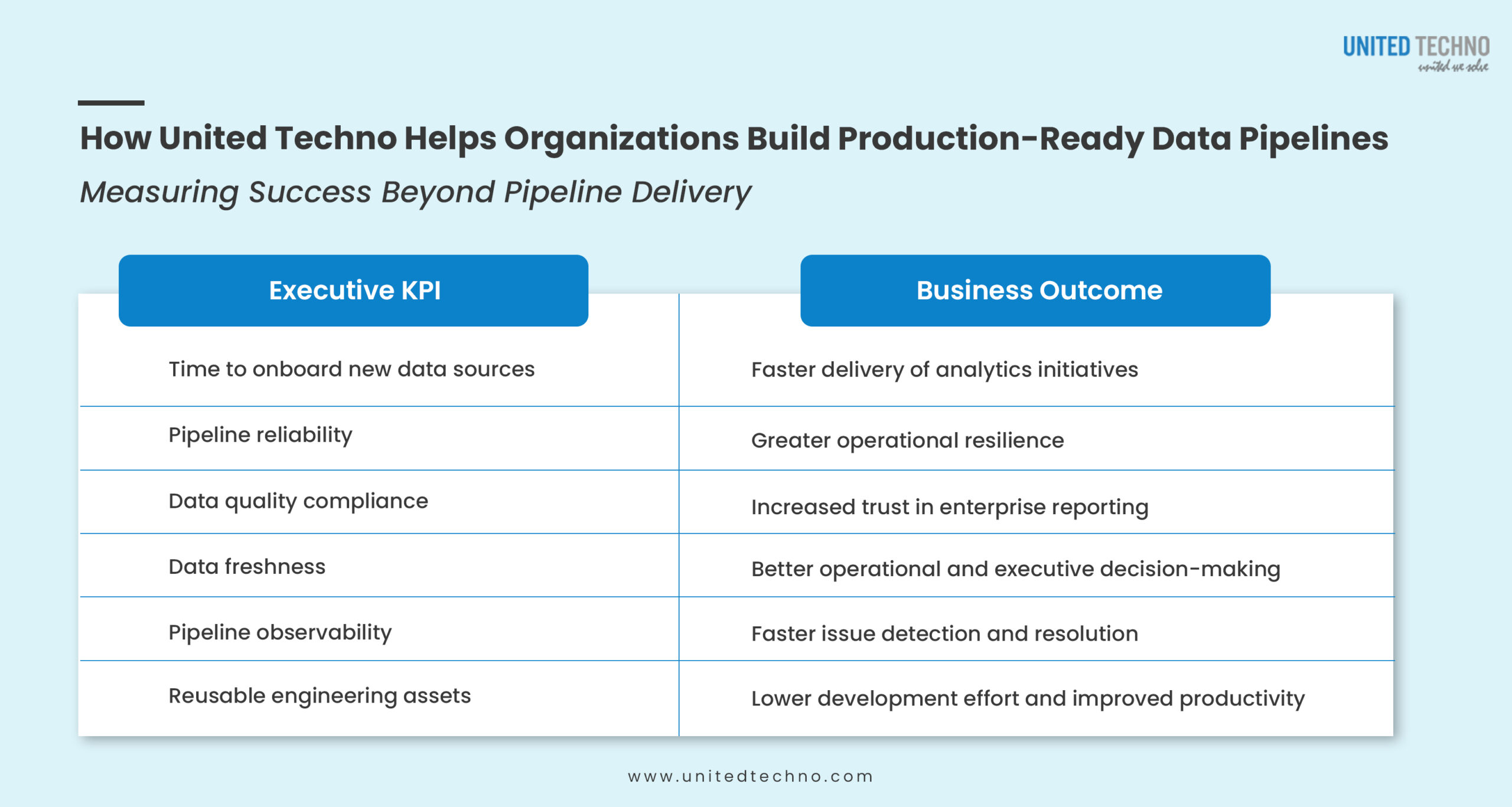
Measuring Success Beyond Pipeline Delivery
Production-ready data engineering should be measured by business outcomes rather than the number of pipelines deployed.
Leading organizations typically focus on metrics such as:
| Executive KPI | Business Outcome |
| Time to onboard new data sources | Faster delivery of analytics initiatives |
| Pipeline reliability | Greater operational resilience |
| Data quality compliance | Increased trust in enterprise reporting |
| Data freshness | Better operational and executive decision-making |
| Pipeline observability | Faster issue detection and resolution |
| Reusable engineering assets | Lower development effort and improved productivity |
These metrics provide a clearer picture of how effectively a data platform supports enterprise growth.
Final Perspective
Databricks has become one of the most powerful platforms for enterprise analytics, data engineering, and AI.
Its long-term success, however, depends less on the ETL or ELT tool an organization selects and more on the engineering discipline behind every production pipeline.
Organizations that standardize architecture, automate engineering practices, embed governance, and continuously improve operational visibility are far better positioned to scale analytics, accelerate AI adoption, and respond to changing business demands.
Technology enables transformation.
A well-defined data engineering strategy ensures that transformation delivers measurable business value.
Ready to Build Production-Ready Databricks Pipelines?
Whether you’re modernizing legacy ETL environments, adopting cloud-native ELT architectures, or scaling enterprise data engineering on Databricks, United Techno helps organizations design data platforms that are resilient, governed, and built for long-term growth.
Using our DataAccel Framework, we help enterprises simplify pipeline engineering, improve operational performance, strengthen governance, and accelerate analytics outcomes.
Schedule a Complimentary Databricks Data Engineering Assessment →
Discover how your current data engineering landscape compares against production-ready best practices, and build a practical roadmap for scalable, enterprise-grade analytics and AI.