AI Is Changing the Role of ERP
ERP has traditionally been the place where business transactions become official.
A customer order is recorded. Inventory is committed. An invoice is posted. A payment is reconciled. Financial results are consolidated.
That role is not going away.
What is changing is the amount of work happening around those transactions.
A buyer may no longer need to search through several systems to understand a supplier problem. A finance analyst may not need to manually review hundreds of transactions to identify a small group of exceptions. A planner may not need to pull information from multiple applications before deciding how to respond to a demand change.
AI in ERP can help bring that information together, interpret it, and support the next business decision.
This changes the way ERP architecture needs to be considered.
Gartner’s 2026 research recommends augmenting ERP with AI rather than attempting to replace the ERP itself. Its research also points to AI-driven changes in how ERP processes are executed and how users interact with enterprise applications.
The practical question for enterprises is therefore not simply whether an ERP platform has AI features.
It is:
How should AI, ERP, data and integration work together when a business decision needs to be made?
ERP Is Only One Part of the Decision
Most enterprise decisions already cross application boundaries.
Consider a manufacturer dealing with a sudden drop in demand from a major customer.
The information may be spread across:
- CRM
- ERP
- Demand planning
- Inventory
- Procurement
- Manufacturing
- Finance
- Logistics
No single application contains the complete picture.
An AI-enabled architecture can bring those signals together and help the business understand the consequences before someone starts changing individual transactions.
For example:
Customer demand changes → inventory exposure is assessed → supplier commitments are reviewed → production plans are evaluated → financial impact is estimated → action is proposed
The value comes from connecting the pieces.
This is why AI in ERP is becoming as much a data and integration problem as an AI problem.
A capable model working with fragmented enterprise information will still produce limited business value.
Five Changes Enterprises Need to Think About
1. ERP Data Needs Business Context
ERP contains enormous amounts of structured information.
But individual records rarely tell the whole story.
A customer may have declining orders while also carrying overdue invoices and several open service issues. A supplier may appear reliable based on historical delivery performance while its current lead times are increasing sharply.
The useful insight comes from seeing those relationships together.
That means AI initiatives need access to more than ERP tables.
They need:
- Business definitions
- Relationships between entities
- Historical information
- Operational events
- Policies and thresholds
- Process status
- Relevant external information
This is one reason data architecture matters so much to ERP AI.
The model is only as useful as the business context surrounding it.
2. ERP Interaction Is Moving Beyond Screens
ERP users have traditionally learned where to find information.
They know which report to open, which transaction to run and which dashboard to check.
AI changes that interaction.
A finance manager could ask:
Which business units are showing unusual working-capital pressure this quarter?
Answering that properly requires more than generating a sentence.
The system needs to understand what “working-capital pressure” means for that organization, retrieve the correct data, apply the appropriate calculations and respect the user’s access rights.
The interface may become conversational.
The underlying architecture becomes more demanding.
It needs governed data, business semantics, application APIs, security controls and reliable calculation logic working together.
3. Automation Is Moving Across Applications
Traditional automation usually follows a defined path inside or between systems.
AI introduces more flexibility.
Suppose a supplier announces a significant delivery delay.
The response may involve procurement, inventory, production, customer commitments and transportation.
Instead of asking a person to investigate each system separately, an AI-enabled workflow could gather the relevant information and prepare the next steps.
That does not mean the agent should automatically change every affected transaction.
It means the enterprise can move from manually coordinating the investigation to coordinating the business process through software.
Forrester’s September 2026 research describes this broader shift as AI agents coordinating work across applications. It also notes that ERP, supply chain and HCM processes face stronger requirements around compliance, auditability and accountability before autonomous execution can be trusted.
That distinction matters.
The opportunity is not simply to put an agent inside every application.
It is to improve the way work moves across applications.
4. Integration Becomes Part of the AI Strategy
Integration has traditionally focused on moving data.
AI increases the importance of what happens after that data arrives.
Consider:
Customer signal → analysis → pricing context → approval → customer response
Or:
Inventory shortage → supply analysis → supplier options → procurement workflow → ERP update
The integration layer becomes part of the decision and execution path.
That puts greater importance on:
- APIs
- Event-driven architecture
- Workflow orchestration
- Identity and access management
- Transaction controls
- Data quality
- Observability
- Error handling
An AI initiative built on weak integration foundations will eventually run into the same fragmentation that affected the original business process.
5. Automation Needs Accountability
This is one of the areas that deserves more attention as enterprises move toward AI agents.
A conventional workflow is relatively easy to trace.
An administrator can usually identify the rule that ran, the system that triggered it and the transaction that resulted.
AI in ERP introduces more questions.
- Why did the system recommend that action?
- What information did it use?
- Which enterprise systems did it access?
- Which policies were applied?
- Did a person approve the action?
- What happened after the action was executed?
These questions become particularly important when AI is allowed to change business data.
For low-risk activities, an audit trail may be straightforward.
For financial postings, procurement decisions, inventory commitments or other controlled transactions, the organization needs much stronger visibility.
AI execution needs to be traceable, reviewable and accountable.
Where AI and ERP Should Have Different Responsibilities
AI in ERP are good at different things.
AI is well suited to working with ambiguity, patterns, large volumes of information and situations where the answer is not explicitly encoded in a rule.
ERP is designed to enforce business transactions and maintain authoritative records.
That creates a practical division of responsibility.
| AI can help with | ERP and enterprise systems should continue to control |
| Interpreting business signals | Authoritative transaction records |
| Finding patterns | Financial postings |
| Identifying unusual situations | Accounting rules |
| Comparing possible actions | Approval policies |
| Preparing recommendations | Transaction validation |
| Coordinating workflow steps | Controlled state changes |
| Summarizing business context | Audit records |
For example, AI might identify that a purchase appears unusual based on historical patterns.
The ERP should still apply the organization’s actual approval rules.
AI might identify a potential cash-flow problem.
The financial system should remain the source of truth for the underlying financial position.
AI might recommend a supplier change.
The procurement workflow should determine whether that change can actually be made.
This division gives enterprises room to use AI aggressively without turning every business transaction into a probabilistic decision.
A Practical AI-to-ERP Architecture
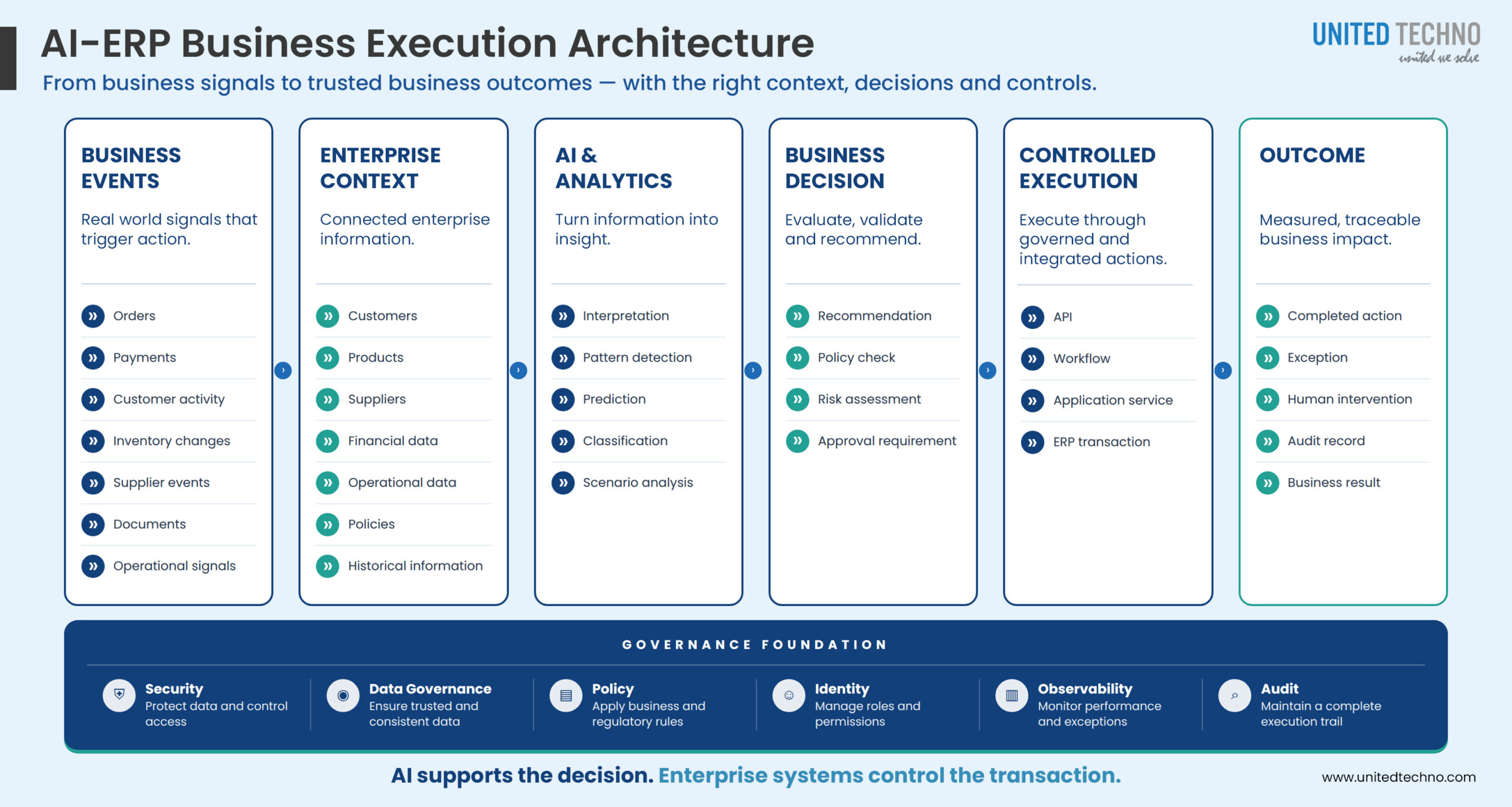 A useful enterprise design starts with the business event and follows it through to the final outcome.
Not Every ERP Process Needs to Become Autonomous
There is considerable momentum behind agentic ERP.
Gartner’s 2026 research describes the evolution of ERP toward more intelligent and autonomous operating models, while its research on ERP replacement cautions against treating AI as a wholesale substitute for the ERP itself.
The more useful question is whether a particular process is ready for greater autonomy.
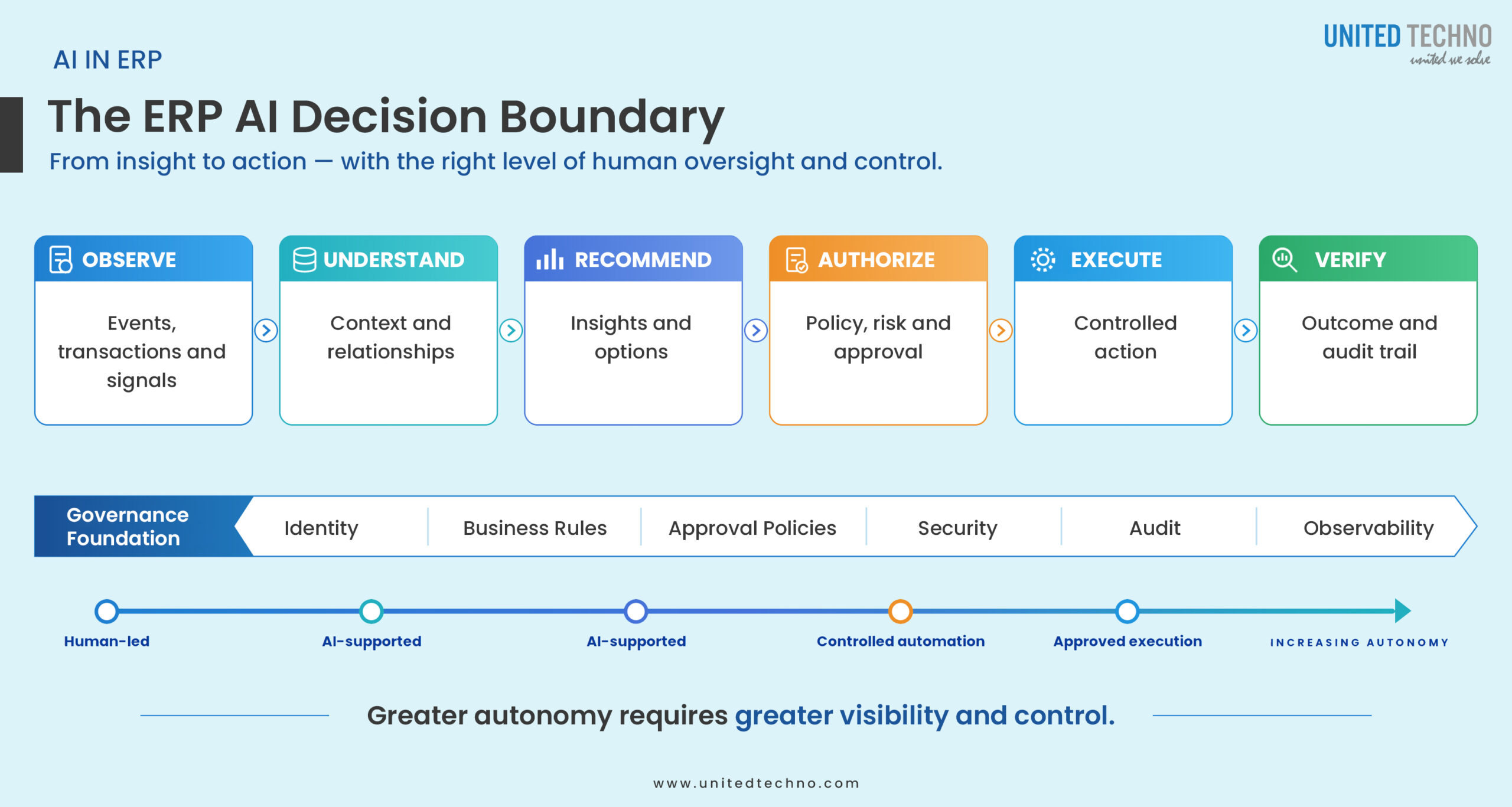
Before allowing an AI capability to execute a business action, enterprises should consider five practical questions:
Is the decision well defined?
If experienced employees regularly disagree about what the correct action should be, the process may not be ready for full automation.
Is the required information available?
An agent cannot compensate for missing or unreliable business data.
Are the rules clear?
Financial, regulatory and contractual requirements should not be left to interpretation when they can be enforced through deterministic logic.
Can the action be reversed?
Some decisions are easy to correct. Others can create financial, operational or customer consequences that are difficult to unwind.
Can the organization explain what happened?
If the answer is no, the process probably needs stronger controls before autonomy increases.
This is where enterprise architecture matters more than the model itself.
Measure the Business Process, Not the AI
The number of deployed agents is not a business outcome.
Neither is the number of prompts processed.
For ERP, the better measures are tied directly to the process being changed.
| Business Area | Example Measure |
| Order management | Order decision cycle time |
| Procurement | Requisition-to-approval time |
| Finance | Exception resolution time |
| Supply chain | Planning response time |
| Customer operations | Resolution cycle time |
| Inventory | Time to respond to critical exceptions |
| Shared services | Human touch rate |
| Agentic workflows | Successful end-to-end completion |
| Governance | Override and policy-exception rate |
One measure is particularly useful across different ERP processes:
Decision Latency
How long does it take to move from a meaningful business event to an approved action?
If AI reduces the time required to understand a situation and prepare the right response, the benefit can be measured directly.
That is much more useful than reporting how many AI features were switched on.
A United Techno Approach to ERP AI
For enterprise organizations, AI adoption should begin with the process rather than the technology.
01 – Identify the Business Decision
Find decisions that consume significant manual effort, involve multiple applications or regularly create delays.
02 – Map the Current Process
Document the people, systems, data, rules and approvals involved.
03 – Identify the Missing Context
Determine what information employees currently have to gather manually before making the decision.
04 – Define the AI Responsibility
Decide whether AI should interpret, analyze, recommend, coordinate or execute.
05 – Establish the Control Boundary
Define which actions require approval and which can safely be automated.
06 – Connect the Enterprise Systems
Use APIs, events, integration services and workflow orchestration to connect the relevant applications.
07 – Measure the Outcome
Track cycle time, exceptions, manual effort, accuracy, overrides and business impact.
08 – Expand Carefully
Once the architecture works for one process, extend the same principles to related processes.
This approach avoids a common enterprise mistake: starting with an AI capability and then searching for somewhere to use it.
The better starting point is a business problem that already matters.
The Future of ERP Is About How Work Moves
ERP will continue to provide the transaction foundation for the enterprise.
What changes is the layer around it.
Data platforms can bring together information that once sat in separate systems. Integration can connect applications around a common business process. AI can help interpret situations and prepare decisions. Workflow can control what happens next.
ERP can continue to maintain the official business transaction.
And governance can provide the accountability across the entire chain.
The result is a more connected operating model:
Business event → context → decision → action → outcome
That is a more useful way to think about AI in ERP than simply adding another assistant to an existing application.
The goal is not to make every ERP process autonomous.
The goal is to help the enterprise understand situations faster, make better-informed decisions and execute the right actions without losing control of the underlying business process.
Building the Next Layer of ERP Intelligence
For organizations evaluating AI across Oracle, SAP, Microsoft Dynamics, NetSuite or other ERP environments, the starting point should be the business process, not the AI feature list.
United Techno helps enterprises assess where AI can improve ERP-driven processes, build the supporting data and integration architecture, establish appropriate execution controls and connect AI initiatives to measurable business outcomes.
Ready to Identify the Right ERP AI Opportunities?
Start with the decisions that take too long, require too much manual coordination or depend on information scattered across multiple systems.
United Techno can help turn those processes into a practical, governed AI roadmap.