Your AI strategy is only as reliable as your data pipelines.
Most enterprises don’t struggle because they lack analytics tools. They struggle because their data arrives late, breaks frequently, and cannot be trusted.
Modern Enterprise ETL ELT Pipeline Engineering isn’t just about moving data anymore.
It’s about building resilient, observable, scalable data products that power analytics, AI, and real-time business operations.
Schedule Enterprise Data Pipeline Assessment
Visualization 1
Enterprise AI
▲
│
Predictive Analytics
▲
│
Business Intelligence
▲
│
Governed Data Warehouse
▲
│
Reliable ELT Pipelines
▲
│
Enterprise Applications
ERP | CRM | POS | APIs | IoT | EDI
Every successful AI initiative rests on one invisible layer – pipeline engineering.
The Reality Most Enterprises Don’t Talk About
Organizations continue investing millions in Snowflake, Databricks, Microsoft Fabric, Power BI, and AI platforms.
Yet many leadership teams still hear the same questions every Monday morning.
- Why is yesterday’s dashboard incomplete?
- Why did the pipeline fail overnight?
- Which version of customer data is correct?
- Why does every new source take weeks to onboard?
- Why do analytics teams spend more time fixing pipelines than building insights? The challenge is rarely the platform.
It’s the engineering discipline behind the pipelines.
The Hidden Cost of Poor Pipeline Engineering
| Business Issue | Operational Impact |
| Pipeline Failures | Delayed executive reporting |
| Manual Monitoring | Higher operational costs |
| Duplicate Data | Poor business decisions |
| Long Development Cycles | Slow product launches |
| Lack of Governance | Compliance risks |
| Pipeline Silos | Limited AI readiness |
Industry Snapshot
According to multiple industry studies from Gartner, IDC, and Monte Carlo, organizations investing in Enterprise ETL ELT Pipeline Engineering consistently identify the following challenges:
80% of analytics effort is still spent finding, cleaning, and validating data.
Poor Data Quality costs organizations millions annually through operational inefficiencies, decision delays, and lost productivity.
Data Volumes continue to grow 30–40% year over year across many large enterprises.
(Reference current Gartner, IDC, Monte Carlo, and IBM Cost of Poor Data Quality reports in the published version.)
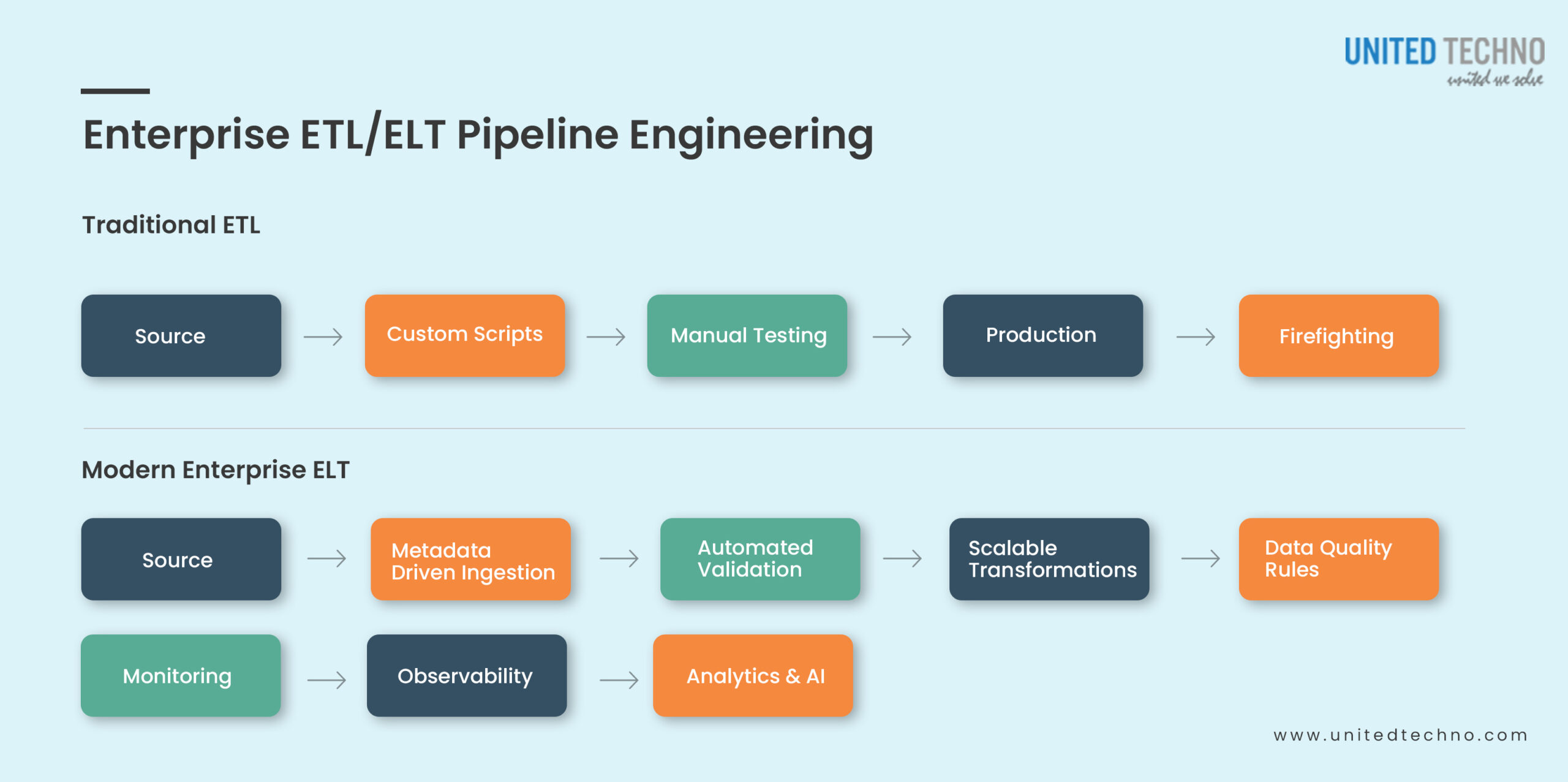
What Modern Pipeline Engineering Looks Like
Leading enterprises no longer build pipelines one integration at a time.
They engineer reusable data platforms.
Traditional ETL
Source
↓
Custom Scripts
↓
Manual Testing
↓
Production
↓
Firefighting
Modern Enterprise ELT
Sources
↓
Metadata Driven Ingestion
↓
Automated Validation
↓
Scalable Transformations
↓
Data Quality Rules
↓
Monitoring
↓
Observability
↓
Analytics & AI
The Five Characteristics of High-Performing Data Pipelines
1. Metadata-Driven Development
Instead of writing hundreds of custom pipelines, engineering teams automate pipeline creation through reusable metadata and templates.
Result:
✔ Faster onboarding
✔ Lower maintenance
✔ Standardized architecture
2. Built-In Data Quality
Data validation is integrated into every pipeline – not added after production issues appear. Examples
- Null checks
- Duplicate detection
- Schema validation
- Business rule enforcement
- Referential integrity
3. End-to-End Observability
Modern pipelines answer questions instantly.
- Which job failed?
- Why?
- Which downstream reports are affected?
- What’s the recovery time?
4. Incremental Processing
Rather than processing entire datasets repeatedly, modern ELT frameworks move only changed records.
Benefits include
- Lower cloud costs
- Faster execution
- Reduced compute consumption
5. Cloud-Native Scalability
Modern engineering separates storage from compute, enabling elastic scaling without redesigning pipelines.
Enterprise Pipeline Maturity
Level 1
Manual Scripts
■■□□□□□□□□
Level 2
Scheduled ETL
■■■□□□□□□□
Level 3
Cloud Pipelines
■■■■■□□□□□
Level 4
Metadata Driven
■■■■■■■■□□
Level 5
AI-Ready Data Platform
■■■■■■■■■■
Where United Techno Adds Value
Many organizations already own powerful cloud platforms.
What they need is a repeatable Enterprise ETL ELT Pipeline Engineering methodology.
United Techno helps enterprises accelerate Enterprise ETL ELT Pipeline Engineering through DataAccel, a metadata-driven engineering framework that standardizes and automates enterprise data integration.
Instead of repeatedly building pipelines from scratch, DataAccel enables engineering teams to:
- Accelerate source onboarding
- Standardize ingestion patterns
- Automate pipeline generation
- Support incremental and historical loads
- Improve governance through consistent engineering practices
- Reduce manual development effort across enterprise data initiatives
This approach helps organizations move from isolated integrations to scalable, production-ready data engineering.
DataAccel Engineering Approach
Enterprise Sources
150+
│
Metadata Configuration
│
Automated Pipeline Generation
│
Validation
│
Incremental Loads
│
Monitoring
│
Databricks
Microsoft Fabric
Azure
Power BI
AI Platforms
Typical Outcomes
While results vary by implementation, organizations adopting standardized, metadata-driven pipeline engineering commonly achieve improvements such as:
| Outcome | Typical Benefit |
| Source onboarding | Days instead of weeks |
| Engineering effort | Significantly reduced through reusable templates |
| Pipeline consistency | Standardized development and governance |
| Operational visibility | Faster issue detection and resolution |
| Cloud readiness | Easier scaling across modern data platforms |
For United Techno implementations using DataAccel, representative project outcomes have included:
- 150+ enterprise tables managed
- 10+ heterogeneous source systems integrated
- 80+ incremental data pipelines deployed
- 70+ historical load pipelines automated
- Production-ready implementations delivered in approximately 45 days for suitable project scopes
Executive Checklist
Before starting your next data engineering initiative, ask:
- Can new sources be onboarded without writing custom code?
- Are pipeline failures detected before business users notice?
- Can every data issue be traced to its origin?
- Are quality checks embedded in every pipeline?
- Can the platform scale for AI and real-time analytics?
- Is development driven by reusable standards rather than individual scripts? If the answer to several of these is “no,” the constraint is likely your pipeline engineering approach, not your cloud platform.
Final Thought
Cloud data platforms have matured rapidly, but competitive advantage no longer comes from choosing the right technology. It comes from engineering data pipelines that are reliable, governed, observable, and built for continuous change.
Enterprise ETL ELT Pipeline Engineering is no longer a back-office integration function. It is the operational foundation for analytics, automation, and AI.
Organizations that invest in scalable pipeline engineering today will be better positioned to accelerate innovation, reduce operational complexity, and deliver trusted data across the business.
Build Data Pipelines That Scale With Your Business
Whether you’re modernizing legacy ETL, migrating to Snowflake, Databricks, or Microsoft Fabric, or designing a cloud-native data platform from the ground up, United Techno can help.
Schedule a complimentary Enterprise ETL/ELT Pipeline Assessment to identify bottlenecks, evaluate your current architecture, and define a roadmap for scalable, production-ready data engineering.