
Understanding Critical Security Risks in Modern Enterprise Environments
Introduction
In today’s fast-paced digital landscape, enterprise systems are continuously exposed to evolving cybersecurity threats. From web applications to cloud infrastructure, real-time vulnerabilities can result in data breaches, service disruptions, and substantial financial impact. This is where security testing plays a critical role, helping organizations identify weaknesses before they can be exploited by attackers. This blog examines some of the most common vulnerabilities encountered in real-world environments, along with practical mitigation strategies and the importance of security testing in strengthening an organization’s overall security posture.
Vulnerability
A vulnerability is a security weakness that cybercriminals can exploit to gain unauthorized access to software applications, computer systems, or networks. Once exploited, these vulnerabilities can enable attackers to perform a range of malicious activities, including deploying malware, executing unauthorized code, and stealing sensitive information.
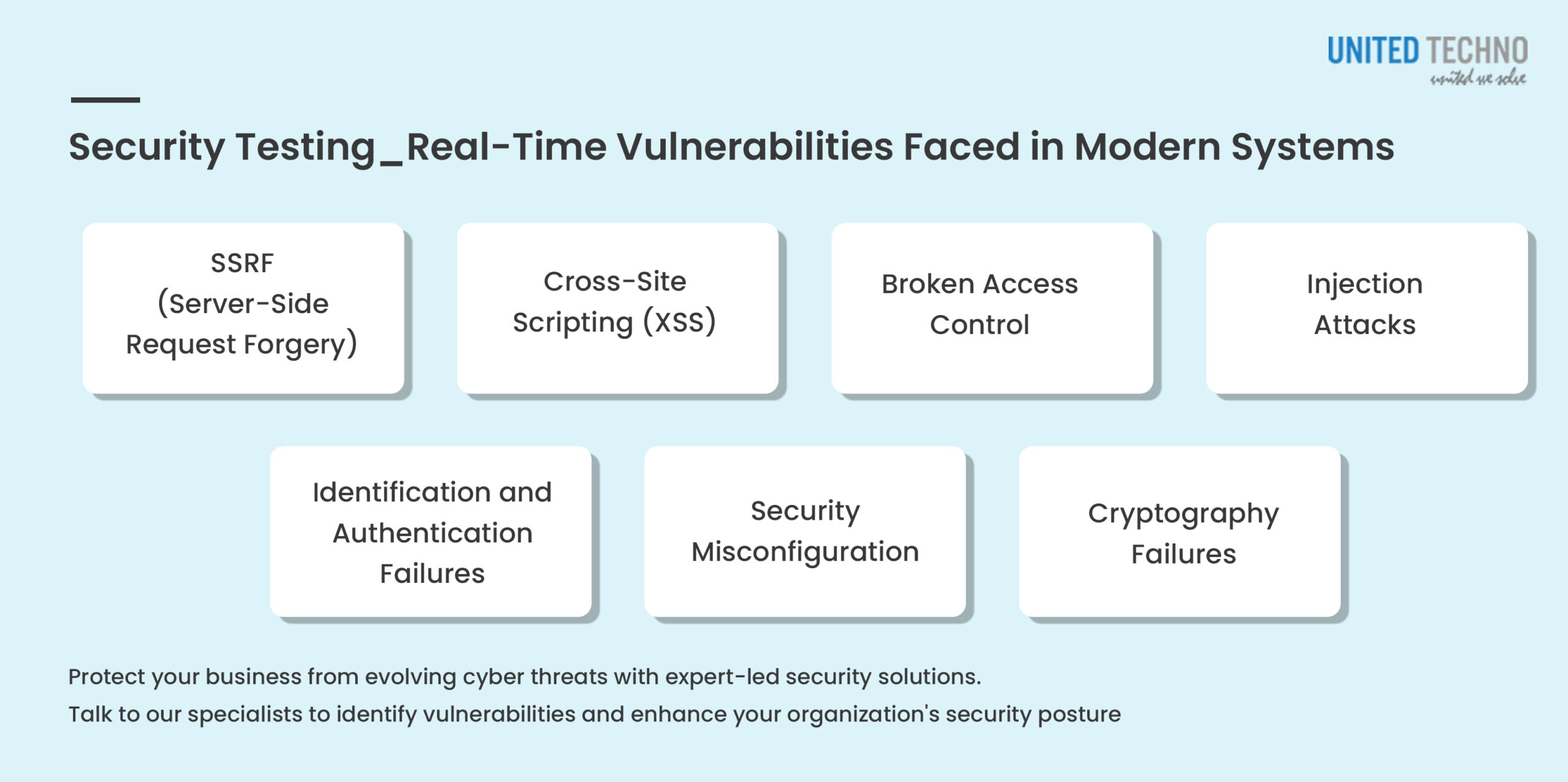
OWASP Top 7 Web Application Security Risks
- SSRF
- Cross Site Scripting (XSS)
- Broken Access Control
- Injections
- Identification and Authentication Failures
- Security Misconfiguration
- Cryptography Failures
Advanced Security Testing Tools
Modern security teams rely on advanced testing and assessment tools to identify vulnerabilities, validate security controls, and improve application resilience.
1. SSRF (Server-Side Request Forgery)
Server-side request forgery is a web security vulnerability that allows an attacker to force a server-side application to send requests to unintended locations. Attackers typically target applications that support data imports from URLs or applications that retrieve data from external URLs.
Real-Time Example
The https://search.usa.gov/help_docs endpoint was identified as vulnerable to SSRF through the URL parameter. Although the parameter was protected, it could still be bypassed.
Steps to Reproduce
- Login to Search.gov and access the help manual.
- The following request was identified as vulnerable.
If http://127.0.0.1:21/?%0A is inserted before the URL parameter and the request is sent, the response time is approximately 450ms, indicating that the port is closed.
If http://127.0.0.1:22/?%0A is inserted before the URL parameter and the request is sent, the response time increases to approximately 10,468ms, indicating that the port is open.
If http://169.254.169.254/latest/meta-data/iam/security-credentials/?%0A is inserted before the URL parameter, the response body remains empty, indicating that /security-credentials exists.
If http://169.254.169.254/latest/meta-data/iam/security-credentialx/?%0A is inserted before the URL parameter, the response displays an “Unable to retrieve” error, indicating that /security-credentialx does not exist.
Impact of This Attack
Attackers can scan internal networks, identify internal ports, and discover internal web applications. This information can help map enterprise infrastructure and support the exploitation of additional vulnerabilities.
2. Cross-Site Scripting (XSS)
Cross-site scripting (XSS) attacks involve injecting malicious code into vulnerable web applications. Rather than directly targeting the application itself, XSS attacks primarily target users interacting with the compromised application.
Example
British Airways was targeted by Magecart, a high-profile hacker group known for credit card skimming attacks. The attackers exploited an XSS vulnerability within a JavaScript library called Feedify, which was integrated into the British Airways website.
The malicious script was modified to transmit customer information to an attacker-controlled server using a domain name designed to resemble the legitimate British Airways domain.
Mitigation
- Enforcing Content Security Policy (CSP)
- Using Subresource Integrity (SRI) for third-party scripts
- Minimizing external JavaScript dependencies
- Applying proper input validation and output encoding
- Continuously monitoring script behavior
3. Broken Access Control
Attackers exploit weaknesses in access control mechanisms to gain unauthorized privileges and access restricted resources.
Example
Facebook’s private post vulnerability reportedly allowed attackers to view user posts that were intended to remain restricted.
Mitigation
- Implement role-based access control (RBAC)
- Enforce least privilege principles
- Conduct regular access audits
4. Injection Attacks
Malicious code injection exploits vulnerabilities in query execution. Attackers can use these weaknesses to steal, modify, or delete data, or even gain complete control over affected systems.
Example
The Heartland Payment Systems breach exposed approximately 130 million credit card records through a SQL injection attack.
Mitigation
- Use prepared statements
- Apply input sanitization
- Implement parameterized queries to prevent injection attacks
5. Identification and Authentication Failures
Weak authentication mechanisms can lead to credential theft and unauthorized access. These vulnerabilities arise when systems fail to adequately verify user identities, enabling attackers to compromise passwords, keys, or session tokens and assume legitimate user identities.
Example
The Uber breach resulted from compromised employee credentials, allowing attackers to infiltrate internal systems.
Mitigation
- Enforce Multi-Factor Authentication (MFA)
- Implement secure session management
- Continuously monitor authentication logs
6. Security Misconfiguration
Poorly configured security settings expose systems to significant threats. These vulnerabilities commonly occur when servers, databases, or cloud services are deployed using insecure default settings or improper configurations.
Example
Capital One’s AWS S3 misconfiguration led to the exposure of approximately 100 million customer records.
Mitigation
- Automate security hardening
- Remove default credentials
- Conduct regular configuration reviews
7. Cryptography Failures
Weak encryption practices or poorly managed cryptographic systems can result in sensitive data exposure.
Example
The Equifax breach exposed the personal information of approximately 147 million users due to unencrypted sensitive data.
Mitigation
- Use strong encryption standards such as AES-256 and TLS 1.2+
- Enforce secure key management practices
- Disable outdated cryptographic protocols
Strengthen Your Enterprise Security Posture
Cyber threats continue to evolve rapidly, making proactive security testing and vulnerability management essential for modern enterprises.
At United Techno, we help organizations identify vulnerabilities, strengthen application security, and improve resilience across cloud and enterprise environments.
Connect With Our Security Experts
- Assess your application security posture
- Strengthen cloud and infrastructure security
- Improve enterprise risk management
- Secure modern digital transformation initiatives
Get Started Today
Schedule a Security Assessment