
A NetSuite quote can look precise long before the project itself is precise.
The number may include licenses, modules, users, and implementation services. What it cannot show by itself is how complicated the business will be to move into the platform.
That depends on a different set of questions:
How many business entities need control? How many systems need to exchange transactions? How clean is the data? Which processes should change? Which ones need to remain specialized? What must work on day one?
That is where NetSuite pricing becomes an architecture conversation.
The platform has a commercial cost.
The operating model built around it determines the rest.
The Quote Is a Snapshot. The Operating Model Is the Cost Driver.
Two companies can buy NetSuite and end up with completely different programs.
A professional services firm may need financials, project accounting, time capture, billing and profitability reporting.
A distributor may need those same financial controls plus multiple warehouses, thousands of items, replenishment, EDI, customer-specific pricing and fulfillment workflows.
An ecommerce company adds another layer: storefront transactions, marketplace orders, payment settlements, returns, inventory synchronization and customer data.
The platform has not fundamentally changed.
The number of decisions around the platform has.
That is the first principle behind a sensible NetSuite cost assessment:
Price the business architecture, not just the software subscription.
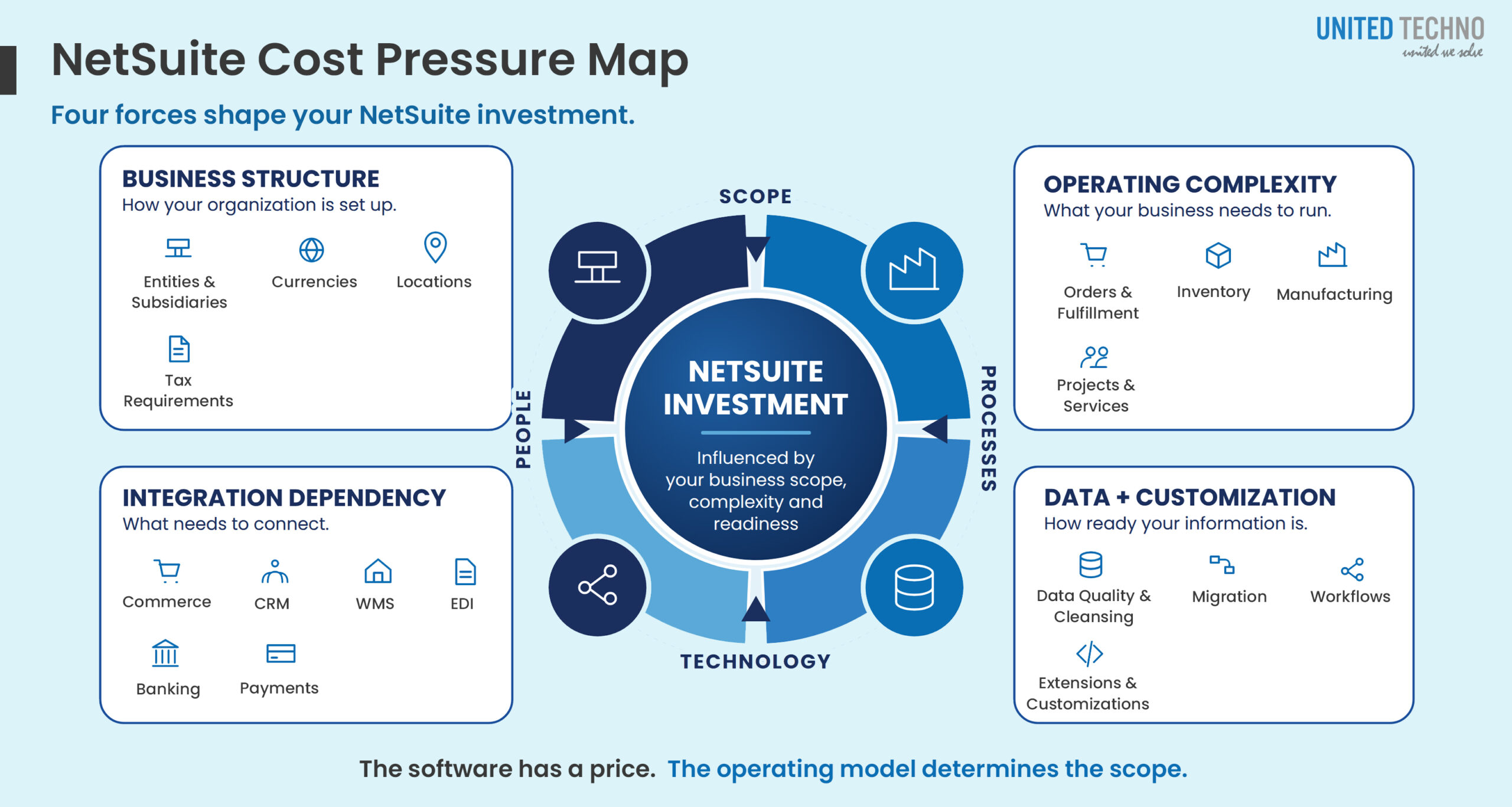
Five Variables Shape the Real NetSuite Cost
1. Business Structure
Entities, subsidiaries, locations, currencies, tax requirements and intercompany activity all affect the financial design.
A single-entity company has a very different control model from an organization operating across multiple legal entities and markets.
The important question is not simply how many entities exist.
It is how transactions move between them.
2. Operational Complexity
This is where an apparently straightforward ERP project can become significantly larger.
Consider a retailer managing:
- Multiple fulfillment locations
- Product variants
- Returns
- Promotions
- Wholesale orders
- Marketplace sales
- High transaction volumes
The cost is not created by the word “retail.”
It comes from the number of operational rules that NetSuite must support, integrate or reconcile.
The same principle applies to manufacturing, distribution, healthcare, SaaS and professional services.
3. Integration Dependency
Most modern businesses already have an ecosystem around the ERP.
Commerce. CRM. WMS. EDI. Banking. Payroll. Payments. 3PL. Analytics.
The question should not be:
“How many integrations do we need?”
A better question is:
“Which business transactions cannot operate correctly without these connections?”
That changes the implementation conversation.
A CRM connection that synchronizes customer information is one thing. A warehouse integration controlling inventory availability and fulfillment status is another. An EDI connection carrying purchase orders and invoices has another level of operational consequence.
Integration scope should therefore be prioritized by business dependency, not application count.
4. Data Condition
Data migration is often treated as a technical workstream.
It is actually a business decision.
A customer master containing duplicates, inconsistent addresses and obsolete accounts creates more than migration effort. It creates uncertainty after go-live.
The same applies to:
- Item masters
- Vendor records
- Units of measure
- Historical transactions
- Chart of accounts
- Product classifications
- Pricing information
The relevant question is not:
“How many records need to be migrated?”
It is:
“How much of this data can the business trust?”
5. Customization Exposure
Customization can solve a legitimate business requirement.
It can also preserve a process that should have been retired years ago.
That distinction has a direct effect on NetSuite implementation cost and future maintenance.
A useful decision sequence is:
Simplify → Standardize → Configure → Integrate → Customize
Customization should appear toward the end of the decision tree, not at the beginning.
These five factors explain why NetSuite Pricing varies significantly between businesses, even when they purchase the same ERP platform.
NetSuite Cost Pressure Map
Where Industry Changes the Economics
The same NetSuite implementation strategy does not fit every industry.
Retail & Ecommerce
The commercial transaction rarely ends at checkout.
Order → Inventory → Fulfillment → Return → Settlement → Finance
Marketplace fees, returns, inventory synchronization and multiple selling channels can make reconciliation a major part of the implementation.
Distribution
The pressure sits closer to inventory and fulfillment.
Thousands of SKUs, multiple warehouses, supplier relationships, customer pricing and EDI partners can make item data and transaction orchestration central to the program.
Manufacturing
The cost structure changes again.
A customer commitment can affect material planning, work orders, production, inventory, quality, shipment and financial reporting.
The ERP must preserve that chain without creating unnecessary manual intervention.
Professional Services
There may be almost no physical inventory, but project economics can be complex.
Contract → Resource → Time → Cost → Billing → Revenue → Margin
Project accounting, revenue treatment, resource visibility and profitability reporting become central to the design.
What a Serious NetSuite Quote Should Explain
A commercial proposal becomes much more useful when leadership can trace the number back to business decisions.
At minimum, the scope should make these visible:
| Decision | Why it matters |
| ERP boundary | Determines what NetSuite owns |
| Module fit | Prevents unnecessary functionality |
| User model | Defines access requirements |
| Integration scope | Establishes technical dependency |
| Data migration | Determines remediation effort |
| Customization | Indicates future maintenance exposure |
| Phase-one scope | Controls implementation size |
| Future roadmap | Prevents the first release from carrying everything |
This also creates a useful discipline:
Every dollar in the program should have a business reason behind it.
The Cheapest Implementation Is Not Always the Smallest One
Cutting scope can reduce an initial quote.
It can also move the cost somewhere else.
Deferring a critical integration may create manual work.
Migrating incomplete data may create reconciliation problems.
Avoiding necessary process redesign may preserve the same inefficiencies the ERP was supposed to remove.
The objective should therefore be controlled scope, not minimal scope.
A strong phase-one release usually protects the processes that have the greatest effect on:
Revenue | Financial Control | Inventory | Fulfillment | Compliance | Customer Experience
Everything else can be evaluated against the roadmap.
This is an important consideration when evaluating NetSuite Pricing: reducing upfront implementation costs should never come at the expense of essential business operations or long-term efficiency.
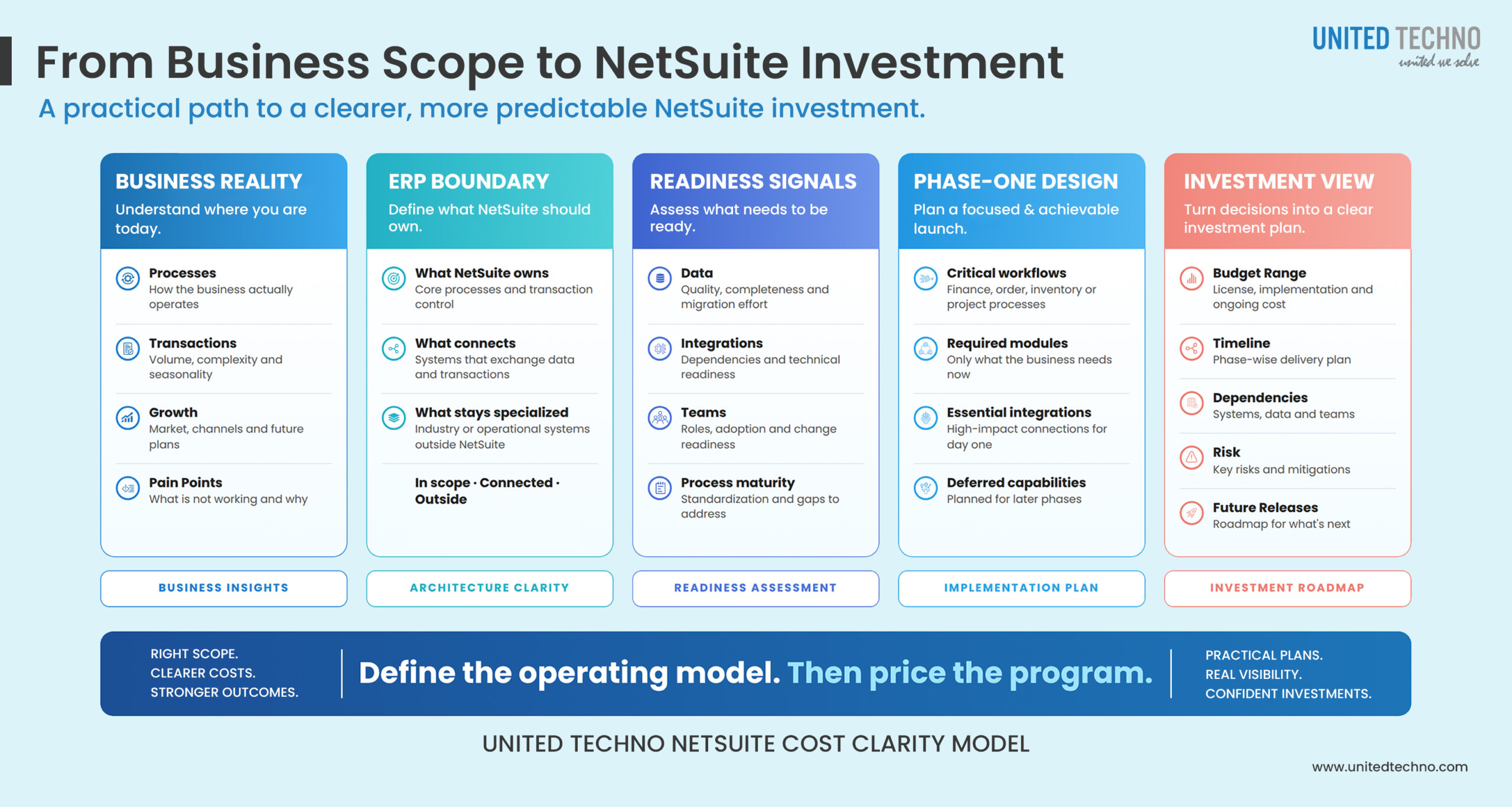
The 90-Day Cost Clarity Approach
Before negotiating the final NetSuite commercial structure, the business should know what it is actually buying.
A practical assessment can move through five decisions:
DISCOVER
Understand processes, bottlenecks and growth plans.
MAP
Define the ERP boundary, modules and connected systems.
ASSESS
Evaluate integration dependencies, data condition and customization exposure.
PRIORITIZE
Separate launch-critical capabilities from later releases.
ROADMAP
Translate the decisions into implementation scope, budget assumptions, timeline and risks.
That process turns a broad NetSuite Pricing conversation into something leadership can actually evaluate.
From Business Scope to NetSuite Investment
What Should Be Measured After the Money Is Spent?
NetSuite success should eventually show up in business performance.
Useful measures include:
- Finance: close-cycle duration
- Order management: order-to-cash time
- Inventory: inventory accuracy
- Integration: failed transaction rate
- Data: duplicate master records
- Operations: manual transaction volume
- Reporting: time required to produce management information
- Adoption: percentage of critical workflows completed inside the platform
One metric connects them all:
How much coordination does the business no longer need?
If employees still reconcile spreadsheets, copy transactions between systems and manually assemble management reports months after implementation, the technology investment has not delivered its full operating value.
This is also an important consideration when evaluating NetSuite Pricing: the real return on investment should be measured through operational improvements, not just the initial software and implementation expenditure.
Turn NetSuite Pricing Into a Business Case
NetSuite licensing is only one part of the commercial decision.
The stronger approach is to establish:
What the ERP should control.
What it should connect to.
What should remain outside it.
What must happen at launch.
What can wait.
What the business needs to change before implementation begins.
That gives leadership something more useful than a price.
It gives them a defensible investment model.
The United Techno Approach
United Techno evaluates Oracle NetSuite pricing from the operating model outward.
The assessment can establish:
- ERP boundary and ownership model
- NetSuite module fit
- User and access requirements
- Integration dependency map
- Data readiness and remediation exposure
- Customization risk
- Phase-one implementation scope
- Future capability roadmap
- Budget and timeline assumptions
Know What You Are Buying Before You Negotiate What It Costs
Start with a NetSuite Cost Clarity Assessment.