Healthcare does not lack data.
It has a data-to-decision problem.
A patient’s story may be distributed across the EHR, laboratory systems, imaging platforms, pharmacy records, claims, care-management applications, medical devices, and unstructured clinical documents. The information exists. The difficulty is bringing the right information together, interpreting it in context, and making it available when a clinician or care team needs it.
That is where Healthcare Data Analytics is becoming essential to healthcare transformation.
In 2026, Forrester projects U.S. healthcare providers will spend $69 billion on technology, up 7.6% year over year. Software alone is projected to account for $25 billion of that spending, with investment shifting toward AI-enabled analytics, cloud platforms, and interoperable systems.
The question for healthcare organizations is no longer simply how much data they have.
It is:
How quickly can trusted data become a useful clinical or operational decision?
The Healthcare Data Problem Is Not Just Volume
A typical healthcare environment might look like this:
| Data source | What it contains | What makes it difficult |
| EHR | Clinical records | Multiple workflows and formats |
| Labs | Test results | Timing and context |
| Imaging | Reports and images | Large, specialized datasets |
| Devices | Patient/asset telemetry | High-frequency streams |
| Claims | Financial and utilization data | Different business context |
| Documents | Notes, PDFs, referrals | Unstructured information |
| Patient apps | Engagement data | Distributed across channels |
The problem becomes more pronounced when these systems are developed independently.
A clinician may have to move between applications to reconstruct a patient’s recent history.
An operations team may wait for a report before identifying a problem that could have been detected earlier.
A data scientist may spend more time preparing clinical data than developing the model that uses it.
The technology is working. The enterprise is still waiting.
The Real Transformation: Shortening Data-to-Decision Time
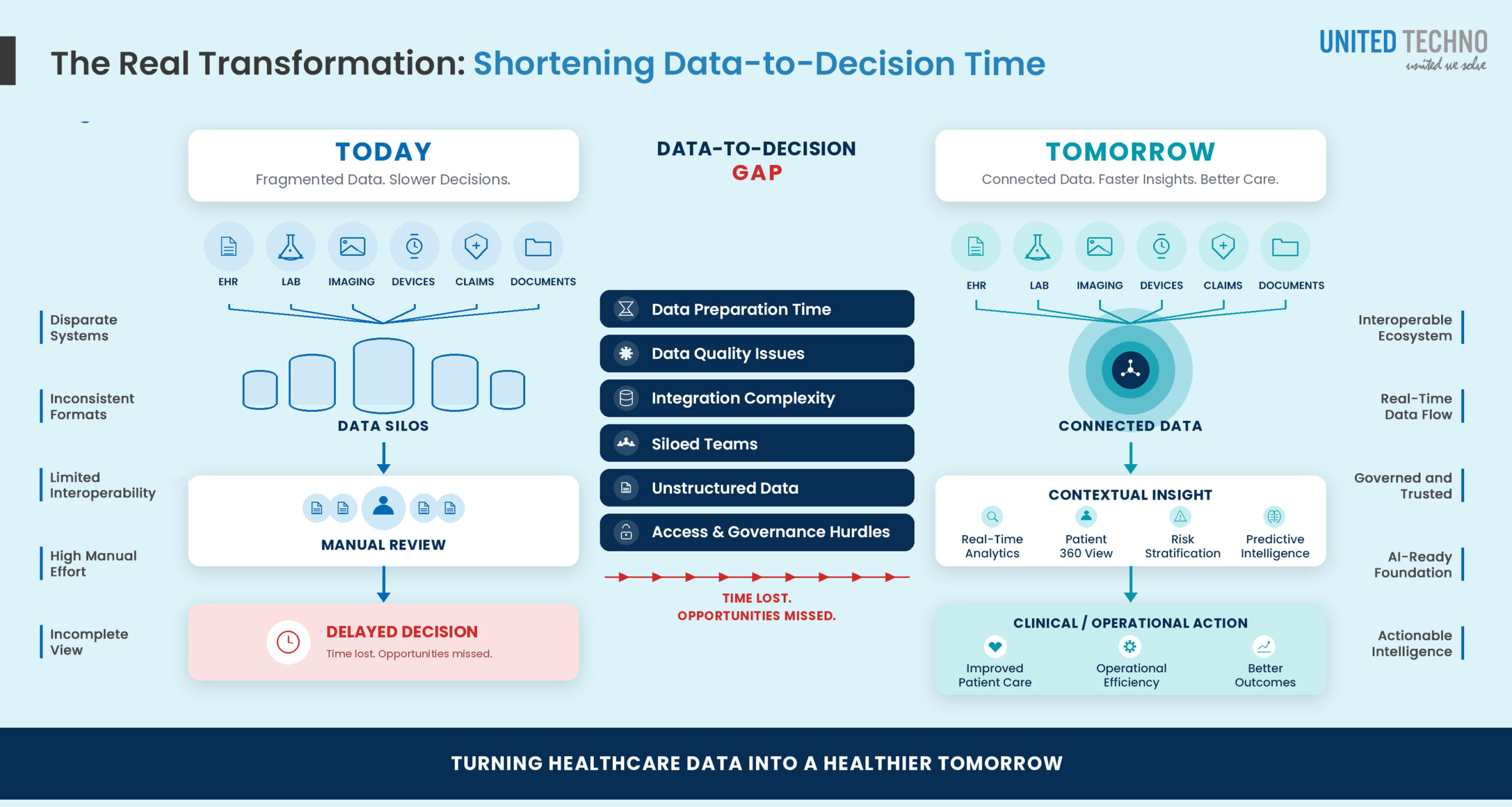 United Techno approaches healthcare data transformation around one measurable idea:
Reduce the distance between an event and the decision it should inform.
Consider a patient’s changing condition.
The old pattern can resemble:
Data Created → Data Stored → Data Extracted → Report Generated → Human Review → Decision
A modern architecture can move toward:
Data Created → Integrated → Governed → Interpreted → Insight → Action
The difference is not simply faster infrastructure. It is a change in how the healthcare organization uses information.
1. Build a Data Foundation Before Building More AI
Healthcare organizations are understandably interested in generative AI, predictive analytics and intelligent assistants.
But sophisticated models cannot compensate for poorly organized source data.
Before introducing advanced AI use cases, organizations need to establish:
- Reliable ingestion
- Data quality controls
- Common definitions
- Metadata
- Lineage
- Access controls
- Interoperability
- Appropriate governance
These foundations are equally important for effective Healthcare Data Analytics, where reliable insights depend on consistent, well-organized and accessible data.
This is particularly important because healthcare data is rarely uniform.
One system may describe a clinical event differently from another. A PDF may contain information that never appears in a structured database. Device data may arrive continuously while clinical documentation is created intermittently.
The engineering challenge is to bring those forms together without stripping away the context that makes them useful.
2. Make Unstructured Clinical Data Usable
Some of the most valuable healthcare information does not live in neat database tables.
It lives inside:
Clinical notes.
Reports.
Referrals.
Discharge summaries.
Scanned documents.
Care plans.
That creates an engineering problem before it creates an AI problem.
The data needs to be extracted, normalized, classified and associated with the appropriate patient and clinical context.
A practical pipeline can move from:
Document → Extraction → Classification → Normalization → Validation → Governed Data → Insight
The objective is not to turn every document into a giant searchable text repository.
It is to make the right information discoverable and usable.
3. Interoperability Is Becoming a Strategic Capability
Healthcare interoperability is moving beyond simple data exchange.
Gartner’s 2026 Market Guide for Health Information Exchange describes a shift from commoditized data transport toward high-value data activation, with interoperability becoming increasingly tied to clinical intelligence.
That distinction matters.
Moving a record from System A to System B is useful.
Making that information available at the exact point where a care decision is being made is considerably more valuable.
United Techno’s approach therefore looks beyond individual interfaces.
We consider the full chain:
Source Systems → Integration → Standardization → Governance → Data Products → Applications / Analytics / AI
This connected approach creates a stronger foundation for Healthcare Data Analytics, enabling healthcare organizations to turn integrated, governed information into actionable insights and support new use cases without rebuilding the integration layer every time.
The goal is a healthcare data environment that can support new use cases without rebuilding the integration layer every time.
4. Move From Reports to Clinical Context
Dashboards have served healthcare organizations well.
But a dashboard still requires someone to interpret what they see.
The next step is contextual intelligence.
Imagine a clinician preparing for an appointment.
Instead of opening several systems and reviewing dozens of individual records, the platform can assemble relevant information into a concise clinical context:
Recent Events
→ Relevant History
→ Abnormal Results
→ Medication Changes
→ Recent Encounters
→ Supporting Documents
The technology does not replace clinical judgment.
It reduces the time required to assemble the evidence around that judgment.
That distinction is critical in healthcare.
5. Design AI Around Data Governance
Healthcare AI cannot be treated like a consumer chatbot.
The architecture needs to answer basic questions before an AI-generated response reaches a user:
- Where did the information come from?
- Is the source current?
- Who is allowed to access it?
- What data was used?
- Can the result be traced back to supporting evidence?
- What happens when the source data changes?
These questions bring data engineering, security, governance and AI engineering into the same conversation.
Gartner’s latest enterprise EHR research similarly highlights the movement toward cloud-first, AI-enabled systems, while emphasizing interoperability, data and analytics, care coordination, safety and operational efficiency as important capabilities.
This also makes Healthcare Data Analytics a critical foundation for AI readiness, ensuring that the information used to generate insights is reliable, governed, traceable and relevant.
AI readiness therefore starts much earlier than the model.
It starts with the data architecture.
6. Measure Healthcare Transformation Differently
Technology teams often report:
- Number of pipelines
- Number of APIs
- Number of dashboards
- Number of models
- Amount of data processed
Those metrics demonstrate engineering activity.
Healthcare executives need another layer of measurement.
| Data Engineering Metric | Business / Care Metric |
| Data latency | Time to clinical insight |
| Pipeline reliability | Availability of critical information |
| Data quality | Reduction in unusable records |
| Integration coverage | Connected care workflows |
| Search/retrieval time | Clinician time saved |
| Automation rate | Manual work reduced |
| Model monitoring | Reliability of AI-supported decisions |
The most interesting metric may be one that rarely appears on a technology dashboard:
How long does it take to move from a meaningful data event to an informed action? That is where the value of healthcare data engineering becomes visible.
The United Techno Healthcare Data Model
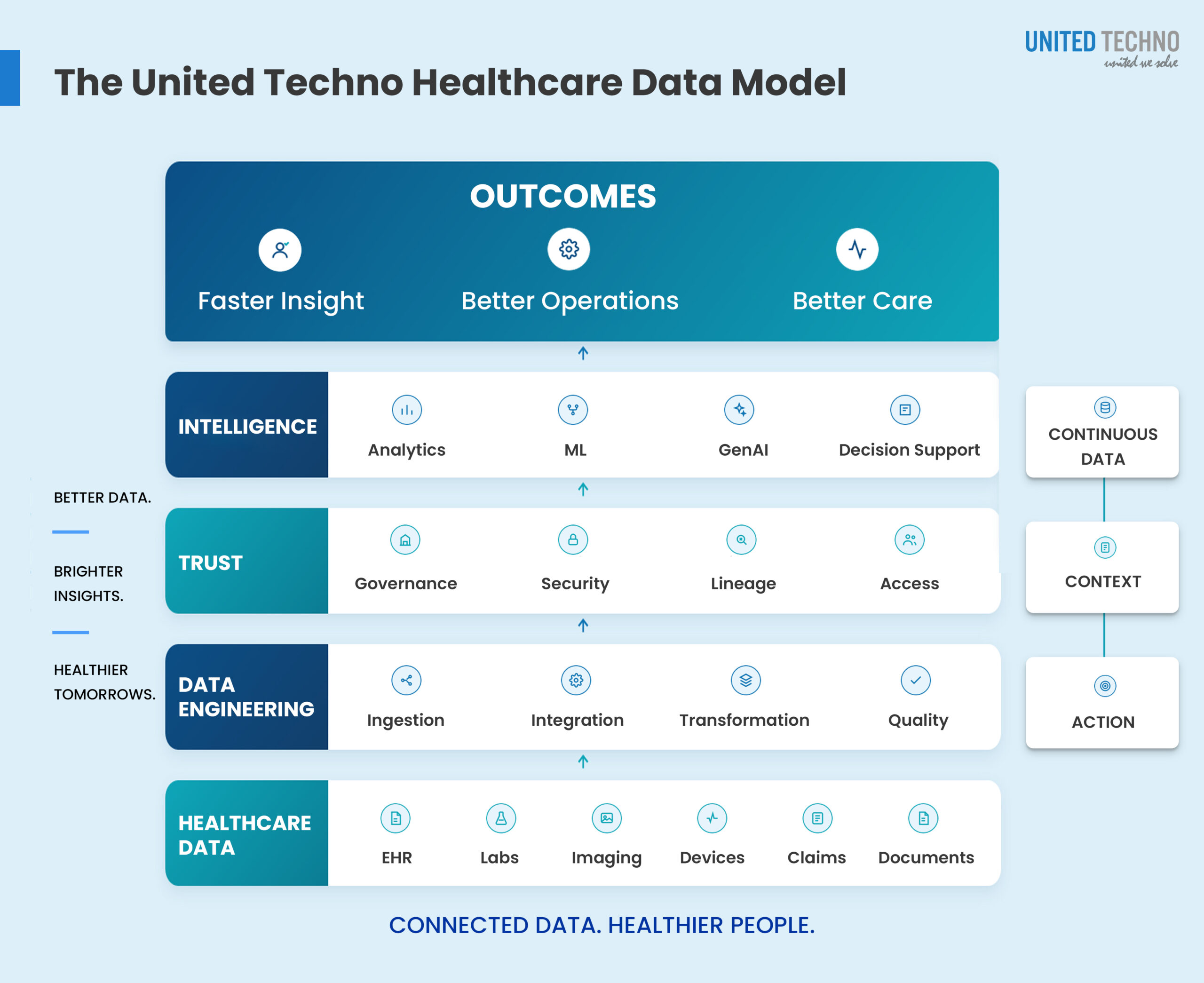
United Techno approaches healthcare transformation as a connected engineering problem rather than a collection of isolated technology projects.
Our model connects six layers:
CONNECT
Bring clinical, operational and external sources together.
ENGINEER
Build reliable pipelines for structured and unstructured data.
GOVERN
Apply quality, security, lineage and access controls.
CONTEXTUALIZE
Turn disconnected information into usable healthcare context.
INTELLIGENTLY ASSIST
Apply analytics and AI where they improve a defined workflow.
MEASURE
Track whether the technology actually improves speed, efficiency, experience or care operations.
The important point is the sequence.
AI is not the starting point.
Trusted, accessible data is.
The Next Healthcare Advantage Will Be Data Velocity
Healthcare organizations have spent years digitizing information.
The next challenge is making that information move with purpose.
A laboratory result should not become useful only after a report is generated.
A clinical document should not remain invisible because it is stored as a PDF.
A device signal should not matter only after someone manually reviews a dashboard.
And AI should not become another application sitting beside the systems clinicians already use.
The stronger model is connected:
Data → Context → Insight → Action
That is the direction healthcare data engineering and Healthcare Data Analytics need to take.
For United Techno, the opportunity is not to build technology for its own sake.
It is to engineer a healthcare data foundation where the right information reaches the right workflow at the right moment with the governance required to trust it.
That is where faster insights become more than an IT improvement.
They become a better way to operate healthcare.
Build a Healthcare Data Foundation Ready for the Next Clinical Workflow
United Techno helps healthcare and life sciences organizations engineer connected data platforms, modernize healthcare data pipelines, integrate clinical and operational systems, establish governed data foundations and prepare enterprise data for analytics and AI.
Talk to United Techno About Your Healthcare Data Strategy →
Identify the data bottlenecks between your systems, your teams and the decisions that matter, and build an architecture designed to remove them.