Logistics has always been a business of decisions.
Which shipment should move first?
Which route should a driver take?
Where should inventory be positioned?
Which delivery is likely to miss its window?
Which carrier can handle the next load?
For years, logistics software helped people execute those decisions.
The next generation of logistics software is beginning to do something different.
It can anticipate the decision, evaluate the options and recommend what should happen next.
That is where artificial intelligence is becoming strategically important.
The real opportunity in AI in Logistics Software, however, is not putting an AI assistant on top of a TMS or WMS.
It is building logistics software that can understand operational context and respond to changing conditions.
Logistics Has a Decision Problem, Not a Data Problem
A modern logistics operation produces enormous amounts of information.
Orders. Shipments. Inventory. GPS signals. Carrier updates. Warehouse events. Delivery windows. Fuel prices. Weather. Customer requests.
Most organizations already have systems collecting this information.
The difficulty is connecting it.
- A dispatcher may have one view of a shipment.
- The warehouse has another.
- Customer service sees another.
- Finance sees the cost after the movement is complete.
By the time everyone has the same picture, the opportunity to act may already be gone.
This creates the real opportunity for AI in Logistics Software:
Move logistics software from recording what happened to helping determine what should happen next.
The Shift: From Workflow Automation to Decision Intelligence
Traditional logistics software generally follows predefined rules.
IF shipment is delayed → send notification.
IF inventory falls below threshold → create replenishment request.
IF vehicle requires service → generate maintenance alert.
These rules are useful. But logistics rarely behaves according to one rule at a time.
A shipment may be delayed because of weather, while the receiving warehouse is congested, the carrier has limited capacity and another order has a tighter delivery commitment.
The decision now requires context.
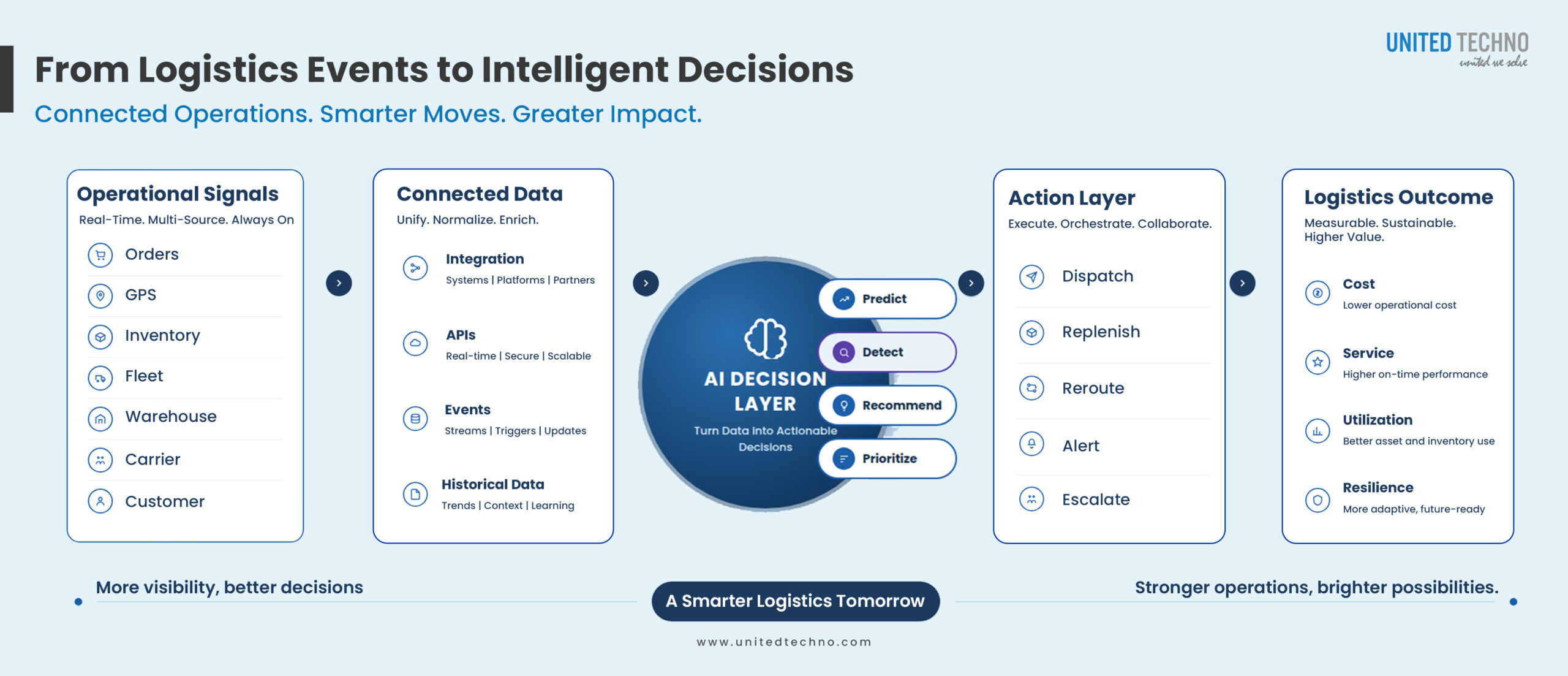
AI in Logistics Software can bring those signals together, helping teams evaluate multiple operational conditions before deciding what action to take.
Traditional
Event → Rule → Action
AI-enabled
Events → Context → Prediction → Options → Decision → Action
That is a much bigger architectural shift than adding machine learning to an existing application.
Where AI Creates Real Value in Logistics
Not every logistics process needs AI.
The strongest opportunities tend to appear where decisions are:
- Frequent
- Data-rich
- Time-sensitive
- Difficult to optimize manually
- Expensive when wrong
| Logistics function | AI opportunity | Business question |
| Transportation | Dynamic routing | What is the best route now? |
| Fleet | Predictive maintenance | Which asset is likely to fail? |
| Inventory | Demand sensing | What should we position before demand changes? |
| Warehousing | Slotting and labor optimization | Where should inventory and people be placed? |
| Customer service | Exception intelligence | Which shipments need intervention first? |
| Procurement | Supplier intelligence | Where is supply risk emerging? |
| Finance | Cost anomaly detection | Which movement is creating unexpected cost? |
| Compliance | Document intelligence | Which records require attention? |
The common thread is not AI itself.
It is the decision density.
1. Route Optimization Becomes Dynamic
Static route planning assumes the world will behave roughly as expected.
Logistics rarely gets that luxury.
Traffic changes.
Weather changes.
A driver becomes unavailable.
A customer changes a delivery window.
A vehicle reaches capacity.
A warehouse becomes congested.
An AI-enabled routing engine can continuously evaluate these conditions against business priorities.
The objective may not simply be the shortest route.
It may be:
Lowest Cost + Delivery Commitment + Vehicle Capacity + Driver Availability + Customer Priority
That produces a more useful question:
What is the best decision given the conditions right now?
2. Inventory Moves From Forecasting to Sensing
Traditional forecasting depends heavily on historical demand.
But today’s logistics environment can change faster than historical patterns can explain.
AI can combine:
Historical Demand + Current Orders + Lead Times + Promotions + Seasonality + External Signals
to identify where demand is moving.
That changes inventory planning from:
“What did customers buy before?”
to:
“What is changing, and what should we do about it?”
For a retailer, that could mean repositioning inventory before a regional demand spike.
For a distributor, it could mean adjusting replenishment before a supplier delay creates a shortage.
For a healthcare logistics operation, it could mean identifying where critical supplies may need to be moved before demand materializes.
3. Predictive Maintenance Changes the Economics of Downtime
A vehicle breakdown is rarely just a maintenance event.
It can become:
Vehicle Failure → Missed Shipment → Customer Delay → Rescheduling → Additional Cost
Traditional maintenance asks:
When is this asset due for service?
Predictive maintenance asks:
What signals suggest this asset may fail?
Telematics, sensor data, maintenance history and operating conditions can be analyzed together to identify patterns associated with equipment degradation.
With AI in Logistics Software, this enables a shift from calendar-based maintenance to condition-based intervention.
4. AI Can Turn Exceptions Into Priorities
This may be one of the most practical applications of AI in logistics.
Most operations already have exception dashboards.
The problem is that there may be hundreds of exceptions.
Which ones matter?
A late shipment worth $500 is different from a late shipment carrying a critical customer order.
A delayed inbound shipment is different when the affected warehouse has three days of inventory versus three hours.
AI can rank exceptions based on:
Business Impact + Probability + Urgency + Customer Commitment + Recovery Options
The system moves from:
“Here are 200 exceptions.”
to:
“These five require intervention now.”
That is a much more valuable form of automation.
The Architecture Has to Change
AI cannot make good decisions if it cannot access reliable operational context.
A modern logistics AI architecture therefore needs more than a model.
It needs a connected data foundation.
AI Needs the Right Data Before It Needs the Right Model
This is where many AI initiatives become difficult.
A logistics company may have excellent models but fragmented data.
The TMS has shipment data.
The WMS has warehouse data.
The ERP has financial information.
GPS platforms have location data.
Carrier systems provide status updates.
Customer platforms hold service information.
If these systems cannot provide reliable context, the AI layer becomes another isolated application.
United Techno approaches logistics AI from the underlying architecture upward:
CONNECT
Bring operational systems and external signals together.
ENGINEER
Build reliable pipelines and real-time data flows.
GOVERN
Establish quality, ownership, security and lineage.
INTELLIGENCE
Apply ML, optimization and generative AI where they fit the decision.
ACT
Connect recommendations back into operational workflows.
The objective is not to create another dashboard. It is to close the loop between information and action.
The Next Step: AI That Can Act
The most interesting development in logistics is the movement from AI that recommends to AI that can participate in execution.
Gartner’s 2026 logistics research describes this shift as logistics execution moving from process-centric workflows toward decision-centric orchestration. Gartner also forecasts spending on supply-chain-management software with agentic AI capabilities to rise from less than $2 billion in 2025 to $53 billion by 2030.
That does not mean every logistics operation should immediately deploy autonomous agents.
It means the architecture should be designed for a future where software can handle increasingly complex decisions.
Consider a delayed shipment.
A conventional system might:
Detect → Alert Dispatcher
A more advanced system might:
Detect → Assess Impact → Evaluate Alternatives → Recommend Reroute
An agentic workflow could eventually:
Detect → Assess → Select Approved Action → Execute → Confirm → Escalate if Necessary
The difference is not the sophistication of the interface.
It is the degree of decision responsibility given to the system.
Autonomy Needs Guardrails
Logistics is not a simulation.
A bad decision can mean missed delivery commitments, wasted fuel, inventory shortages or financial loss.
AI therefore needs boundaries.
| AI capability | Appropriate control |
| Prediction | Monitor model accuracy |
| Recommendation | Human approval where impact is high |
| Prioritization | Business rules and thresholds |
| Automated action | Pre-approved decision boundaries |
| Agentic workflow | Permissions, audit trail and escalation |
| Critical decision | Human-in-the-loop |
The objective is not maximum autonomy.
It is appropriate autonomy.
A system should know what it can decide, what requires approval and when it needs to stop.
Measure AI by Operational Outcomes
AI projects often begin with model metrics.
Accuracy. Precision. Recall. Latency.
Those metrics matter.
But logistics leaders ultimately need business measures.
| AI metric | Logistics outcome |
| Forecast accuracy | Inventory availability |
| Route optimization quality | Cost per shipment |
| Prediction accuracy | Unplanned downtime |
| Exception prioritization | Response time |
| Recommendation acceptance | Planner productivity |
| Automation rate | Manual effort |
| ETA accuracy | Customer experience |
| Decision cycle time | Operational responsiveness |
The strongest AI program can answer a simple question:
What changed in the operation because the AI made the decision process better?
United Techno Logistics AI Framework
United Techno views AI in logistics as an extension of the operational architecture, not a separate AI project.
The framework connects:
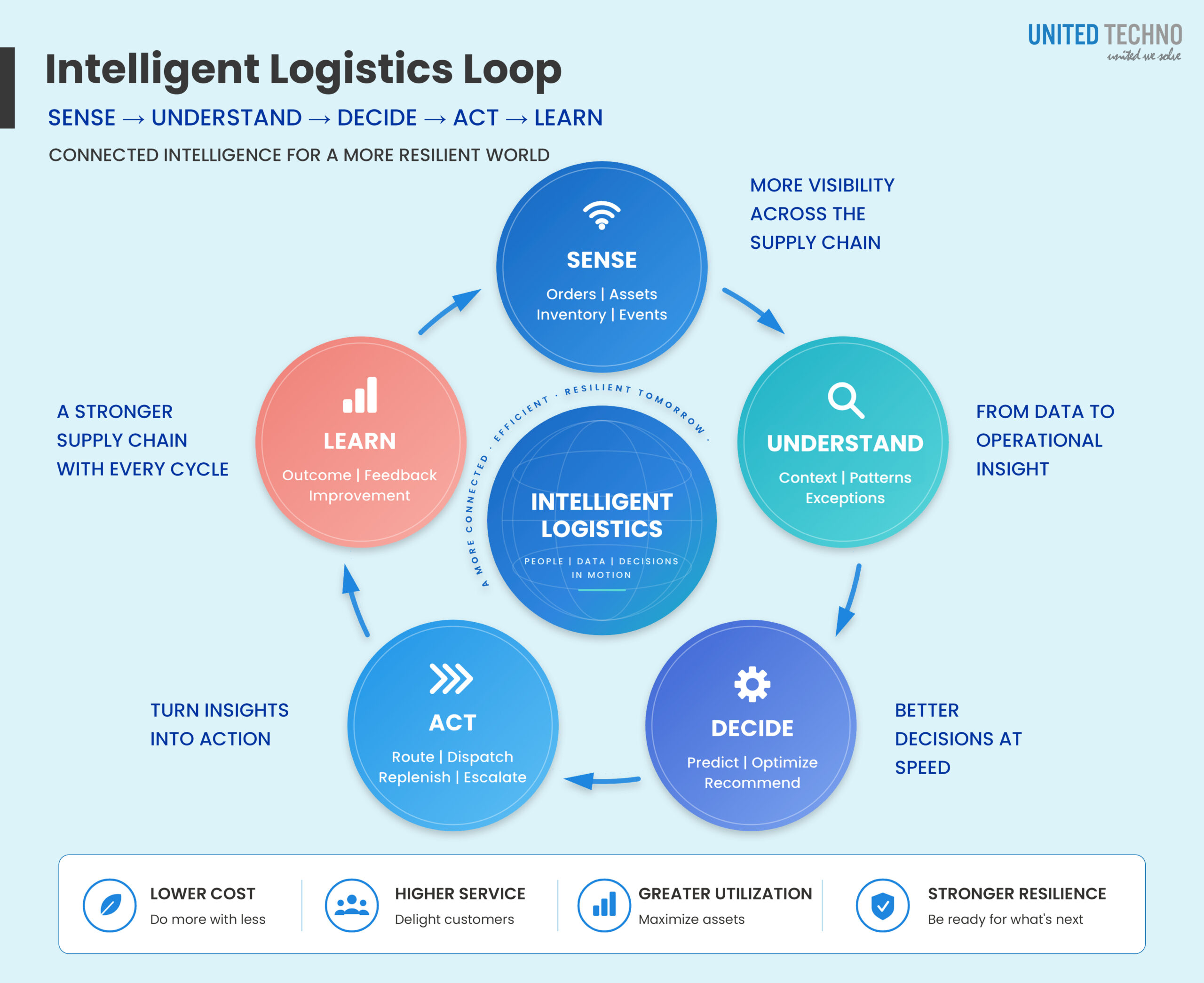
BUSINESS EVENT
Something changes.
↓
OPERATIONAL CONTEXT
The platform gathers relevant data.
↓
INTELLIGENCE
AI identifies patterns, predicts outcomes or evaluates options.
↓
DECISION
The system recommends or selects an action within defined controls.
↓
EXECUTION
The action moves back into the logistics workflow.
↓
FEEDBACK
The outcome becomes new operational data.
That final step matters.
The system learns from what actually happened.
The Real Opportunity Is Not “AI in Logistics”
That phrase is already too broad.
The more important question is:
Which logistics decisions should become intelligent?
Start there.
For some organizations, the answer may be route planning.
For another, it may be warehouse labor.
For another, inventory positioning.
For another, shipment exceptions.
And for an enterprise logistics network, the opportunity may be connecting several decisions into one coordinated operating model.
AI becomes valuable when it sits close to the decision—and even more valuable when the decision can flow directly back into execution.
From Logistics Software to an Intelligent Operating Layer
The logistics platforms of the past were designed primarily to record, coordinate and execute.
The next generation will increasingly:
Sense → Understand → Predict → Decide → Act → Learn
That does not eliminate planners, dispatchers or operations teams.
It changes what they spend their time doing.
Less searching.
Less reconciliation.
Less reacting to yesterday’s problems.
More attention on the decisions that actually move the operation forward.
For United Techno, that is the real role of AI in logistics software development:
Not replacing the logistics operation with AI, but engineering a logistics operation that can make better decisions at the speed of the business.
Build Intelligent Logistics Software With United Techno
United Techno helps logistics and supply-chain organizations connect TMS, WMS, ERP, fleet, IoT, carrier and customer data and apply AI across forecasting, optimization, exception management, predictive analytics and intelligent operations.
From data engineering and integration to AI-enabled applications and enterprise modernization, the focus remains the same:
Turn operational data into decisions. Turn decisions into action.
Ready to Identify Where AI Can Create Measurable Value in Your Logistics Operation?
Talk to United Techno about building an AI-ready logistics architecture and prioritizing the decisions worth automating.