A 15+ year architect’s view on moving critical applications to modern platforms without making the migration itself the next legacy problem
Legacy Application Modernization is often presented as a destination.
Move to the cloud.
Refactor the application.
Adopt modern architecture.
Retire the old platform.
In production environments, that is rarely how modernization actually happens.
For a critical enterprise application, the old system cannot simply disappear on Monday morning.
Customers are still using it.
Orders are still being processed.
Employees still depend on it.
Downstream systems still consume its data.
Partners still exchange transactions with it.
Meanwhile, the new architecture is being built beside it.
That creates the real engineering problem:
How do you operate yesterday’s architecture and tomorrow’s architecture at the same time—without creating two competing versions of the business?
That is the part of modernization that deserves more architectural attention.
The Hardest Phase Is the Middle
Most Legacy Application Modernization strategies spend considerable attention on the current state and target state.
The difficult state is the one between them.
TODAY
Legacy application
Legacy database
Existing interfaces
Existing users
Existing business rules
↓
TRANSITION
Old + New
Shared data
Parallel transactions
Temporary interfaces
Incremental migration
↓
TOMORROW
Modern application
Modern APIs
Modern data architecture
New operating model
The transition period can last months or years.
During that period, the architecture has to answer questions that do not exist in either the old or new environment independently.
- Which system is authoritative?
- Which application owns a transaction?
- Where does a change originate?
- How does data reach both environments?
- How are discrepancies resolved?
- Which users move first?
- When can an old interface be disconnected?
- What happens if the new service fails?
- How is rollback handled?
Modernization succeeds or fails in this middle layer.
Stop Treating the Legacy System as One Block
A legacy application is rarely one thing.
It is usually a combination of:
Business Functions + Data + Interfaces + Jobs + Rules + User Workflows + Infrastructure
In Legacy Application Modernization, those components do not necessarily deserve the same modernization treatment.
One business function may be ready for replacement.
Another may need API enablement.
A third may require re-engineering.
A fourth may be stable enough to leave untouched for several years.
This leads to a more useful modernization question:
Which parts of the application need to change now, and which parts can safely coexist with the new architecture?
That creates a modernization portfolio rather than a single migration project.
The Modernization Transition Zone
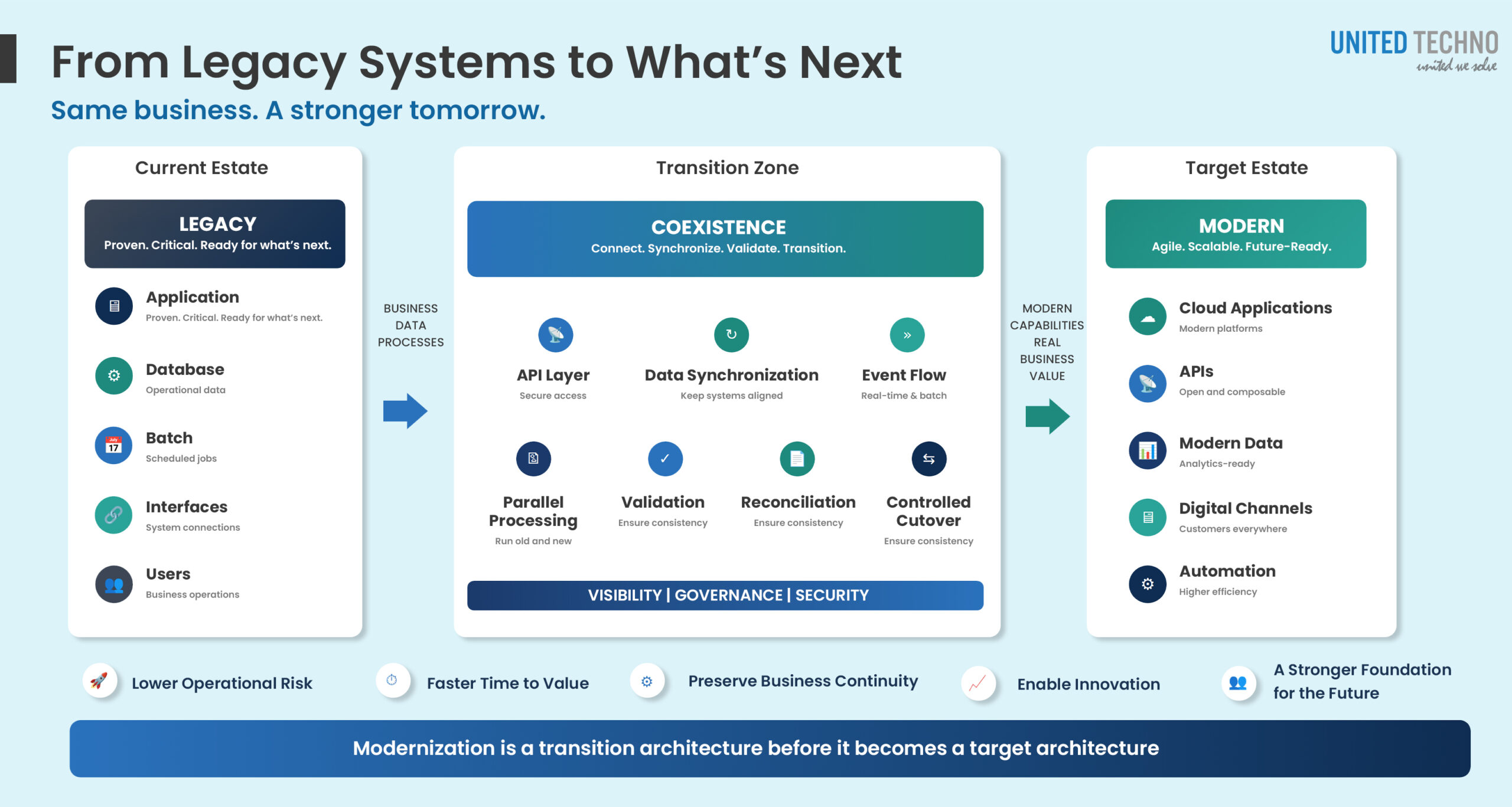
The New Architecture Should Not Become Dependent on the Old One
There is an important distinction in Legacy Application Modernization between using the legacy system during transition and building the new architecture around it.
If every new service continues to call the legacy application directly, modernization has created another dependency layer.
A better transition introduces controlled boundaries.
For example:
Digital Channel
↓
API / Integration Boundary
↓
Modern Capability
↓
Legacy Dependency – temporarily
The legacy system remains behind the boundary.
Over time:
Legacy Dependency ↓
Modern Capability ↑
That is a much more controlled path toward retirement.
The transition architecture should therefore make the old system increasingly less relevant, rather than making the new architecture increasingly dependent on it.
Data Is Where Coexistence Gets Difficult
Application code can be separated.
Data is harder.
During Legacy Application Modernization, there may temporarily be two applications that need access to the same customer, order, product, or inventory information.
That creates a dangerous condition:
Two systems can believe they are correct.
Consider inventory.
The legacy application records:
100 units
The new platform records:
96 units
Which one should commerce use?
Which one should the warehouse use?
Which number should finance reconcile?
Modernization therefore needs an explicit data ownership model.
For each important data domain, establish:
- System of record
- Data owner
- Read/write authority
- Synchronization mechanism
- Conflict resolution
- Reconciliation method
- Migration completion criteria
Without this discipline, application modernization can create a data-consistency problem that did not exist before.
Don’t Migrate Everything at the Same Speed
A common mistake in Legacy Application Modernization is creating one enterprise migration schedule.
Applications have different risk profiles.
A customer-facing transaction platform may require extensive parallel validation.
An internal reporting application may not.
A regulatory workload may require a longer evidence period.
A low-value batch process may be retired rather than migrated.
Modernization waves should therefore be based on business risk and architectural dependency, not simply application size.
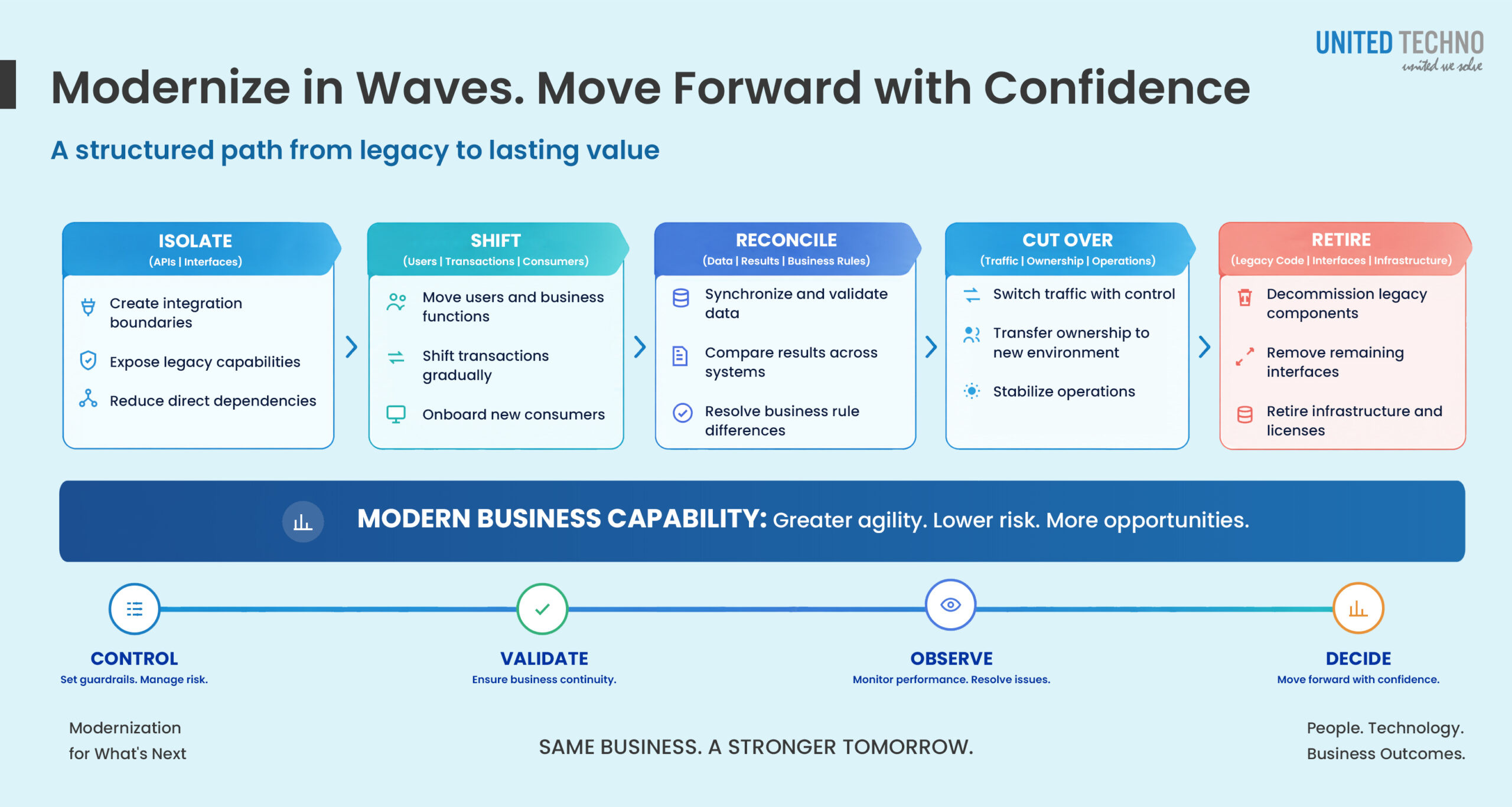
A practical sequencing model is:
WAVE 1 – ISOLATE
Create interfaces around the legacy capability.
WAVE 2 – REDUCE
Move selected consumers away from the legacy implementation.
WAVE 3 – TRANSITION
Move the capability and its data into the modern environment.
WAVE 4 – VERIFY
Run reconciliation and operational validation.
WAVE 5 – RETIRE
Remove the legacy dependency only after evidence shows that it is no longer required.
This is substantially different from treating modernization as a single migration event.
The Cutover Is an Engineering Problem
A migration plan is incomplete without a cutover strategy.
Before switching production traffic, the architecture should establish:
Entry criteria
What must be true before the cutover?
Validation criteria
How will business behavior be verified?
Rollback criteria
What conditions trigger reversal?
Data reconciliation
How will old and new results be compared?
Operational readiness
Who owns the system after the switch?
Decommission criteria
When can the legacy platform actually be turned off?
This changes the conversation from:
“The new application is ready.”
to:
“The business can safely operate without the old application.”
Those are very different milestones.
United Techno Modernization Wave Model
Modernization Needs an Exit Strategy
One of the least discussed parts of Legacy Application Modernization is what happens after migration.
A legacy environment that remains online “just in case” continues to create:
- Infrastructure expense
- Security exposure
- Support requirements
- Operational complexity
- Data synchronization
- Licensing overhead
- Specialist dependency
Therefore, every modernization wave should have a legacy exit condition.
For example:
Capability migrated
→ consumers moved
→ data reconciled
→ monitoring stabilized
→ fallback window completed
→ interfaces removed
→ users migrated
→ legacy workload decommissioned
The final step is not migration.
It is removal of the dependency.
Where AI Can Improve the Modernization Process
AI is becoming useful in Legacy Application Modernization, but not because it magically converts legacy applications into modern ones.
Its stronger role is in the work surrounding the transformation.
It can assist with:
- Codebase analysis
- Dependency discovery
- Business-rule identification
- Documentation generation
- Test-case creation
- Code translation
- Data mapping analysis
- Impact assessment
- Test-result analysis
The architect still has to determine whether an identified rule is actually a business requirement, whether a dependency is safe to remove, and whether the proposed target architecture makes operational sense.
That distinction matters.
AI can process legacy complexity. Architecture decides what should survive it.
A Different Way to Measure Modernization
The number of applications migrated is an incomplete metric.
A successful Legacy Application Modernization program should also demonstrate that the enterprise has reduced its dependence on the old architecture.
Useful measures include:
| Transition measure | What it reveals |
| Legacy transactions remaining | Migration progress |
| Consumers still dependent on legacy | Coupling |
| Data reconciliation exceptions | Transition quality |
| Legacy interfaces retired | Dependency reduction |
| Modern capability adoption | Business transition |
| Cutover rollback events | Operational readiness |
| Legacy infrastructure decommissioned | Actual modernization |
| Change lead time | Architectural improvement |
The most meaningful end state is not:
“The new application is live.”
It is:
“The business no longer needs the old application to operate.”
The United Techno Modernization Framework
United Techno approaches legacy modernization around the transition architecture, not just the target architecture.
01 — MAP
Identify business capabilities, applications, interfaces, data ownership, dependencies, and operational constraints.
02 — SEGMENT
Break the legacy estate into capabilities that can be modernized independently.
03 — ISOLATE
Create APIs, integration boundaries, and controlled interfaces around legacy functionality.
04 — TRANSITION
Move consumers, transactions, data, and workloads in deliberate modernization waves.
05 — RECONCILE
Validate data, business behavior, integrations, performance, and operational outcomes.
06 — CUT OVER
Transfer ownership through controlled production transitions with explicit rollback criteria.
07 — RETIRE
Remove obsolete interfaces, infrastructure, licenses, code, and operational dependencies.
This makes modernization a controlled change program, rather than a high-risk rewrite.
The Goal Is Not a New Application. It Is a Smaller Legacy Footprint.
That is the architectural outcome that matters.
A successful Legacy Application Modernization program gradually changes the balance:
More modern capabilities.
Fewer legacy dependencies.
Less duplicated data.
Fewer fragile interfaces.
Lower operational dependency.
Greater freedom to change.
The legacy application does not have to disappear on day one.
It has to become less necessary with every modernization wave.
Modernize in Waves. Prove the Change. Retire the Dependency.
United Techno helps enterprises modernize complex legacy estates across IBM i/AS400, mainframe, client-server, custom enterprise applications, legacy databases, APIs, integration platforms, and cloud environments.
The focus is not simply moving an application from one environment to another.
It is designing the transition architecture, managing coexistence, protecting business continuity, and systematically reducing the legacy footprint until the organization can operate on a modern foundation.
Start Your Legacy Modernization Assessment
Talk to United Techno →