
NetSuite can centralize finance, operations, customer information, inventory, and commercial processes.
But an ERP does not operate in isolation.
The order may begin on an eCommerce platform. The customer may originate in a CRM. Inventory may be managed by a warehouse system. A carrier may provide shipment events. Payments may come through a separate platform. Suppliers may exchange transactions through EDI. Business leaders may expect all of that information to appear consistently in NetSuite and downstream analytics.
That is where integration becomes an enterprise architecture problem.
The objective is not simply to connect NetSuite to more applications. It is to make the business behave like one connected operation.
That distinction is at the center of how United Techno approaches NetSuite ERP integration Services.
The Problem Is Not Connectivity. It Is Continuity.
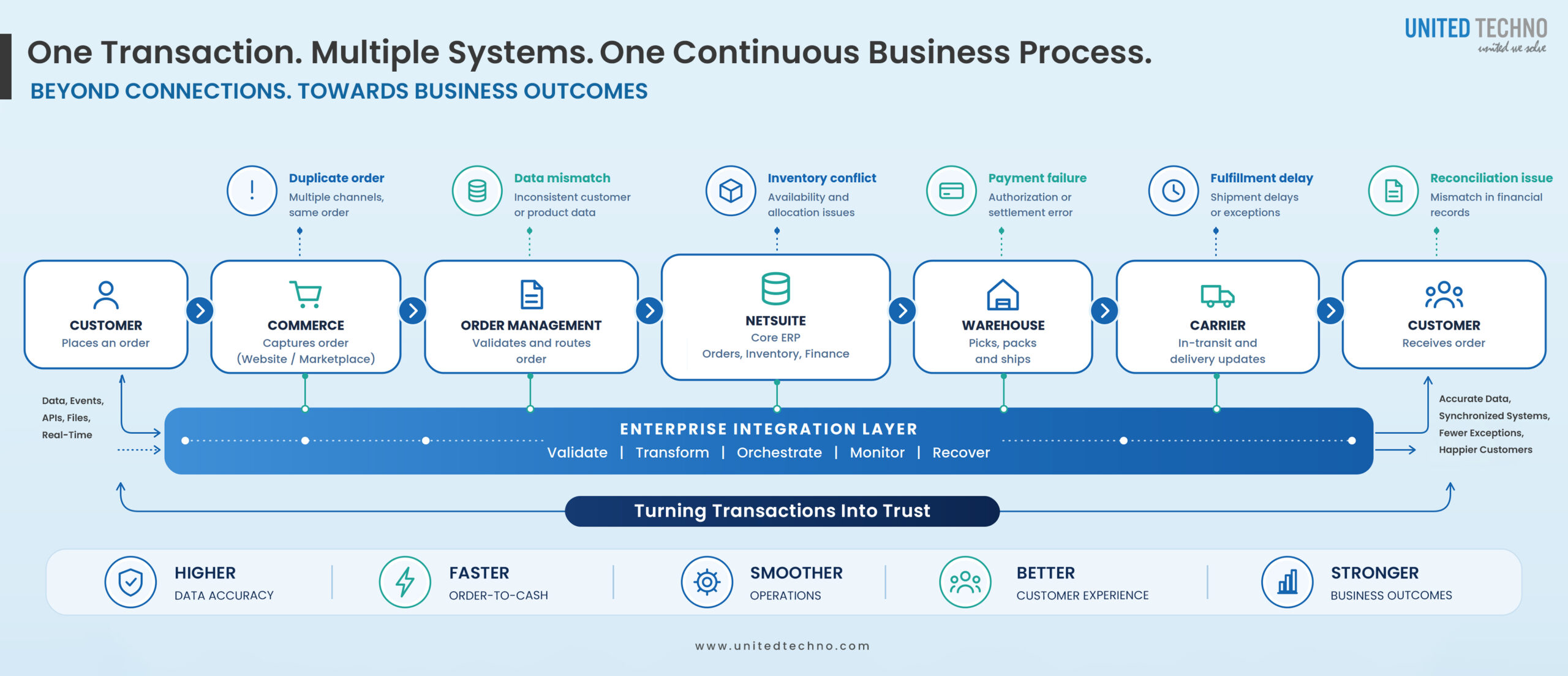
A typical enterprise transaction can cross half a dozen systems before it is complete.
Consider an order:
Customer → Commerce → Order Management → NetSuite → Warehouse → Carrier → Customer
Now add payments, returns, customer service, tax, promotions, inventory allocation, and financial reconciliation.
The transaction becomes a chain of dependencies.
If one system receives outdated information, the problem rarely remains inside that application.
An inventory discrepancy can become an oversold product.
A delayed fulfillment message can become a customer-service issue.
A failed payment update can create a reconciliation problem.
A duplicate order can affect inventory, revenue, fulfillment, and reporting simultaneously.
This is why we view NetSuite ERP integration Service differently:
Integration quality should be measured by the continuity of the business transaction, not by whether an API successfully exchanged a message.
That is a much higher standard.
The Enterprise Transaction Continuity Model
NetSuite ERP Integration Service Should Be Part of the Operating Architecture
One of the common mistakes in ERP integration is treating NetSuite ERP Integration Service as the destination for everything.
It is not.
Different applications often have legitimate ownership of different business capabilities.
For example:
| Business Domain | Possible System of Record |
| Customer | CRM |
| Product | ERP / PIM |
| Inventory | ERP / WMS |
| Order | Commerce / OMS / ERP |
| Shipment | WMS / TMS |
| Payment | Payment Platform / ERP |
| Financial Record | ERP |
| Analytics | Enterprise Data Platform |
The architecture should determine where information is mastered, where it is consumed, and where business decisions are made.
Without that clarity, integration gradually becomes a collection of synchronization rules:
“Copy this field there.”
“Update that record when this changes.”
“Run this job every 15 minutes.”
That may work initially.
At scale, it becomes difficult to understand, govern, test, and change.
The Integration Layer Should Absorb Complexity
A growing organization rarely has just two applications connected to NetSuite ERP Integration Service.
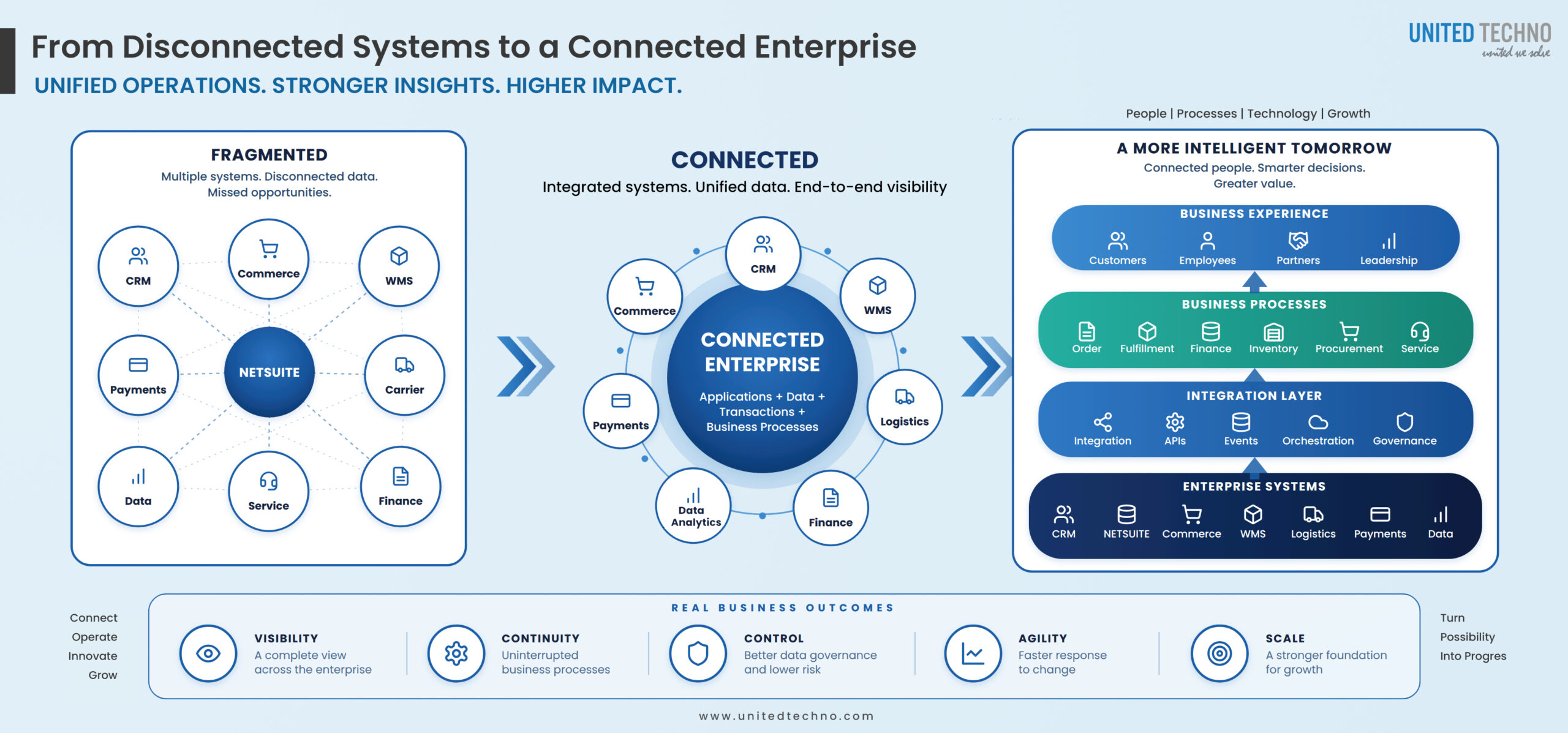
The landscape can quickly become:
CRM
↓
Commerce → Integration Layer → NetSuite ← WMS
↓
Customer Service
↓
Payments
↓
3PL / Carriers
↓
Data & Analytics
Without an architectural layer between applications, business logic starts appearing everywhere.
One application transforms data.
Another contains validation rules.
A third performs duplicate checking.
Someone eventually maintains a spreadsheet explaining what each integration actually does.
That is a warning sign.
A properly designed integration layer centralizes the concerns that should not be duplicated across every connection:
- Transformation
- Validation
- Routing
- Orchestration
- Error handling
- Retry management
- Security
- Monitoring
- Auditability
- Reusable business rules
The result is not simply fewer interfaces.
There is less dependency between applications.
Design Around Business Events, Not Screens
The most useful question during a NetSuite ERP integration service assessment is rarely:
“Which applications need to connect?”
Instead, ask:
“Which business events need to move through the enterprise?”
Examples include:
- Customer created
- Product introduced
- Order submitted
- Inventory allocated
- Purchase order approved
- Shipment dispatched
- Delivery confirmed
- Invoice generated
- Payment received
- Return initiated
- Refund completed
Once the business events are understood, the architecture becomes much clearer.
Each event can be evaluated for:
Source → Business Meaning → Transformation → Destination → Response → Exception
That creates a more resilient integration model than designing isolated point-to-point connections.
Real-Time Is a Design Decision – Not a Default
There is a tendency to describe modern integration as real-time integration.
That sounds attractive.
It is not always necessary.
A customer placing an order may require immediate processing.
Inventory availability may need near-real-time synchronization.
A financial reconciliation process may be perfectly suited to scheduled processing.
Historical data movement may be better handled through controlled batch processing.
The right architecture for a netSuite erp integration service therefore asks:
How quickly does the business actually need this information?
A useful model is:
Immediate
For transactions where delay directly affects the customer or operation.
Near Real-Time
For processes where short synchronization intervals are sufficient.
Scheduled
For high-volume, analytical, reconciliation, or administrative workloads.
This approach avoids creating an expensive real-time architecture where the business gains little from it.
The Hardest Part of Integration Happens After the Happy Path
Most integration designs demonstrate this:
System A → NetSuite → System B
Everything works.
Production is different.
What happens when NetSuite is temporarily unavailable?
What happens when the downstream application rejects a transaction?
What happens when the same order arrives twice?
What happens when inventory changes between two related transactions?
What happens when a required field is missing?
What happens when an external system changes its payload?
What happens when 10,000 transactions arrive instead of 1,000?
These are not edge cases in enterprise integration.
They are part of the architecture of a netSuite erp integration service.
A mature NetSuite ERP integration therefore needs a deliberate failure model:
Detect
Identify the failed transaction.
Classify
Determine whether it is a data, system, business-rule, or dependency failure.
Recover
Retry automatically where appropriate.
Reconcile
Determine what actually reached each system.
Escalate
Bring human attention to failures that require intervention.
Learn
Identify recurring failure patterns and eliminate their root causes.
An integration that works only when nothing goes wrong is not production-ready.
NetSuite ERP Integration Changes by Industry
The technology may be similar. The business risk is not.
Retail
Retail integration is heavily transaction-driven.
Commerce → Order → Inventory → Fulfillment → Shipment → Return → Finance
The architecture must keep customer-facing channels synchronized with operational and financial systems.
A delay of minutes can sometimes become a customer experience problem.
Manufacturing
Manufacturing integration follows a different chain:
Demand → Planning → Procurement → Production → Inventory → Finance
The challenge is maintaining consistency between operational transactions and the financial consequences of those transactions.
Logistics
Logistics environments are event-heavy.
Orders, warehouse movements, shipment milestones, carrier updates, delivery events, exceptions, and billing information may all move through different systems.
The integration architecture must therefore be designed for high event frequency and operational exceptions, not simply record synchronization.
Healthcare
Healthcare integration introduces stronger requirements around data governance, access, traceability, and controlled information exchange.
The architecture has to consider not only whether information moves, but also who should be able to access it, where it should reside, and how the transaction can be traced.
Financial Services
Financial processes demand a different level of transaction integrity.
Reconciliation, auditability, security, authorization, and controlled change become architectural priorities.
The same integration pattern that works for a retail workflow may be inappropriate for a financial transaction.
That is why United Techno does not approach NetSuite ERP integration service as a packaged connector exercise.
The architecture follows the business.
The Next Step: From Integration to Intelligent Operations
Once NetSuite is connected to the enterprise, another opportunity emerges.
The integration layer begins producing a valuable stream of operational information.
Orders.
Inventory movements.
Payments.
Shipments.
Returns.
Customer interactions.
Exceptions.
Failures.
These signals can become inputs to intelligent decision-making.
For example:
Order + Inventory + Fulfillment Data
can help identify potential fulfillment issues before they become customer complaints.
Payment + Transaction + Customer Data
can help surface unusual transaction patterns.
Inventory + Sales + Historical Data
can support demand and replenishment decisions.
Integration Errors + Business Impact
can help prioritize which failures require immediate intervention.
This is where integration becomes more than infrastructure.
It becomes part of the organization’s decision architecture.
A United Techno Approach to NetSuite Integration
At United Techno, we structure NetSuite ERP integration service programs around seven practical stages.
01 – MAP
Understand the application landscape, business processes, transactions, dependencies, and integration pain points.
02 – ASSIGN
Define data ownership and establish the authoritative source for critical business entities.
03 – ARCHITECT
Determine the right combination of APIs, events, batch processing, files, middleware, and orchestration.
04 – ENGINEER
Build reusable integrations with transformation, validation, security, exception handling, and recovery mechanisms.
05 – GOVERN
Establish standards for interfaces, credentials, data quality, versioning, monitoring, and operational ownership.
06 – OBSERVE
Monitor not only technical performance, but also business transaction health.
07 – OPTIMIZE
Use production insights to improve reliability, throughput, reuse, cost, and business outcomes.
This creates a different objective from simply completing an integration project.
The goal is to create an integration capability that can continue evolving with the enterprise.
Measure the Business, Not Just the Interface
An integration dashboard can tell you:
- API response time
- Message volume
- Failed transactions
- Processing duration
- Retry counts
Those metrics matter.
But executives need another layer of measurement.
Business Integration KPIs
| Metric | What It Reveals |
| Order processing time | Transaction efficiency |
| Inventory synchronization accuracy | Operational reliability |
| Manual reconciliation volume | Automation effectiveness |
| Exception resolution time | Recovery maturity |
| Failed transaction rate | Integration stability |
| New-system onboarding time | Architectural agility |
| Duplicate transaction rate | Data integrity |
| Integration-related incidents | Operational risk |
| Cost per transaction | Integration economics |
The strongest NetSuite ERP integration programs connect technical metrics to business outcomes.
The Real Goal Is Not a Connected ERP
A connected ERP is useful.
A connected enterprise is more valuable.
The difference is significant.
A connected ERP exchanges information.
A connected enterprise understands:
- where information originates,
- who owns it,
- where it needs to go,
- how quickly it must move,
- what happens when it fails,
- and what business decision depends on it.
That is the level at which NetSuite ERP integration starts delivering strategic value.
United Techno Perspective
NetSuite should not become another island inside an already fragmented technology landscape.
It should sit within an architecture where applications, data, transactions, and business processes work together without forcing people to manually bridge the gaps.
That is the real purpose of enterprise integration.
Connect less for the sake of connectivity. Architect more for the sake of business continuity.
United Techno helps enterprises assess, architect, build, modernize, and manage NetSuite integration environments across ERP, CRM, commerce, WMS, logistics, finance, B2B, analytics, and enterprise applications.
Is NetSuite at the center of your business but not yet at the center of your operations?
Talk to United Techno about designing a NetSuite ERP integration architecture built around your business processes, data ownership, transaction volumes, and growth roadmap.