Why High-Performing Enterprises Are Reengineering Their Analytics Foundation
Your Dashboards Are Only as Fast as Your ELT Pipelines.
Every executive wants real-time analytics.
Few organizations have the data engineering foundation to deliver it consistently.
As enterprises scale from gigabytes to petabytes of operational data, traditional ETL architectures often struggle with latency, governance, cloud costs, and engineering complexity. ELT data pipelines change that equation by enabling faster analytics, cloud-native scalability, and AI-ready data platforms.
The question is no longer whether to modernize.
It’s how quickly your analytics platform can keep pace with business growth.
Schedule Your Enterprise ELT Architecture Assessment
Analytics at Enterprise Scale
Enterprise Systems
│
▼
Cloud ELT Pipelines
│
▼
Modern Data Platform
│
▼
Business Intelligence
│
▼
Predictive Analytics
│
▼
Generative AI
Key Insight
Every advanced analytics initiative depends on one foundational capability:
Reliable, scalable ELT pipelines.
Analytics Has a Scale Problem
Organizations have invested heavily in Snowflake, Databricks, Microsoft Fabric, Power BI, Tableau, and AI platforms.
Yet many executive teams continue asking the same questions:
- Why is yesterday’s sales dashboard still refreshing?
- Why do finance and operations report different revenue numbers?
- Why does onboarding one new ERP take three weeks?
- Why does every analytics initiative require rebuilding pipelines?
- Why are cloud compute costs increasing while dashboard performance declines?
The challenge is rarely visualization. It is almost always the data engineering layer underneath.
Industry Snapshot
Enterprise Data Growth
2026 Enterprise Analytics Reality
Structured Data ████████████
Semi-Structured Data ██████████████████
Streaming Data ███████████████
Machine Data ███████████████████
AI Data ███████████████████████
What Industry Reports Show
| Enterprise Trend | Industry Observation |
| Annual enterprise
data growth |
30–40% YoY across many organizations (IDC) |
| Analytics engineering effort | Up to 80% spent preparing and validating data instead of generating insights (industry benchmark commonly cited by IBM and others) |
| Data quality impact | Poor data quality continues to cost organizations millions annually in operational inefficiencies (IBM) |
| Cloud analytics
adoption |
Cloud-native data platforms continue to dominate enterprise modernization initiatives (Gartner/IDC trends) |
Insight: Organizations don’t need more dashboards. They need better data movement.
Where Analytics Projects Lose Time
Business Questions
│
▼
Dashboard Development
│
▼
WAITING FOR DATA
██████████████████████
Visualization
██
Insights
███
Decision Making
████
Nearly every analytics initiative spends more time preparing data than delivering insights.
Why ELT Has Become the Enterprise Standard
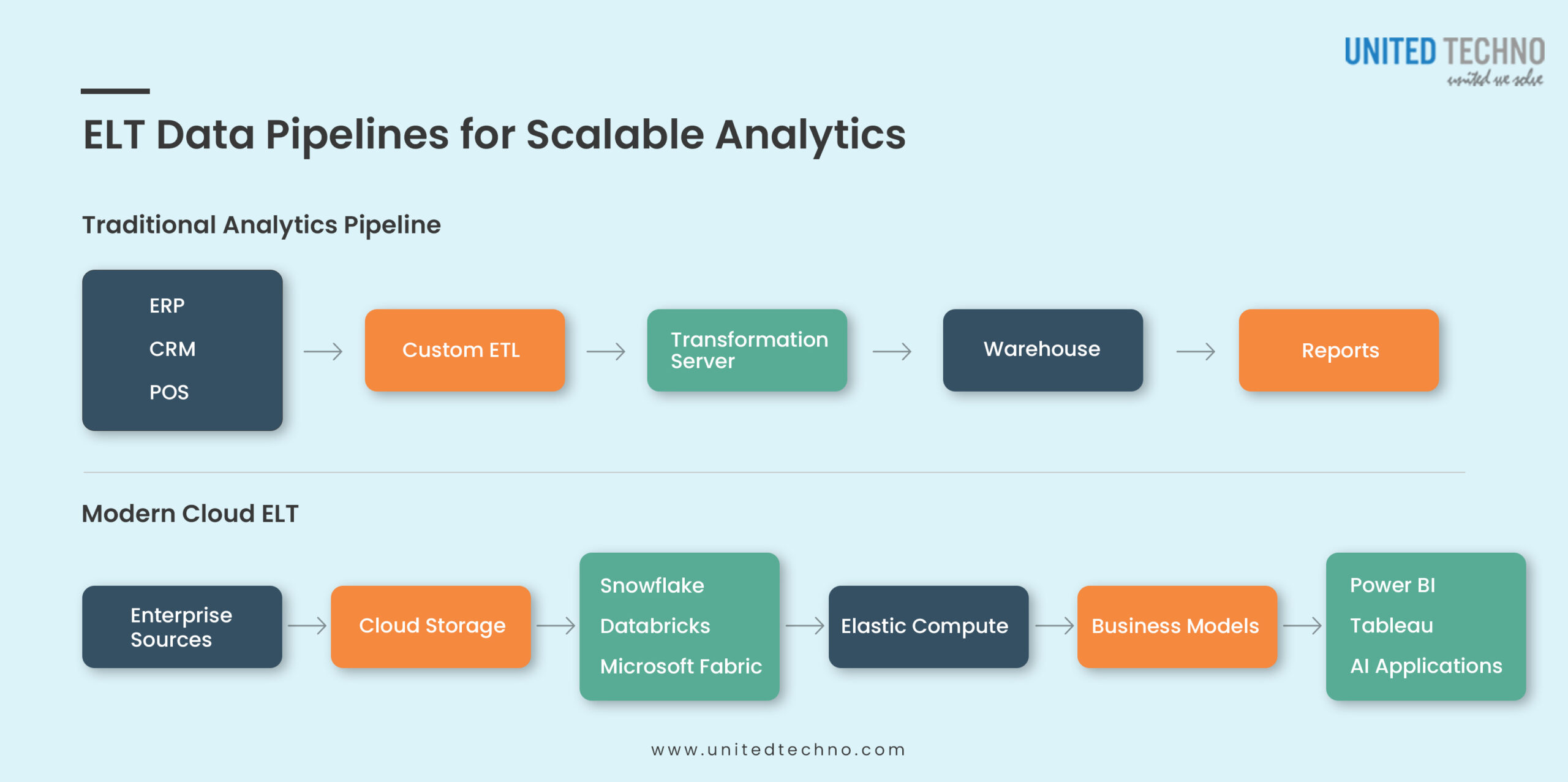
Traditional ETL architectures transform data before loading it into the warehouse. Modern cloud platforms reverse that model through ELT data pipelines.
They ingest data first and leverage cloud-scale compute for transformations. The result is a more flexible, scalable, and analytics-friendly architecture.
Traditional Analytics Pipeline
ERP
CRM
POS
↓
Custom ETL
↓
Transformation Server
↓
Warehouse
↓
Reports
Modern Cloud ELT
Enterprise Sources
↓
Cloud Storage
↓
Snowflake
Databricks
Microsoft Fabric
↓
Elastic Compute
↓
Business Models
↓
Power BI
Tableau
AI Applications
What High-Performing ELT Pipelines Have in Common
Metadata-Driven Ingestion
Rather than engineering every pipeline manually, leading organizations define ingestion patterns through reusable metadata.
Business Outcome:
- Faster onboarding
- Standardized architecture
- Lower engineering effort
Incremental Processing
Only changed records are processed.
Benefits include:
- Reduced cloud compute consumption
- Lower execution times
- Faster dashboard refresh cycles
Automated Data Quality
Quality validation becomes part of every pipeline.
Checks include:
- ✔ Null validation
- ✔ Duplicate detection
- ✔ Schema drift monitoring
- ✔ Referential integrity
- ✔ Business rule validation
Built-In Observability
Modern ELT platforms provide visibility into:
- Pipeline failures
- SLA breaches
- Refresh latency
- Data lineage
- Downstream business impact
Cloud-Native Scalability
Storage and compute scale independently. Analytics teams process terabytes or petabytes without redesigning pipelines.
Analytics Maturity Dashboard
LEVEL 1
Spreadsheet Reporting
■□□□□□□□□□
LEVEL 2
Traditional BI
■■■□□□□□□□
LEVEL 3
Centralized Warehouse
■■■■■□□□□□
LEVEL 4
Modern ELT Platform
■■■■■■■■□□
LEVEL 5
Real-Time AI Analytics
■■■■■■■■■■
Analytics KPI Dashboard
Imagine a CIO dashboard measuring pipeline performance.
| KPI | Target |
|---|---|
| Pipeline Success Rate | 99.9% |
| Average Refresh Time | <15 minutes |
| New Source Onboarding | <3 days |
| Data Quality Compliance | >99% |
| Pipeline Automation | >90% |
| Production Monitoring Coverage | 100% |
These KPIs directly influence executive confidence in analytics.
Where United Techno Delivers Value
Technology alone does not create scalable analytics. Engineering discipline does.
United Techno helps organizations modernize analytics platforms through DataAccel—its metadata-driven data engineering framework designed to accelerate enterprise ELT data pipelines and implementations.
Instead of developing ELT data pipelines individually, DataAccel standardizes engineering across ingestion, validation, transformation, orchestration, and monitoring.
The result is a repeatable approach that improves delivery speed while maintaining governance and operational consistency.
DataAccel at a Glance
150+ Tables Managed
│
10+ Enterprise Sources
│
Metadata Configuration
│
Automated ELT Generation
│
80+ Incremental Pipelines
│
70+ Historical Loads
│
Monitoring
│
Analytics Ready
Representative Outcomes
Organizations implementing standardized ELT engineering practices commonly realize benefits such as:
| Business Outcome | Typical Impact |
|---|---|
| Source onboarding | Days instead of weeks |
| Engineering productivity | Higher through metadata-driven automation |
| Pipeline consistency | Improved governance and standardization |
| Operational visibility | Faster detection and resolution of failures |
| Analytics readiness | Faster delivery of trusted datasets for BI and AI |
For United Techno engagements leveraging DataAccel, representative project outcomes have included:
- 150+ enterprise data tables orchestrated
- 10+ heterogeneous systems integrated
- 80+ incremental ELT pipelines deployed
- 70+ historical data migration pipelines automated
- Production-ready delivery in approximately 45 days for appropriate project scopes
Executive Checklist
Before scaling your analytics platform, ask:
- Can your pipelines process growing data volumes without redesign?
- Are new enterprise systems onboarded through reusable patterns?
- Is data quality validated before analytics consumption?
- Can every dashboard metric be traced to its source?
- Are pipeline failures identified before business users report them?
- Is your ELT architecture prepared for AI and real-time analytics?
If several of these questions remain unanswered, the limiting factor is unlikely to be your BI platform—it is your ELT architecture.
Final Perspective
The next generation of enterprise analytics will not be defined by better dashboards. It will be defined by better data engineering.
Organizations that invest in scalable, cloud-native ELT data pipelines create a foundation for trusted analytics, operational agility, and AI-driven decision-making. Those that continue to rely on fragmented, manually engineered pipelines will find it increasingly difficult to keep pace with growing data volumes and business expectations.
Scalable analytics begins long before a dashboard is built. It begins with engineering ELT data pipelines that are resilient, observable, governed, and designed to evolve with the enterprise.
Ready to Modernize Your ELT Architecture?
Whether you’re building a modern analytics platform on Snowflake, Databricks, or Microsoft Fabric, United Techno helps enterprises design and implement scalable ELT pipelines that support enterprise reporting, advanced analytics, and AI initiatives.
Request a Complimentary ELT Pipeline Assessment →
Our specialists will evaluate your current architecture, identify scalability bottlenecks, and provide a roadmap for a high-performance, cloud-native analytics platform.