A Strategic Buyer’s Guide to Choosing the Right Data Integration Platform for Enterprise Growth
The Most Important ETL Decision You’ll Make in 2026 Isn’t About Choosing a Tool
It’s about choosing the right data engineering strategy.
Every year, organizations invest millions in modern data platforms, cloud migrations, analytics initiatives, and AI programs. Yet many continue to face the same challenges, often because they haven’t selected the Best ETL & ELT Tools to support their evolving data integration and transformation needs.
- Business reports that don’t match
- Delayed executive dashboards
- Rising cloud processing costs
- Increasing pipeline complexity
- Slow onboarding of new applications
- Data quality issues impacting business decisions
The challenge isn’t a shortage of ETL or ELT tools.
It’s selecting the right platform for the right business problem—and implementing it within a scalable engineering framework.
Executive Perspective
The organizations extracting the greatest value from data aren’t necessarily using the most popular ETL platform. They’re using one of the Best ETL & ELT Tools that aligns with their business strategy, cloud architecture, governance model, and long-term analytics roadmap.
Meet David, Chief Data Officer
David has narrowed his shortlist to several leading ETL and ELT platforms.
Each vendor promises:
- AI-powered automation
- Faster pipelines
- Low-code development
- Cloud-native scalability
- Better governance
- Lower operational effort
Every demonstration looks compelling.
The real question, however, isn’t “Which tool has more features?”
It’s:
“Which platform will support our business for the next five years?”
That shift, from product comparison to business alignment—is where successful modernization begins.
Enterprise Platform Selection Journey
Business Goals
│
▼
Data Strategy
│
▼
Architecture Assessment
│
▼
Platform Category
│
▼
Implementation
│
▼
Business Outcomes
Technology should follow strategy, not define it.
A Different Approach to Platform Selection
At United Techno, we encourage organizations to evaluate platforms through the lens of business outcomes rather than feature lists.
Before comparing products, ask:
| Strategic Question | Why It Matters |
| What business decisions will this platform support? | Aligns technology with measurable outcomes |
| How many systems require integration? | Determines architectural complexity |
| What are the latency requirements? | Helps determine ETL, ELT, streaming, or hybrid architecture |
| What governance standards must be met? | Influences metadata, lineage, and data quality |
| What is the long-term cloud strategy? | Ensures future scalability |
Organizations that answer these questions first typically make more sustainable technology investments.
DataAccel: Strategy Before Software
Technology alone doesn’t create a modern data platform.
A repeatable engineering approach does.
United Techno’s DataAccel framework helps organizations standardize data engineering through metadata-driven pipeline design, automated validation, orchestration, and governance.
Rather than replacing leading ETL or ELT platforms, DataAccel complements them by providing a consistent delivery methodology across diverse technology ecosystems.
Business Objectives
│
▼
Current Data Assessment
│
▼
Architecture Blueprint
│
▼
DataAccel Framework
│
▼
ETL / ELT Platform
│
▼
Trusted Analytics & AI
Enterprise ETL & ELT Platform Landscape (2026)
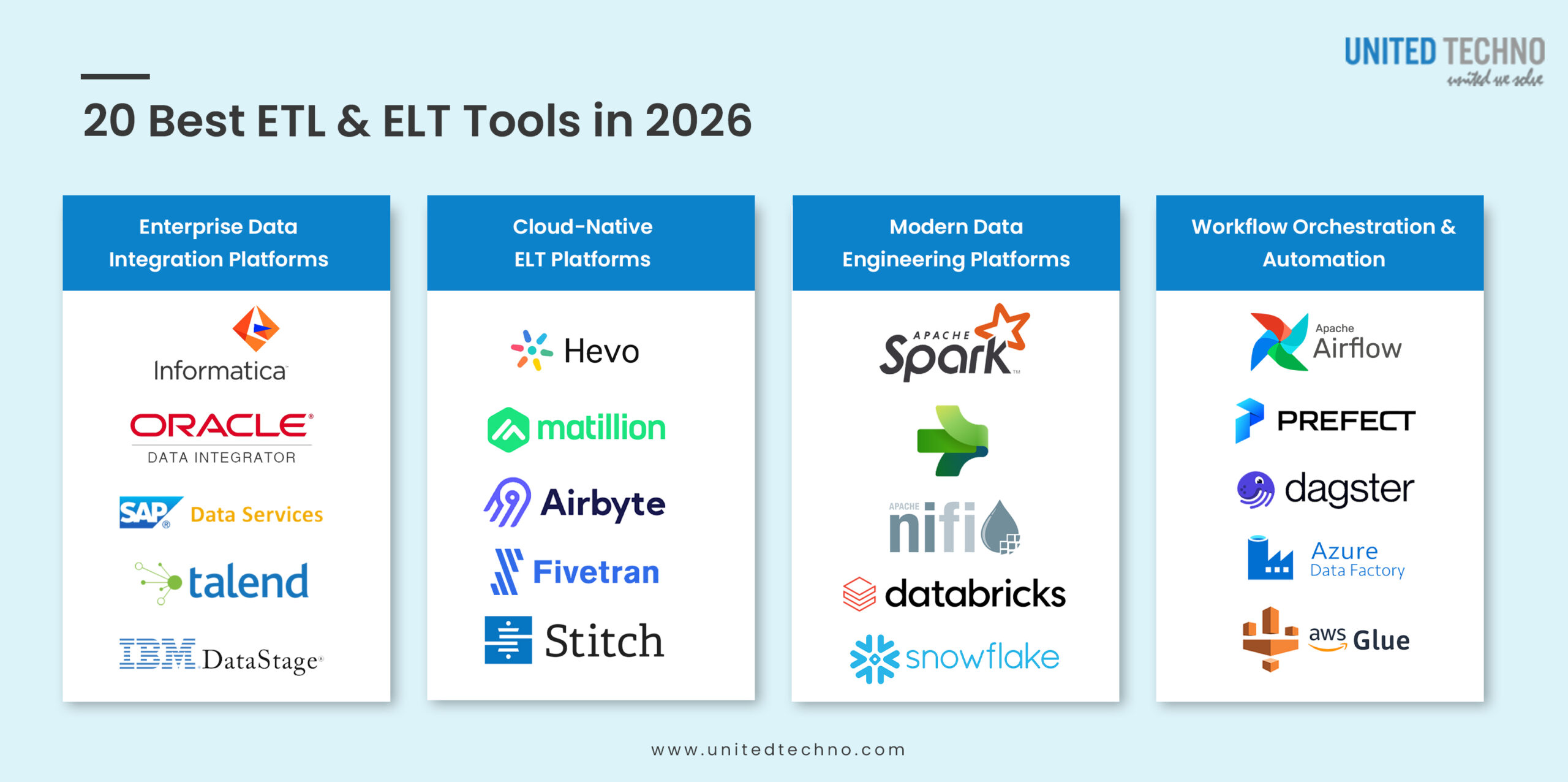
There is no universally “best” ETL tool. The best ETL & ELT tools vary based on enterprise requirements, as different platforms serve different business needs. The following categories reflect how architecture teams typically evaluate the market.
1. Enterprise Data Integration Platforms
Ideal for organizations modernizing complex enterprise environments with strong governance requirements.
| Platform | Typical Use Case |
| Informatica Intelligent Data Management Cloud | Enterprise-scale data integration & governance |
| IBM DataStage | Large transformation workloads |
| Talend Data Fabric | Integration with embedded data quality |
| Oracle Data Integrator | Oracle-centric ecosystems |
| SAP Data Services | SAP enterprise landscapes |
Consultant’s Note: These platforms are often selected by organizations managing large ERP, finance, and operational integration programs.
2. Cloud-Native ELT Platforms
Designed for cloud analytics, SaaS integration, and rapid data onboarding.
| Platform | Typical Use Case |
|---|---|
| Fivetran | Automated SaaS data ingestion |
| Matillion | Cloud-native ELT |
| Airbyte | Open-source connector ecosystem |
| Hevo Data | Rapid cloud integration |
| Stitch Data | Lightweight cloud pipelines |
Consultant’s Note: Cloud-native ELT platforms are frequently adopted alongside modern cloud data warehouses to accelerate analytics initiatives.
3. Modern Data Engineering Platforms
Built for high-scale analytics, AI, machine learning, and advanced data engineering.
| Platform | Typical Use Case |
| Databricks | Enterprise AI and large-scale data engineering |
| Microsoft Fabric Data Factory | Unified Microsoft analytics ecosystem |
| Snowflake | Cloud-native ELT and scalable analytics |
| Apache Spark | Distributed big data processing |
| Apache NiFi | Real-time data movement |
Consultant’s Note: These platforms are commonly used when organizations require advanced analytics, real-time processing, or AI-ready architectures.
4. Workflow Orchestration & Automation
Focused on pipeline scheduling, orchestration, and operational reliability.
| Platform | Typical Use Case |
| Apache Airflow | Enterprise workflow orchestration |
| Prefect | Python-based workflow automation |
| Dagster | Modern data asset orchestration |
| Azure Data Factory | Azure-native integration |
| AWS Glue | AWS-native ETL services |
Consultant’s Note: Orchestration platforms are often combined with ETL or ELT solutions to improve operational visibility and automation.
Which Platform Category Fits Your Business?
Legacy Modernization
│
▼
Enterprise Integration Platforms
────────────────────────────
Cloud Analytics
│
▼
Cloud-Native ELT Platforms
────────────────────────────
AI & Machine Learning
│
▼
Modern Data Engineering Platforms
────────────────────────────
Workflow Automation
│
▼
Pipeline Orchestration Platforms
Enterprise Data Engineering Maturity
Level 1
Department Integrations
■□□□□□□□□□
Level 2
Enterprise ETL
■■■□□□□□□□
Level 3
Cloud Data Platform
■■■■■□□□□□
Level 4
Standardized Engineering
■■■■■■■■□□
Level 5
AI-Ready Enterprise
■■■■■■■■■■
Technology enables progress.
Standardized engineering accelerates it.
Executive Integration Scorecard
The most successful organizations measure business outcomes, not the number of pipelines deployed.
| KPI | Why It Matters |
| Time to onboard new data sources | Business agility |
| Data quality compliance | Trust in analytics |
| Pipeline observability | Operational resilience |
| Metadata coverage | Governance readiness |
| Data freshness | Better decision-making |
| Reusable pipeline assets | Engineering productivity |
Final Perspective
The ETL and ELT landscape has never been richer, with organizations having access to some of the best ETL & ELT tools available today.
Yet successful data modernization is rarely determined by software alone.
Organizations that consistently deliver trusted analytics and scalable AI capabilities begin by defining business priorities, standardizing engineering practices, and selecting technologies that align with long-term enterprise objectives.
The most valuable question in 2026 is no longer:
“Which ETL tool is the best?”
It is:
“Which data integration strategy will best support our business over the next decade?”
The answer will be different for every organization—and that’s precisely why platform selection should be guided by strategy rather than popularity.
Ready to Build the Right Data Integration Strategy?
Whether you’re modernizing legacy ETL, adopting cloud-native ELT, or evaluating the best ETL & ELT tools for your next analytics initiative, United Techno helps organizations make informed, strategy-led decisions.
Through our DataAccel Advisory Framework, we assess:
- Current data architecture
- Integration maturity
- Business-critical data flows
- Cloud modernization strategy
- Governance and compliance requirements
- AI and analytics readiness
- Platform alignment
The outcome isn’t just a technology recommendation, it’s a practical roadmap for building a scalable, future-ready data engineering foundation.
Book Your Complimentary ETL & ELT Strategy Workshop →
Let’s evaluate your current integration landscape, identify modernization opportunities, and determine the platform approach that best aligns with your business goals.