How integration architects should evaluate the platform behind applications, APIs, data, and digital business
An enterprise integration platform is easy to judge when the requirement is simple:
Connect two systems. Move the data. Finish the project.
That is no longer how enterprise integration works.
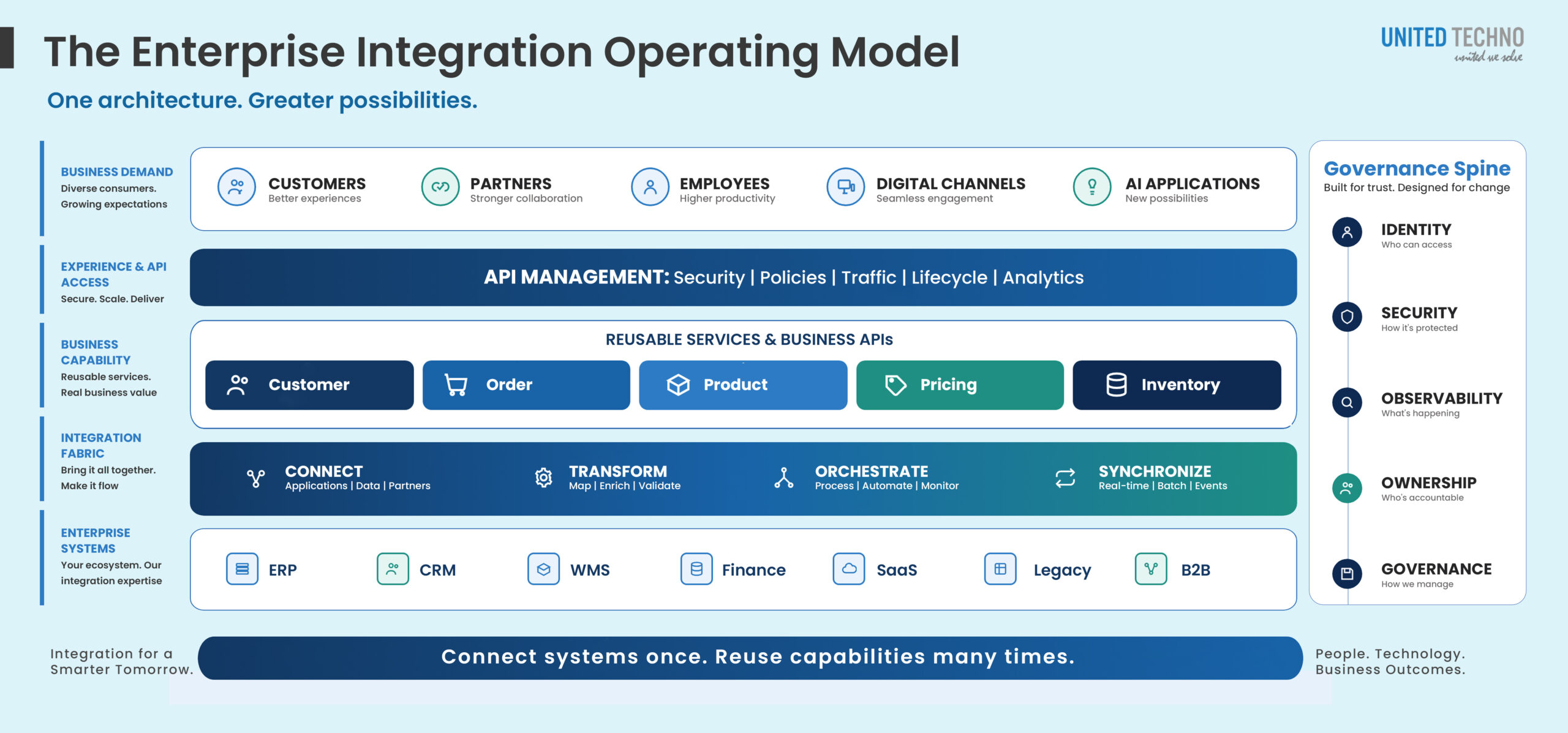
A modern order may begin in commerce, pass through pricing and payment, reach an ERP, trigger inventory updates, generate a warehouse transaction, notify a carrier and expose status through a customer API.
Now introduce legacy applications, B2B partners, mobile channels, events, data platforms and AI applications.
The integration layer becomes something much bigger:
It becomes the mechanism through which business capabilities move across the enterprise.
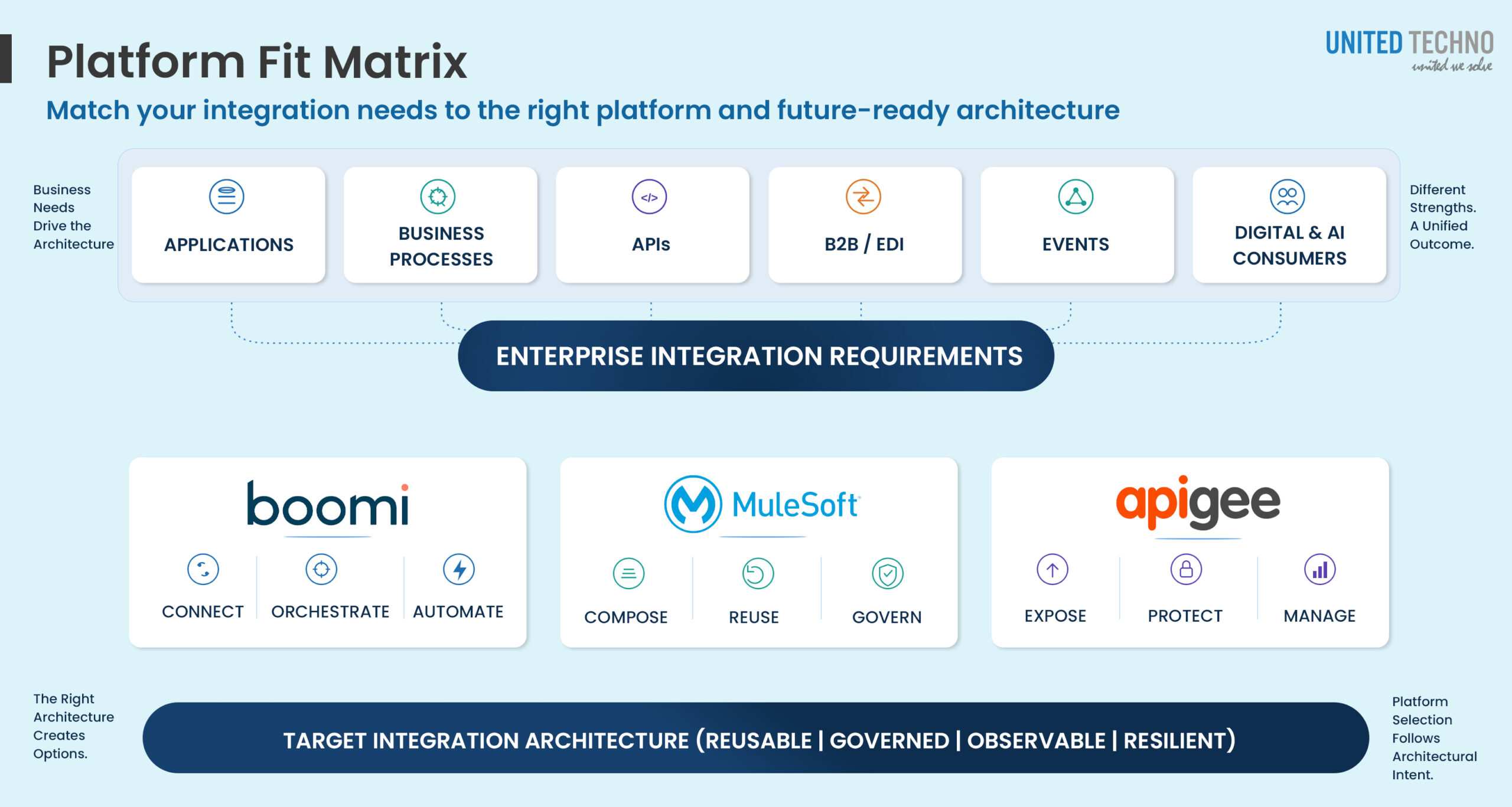
That is why Boomi vs MuleSoft vs Apigee should not be evaluated as three versions of the same product.
They address different architectural priorities.
Start With the Problem, Not the Platform
A useful integration architecture begins with one question:
What is becoming difficult to change?
If every new application requires another point-to-point connection, the problem is connectivity.
If valuable business capabilities are buried inside applications, the problem is reuse.
If APIs are multiplying without consistent security, ownership or lifecycle controls, the problem is API governance.
If partners, customers and digital channels are consuming enterprise capabilities at increasing scale, the problem becomes controlled API exposure.
These are related problems.
They are not identical problems.
And that distinction should drive the platform conversation, especially when evaluating Boomi vs MuleSoft vs Apigee for enterprise integration, API governance, and connectivity requirements.
The Integration Layer Has Four Jobs
A mature enterprise integration architecture usually has to perform four fundamental jobs.
1. CONNECT
Bring applications, data sources and external systems together.
2. ORCHESTRATE
Coordinate a business transaction that crosses multiple systems.
3. EXPOSE
Turn internal capabilities into reusable APIs and services.
4. CONTROL
Apply security, policies, monitoring, lifecycle management and operational discipline.
Boomi vs MuleSoft vs Apigee can participate in these areas, but their architectural emphasis differs.
That is where the comparison becomes useful.
Boomi: When the Enterprise Needs a Stronger Connectivity Fabric
Boomi fits naturally into environments where the integration challenge is broad.
Think about an enterprise with:
ERP + CRM + SaaS + WMS + Finance + Legacy + EDI + APIs + Cloud
The problem is not one complicated API.
It is the sheer number of things that need to be communicated.
The architecture needs a common way to:
- Connect applications
- Transform information
- Orchestrate transactions
- Integrate partners
- Expose APIs
- Handle errors
- Monitor execution
- Manage integration assets
Boomi can serve as that broader integration fabric.
The architectural question becomes:
How can the enterprise reduce the complexity of connecting everything without creating another collection of isolated interfaces?
That makes Boomi particularly relevant when application connectivity and operational integration are the dominant concerns.
MuleSoft: When Connectivity Needs to Become Reusable
MuleSoft brings a different architectural idea into the center:
Do not repeatedly integrate the same business capability.
Suppose customer information is scattered across CRM, ERP, commerce and service systems.
Instead of allowing every consumer to build its own connection, the architecture can create a reusable customer capability.
That capability can then support:
Mobile → Customer API
Commerce → Customer API
Service → Customer API
Partner → Customer API
The important shift is from:
System-to-system integration
to:
Capability-to-consumer integration
This is where API-led architecture becomes valuable.
The objective is not simply to expose more APIs.
It is to create reusable interfaces around business capabilities so that application change does not repeatedly propagate through the entire enterprise.
For organizations pursuing this model, MuleSoft becomes an important architectural consideration.
Apigee: When the API Becomes the Enterprise Boundary
Apigee sits in a different part of the architecture conversation.
Consider an enterprise exposing APIs to:
Customers | Partners | Developers | Mobile Applications | Digital Platforms
The concern is no longer only how the backend systems connect.
The concern becomes:
- Who can access the API?
- What can they access?
- How much traffic can they generate?
- Which policies apply?
- How are APIs versioned?
- How is usage monitored?
- How are consumers managed?
- What happens when traffic spikes?
That is an API management problem.
Apigee provides an API management layer around backend services, including API proxies, security controls, traffic management, quotas and analytics.
The architectural value is therefore concentrated around controlled API exposure and management.
The important distinction is subtle:
Integration moves business capability.
API management controls how that capability is consumed.
The Three Platforms Through an Architect’s Lens
| Architectural question | Boomi | MuleSoft | Apigee |
| How do applications connect? | Strong focus | Strong focus | Primarily through APIs |
| How are business processes orchestrated? | Core integration use case | Core integration use case | Not the central role |
| How are reusable APIs developed? | Supported | Strong architectural focus | Strong API management focus |
| How are APIs governed? | Supported | Strong capability | Core capability |
| How are B2B/EDI flows handled? | Strong fit | Supported | Not the primary architectural role |
| How are external API consumers managed? | Supported | Supported | Core strength |
| What should drive the decision? | Integration estate | Reusable business capabilities | API ecosystem and control |
This is not a scorecard.
It is a way of asking a better question:
Where does the enterprise need the greatest architectural control?
The Surprising Part: Enterprises May Need More Than One
A mature integration estate does not necessarily need to force every responsibility into one platform.
Consider this model:
DIGITAL CHANNELS
│
▼
API MANAGEMENT
│
▼
BUSINESS CAPABILITIES
│
▼
INTEGRATION & ORCHESTRATION
│
┌──────────┼────────────┐
▼ ▼ ▼
ERP CRM WMS
│
▼
DATA / EVENTS / PARTNERS
Here, different technologies can have clearly defined responsibilities.
The architectural objective is not platform consolidation at any cost.
It is responsibility consolidation.
- Every capability should have a clear owner.
- Every interface should have a reason to exist.
- Every API should have a defined consumer and lifecycle.
- Every critical transaction should be observable.
That is how an integration landscape stays manageable as it grows.
The Real Enemy Is Not Multiple Platforms
It is an uncontrolled overlap.
An enterprise can have Boomi, MuleSoft and Apigee and still maintain a clean architecture.
It can also have one platform and create a highly complicated integration estate.
The difference is governance.
Without architectural boundaries, teams can independently create:
- Duplicate APIs
- Multiple customer interfaces
- Parallel transformation logic
- Repeated integrations
- Inconsistent security policies
- Conflicting data contracts
- Separate monitoring approaches
- Interfaces with no accountable owner
The technology stack may look modern.
The architecture underneath it may still be fragmented.
What Should Be Evaluated Before a Platform Decision?
A platform assessment should begin with the existing estate.
Integration Density
How many systems depend on one another today?
Business-Critical Flows
Which transactions cannot tolerate delay or failure?
API Maturity
Are APIs simply endpoints, or are they treated as reusable business capabilities?
Transformation Complexity
How much data mapping, enrichment and business logic sits inside integrations?
Partner Complexity
How many external organizations, protocols and document formats are involved?
Operational Risk
Can the team identify a failed transaction, trace it across systems and recover it safely?
Change Impact
What happens when a system changes its data model, API or business rules?
Future Consumption
Will new digital channels, AI applications, partners or agents consume the same capabilities?
This assessment often reveals that the platform decision is actually a change-management decision.
The AI Question Changes the Architecture Again
AI introduces a new class of consumers.
An AI agent may need to:
- Check inventory
- Retrieve customer information
- Create an order
- Update a case
- Trigger a workflow
That does not mean the agent should receive direct access to enterprise databases and applications.
A controlled architecture looks more like:
AI Consumer
↓
Governed API / Business Capability
↓
Integration Layer
↓
Enterprise System
This creates a controlled boundary for identity, authorization, validation, transaction handling and observability.
The implication is significant:
As AI consumes more enterprise capabilities, poorly governed integration becomes an AI risk, not just an IT problem.
The platform decision therefore has to account for tomorrow’s consumers, not only today’s applications.
United Techno Platform Assessment Approach
A meaningful Boomi vs MuleSoft vs Apigee assessment should produce more than a recommendation.
United Techno approaches the decision through six architectural stages:
1. MAP
Understand applications, data, APIs, partners and business transactions.
2. TRACE
Follow critical business flows across the enterprise.
3. CLASSIFY
Separate integration, API, event, B2B and orchestration requirements.
4. ARCHITECT
Define the responsibilities of each technology layer.
5. FIT
Determine where Boomi vs MuleSoft vs Apigee or an existing platform fits.
6. ROADMAP
Create a practical migration, modernization and governance plan.
The result is a target architecture that answers the questions technology teams actually face:
- What should connect?
- What should become an API?
- What should be event-driven?
- What should remain in the batch?
- What should be consolidated?
- What should be retired?
- Where should governance sit?
The Platform Is Only One Part of the Decision
Boomi, MuleSoft and Apigee should not be treated as three products competing for a single checkbox.
They represent different architectural approaches to enterprise connectivity.
Boomi can become the integration fabric across a heterogeneous application landscape.
MuleSoft can support an architecture built around reusable APIs and business capabilities.
Apigee can provide the controlled management layer around an expanding API ecosystem.
And in a complex enterprise, those architectural roles can coexist when responsibilities are clearly defined.
The strongest integration strategy is therefore not the one with the most technology.
It is the one with the least unnecessary complexity.
Design the Integration Architecture Before Choosing the Platform
United Techno helps enterprises assess and modernize complex integration estates across Boomi, MuleSoft, Apigee, APIs, EDI, event-driven architectures, cloud environments and legacy systems.
From platform assessment and target architecture to implementation, migration and managed integration, the focus remains the same:
Make enterprise connectivity easier to change, govern and scale.
Start Your Integration Architecture Assessment →