
What happens when integration development moves from building components to describing outcomes?
The Integration Developer Is No Longer Starting With the Canvas
For two decades, enterprise integration has largely been a construction exercise.
A requirement arrives.
An architect decides how the transaction should move.
A developer opens the platform, creates connections, builds maps, configures processes, tests individual paths, fixes errors and eventually promotes the result.
That model works.
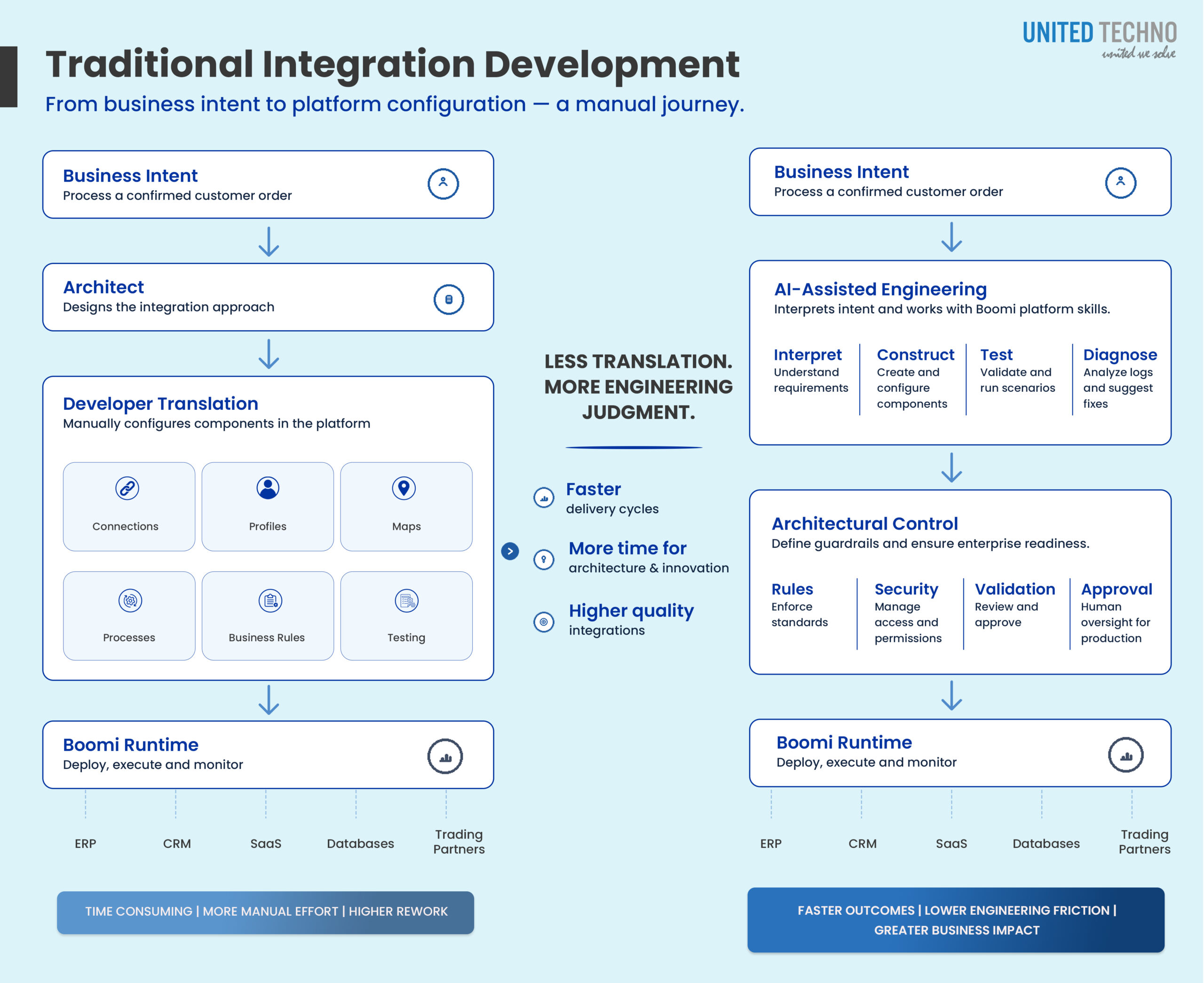
But it has an inherent limitation: people spend a significant amount of time translating business intent into platform configuration.
Boomi Companion changes that boundary.
Instead of beginning with a blank integration canvas, an engineer can begin with an intended outcome and allow an AI agent to work through parts of the implementation.
That sounds like a productivity improvement.
From an architect’s perspective, it is something more significant:
The interface between human intent and integration infrastructure is changing.
That deserves more attention than the usual conversation about AI making developers faster.
From Components to Outcomes
Consider a simple business requirement:
“When a confirmed order arrives, validate it, enrich the customer information, send it to the ERP and return an acknowledgement.”
Traditionally, the developer translates that sentence into:
- connector configuration
- profiles
- operations
- maps
- process shapes
- routing
- exception handling
- deployment configuration
- testing
The platform understands components.
The business understands outcomes.
The engineer has always been the translator between the two.
Boomi Companion introduces another possibility by helping engineers translate business requirements into integration implementations with AI assistance.
Business Intent
↓
Integration Interpretation
↓
Platform Construction
↓
Execution Feedback
↓
Engineering Review
The interesting change is not that fewer clicks are required.
It is that intent can become a more direct starting point for engineering work.
But Faster Construction Creates a New Problem
If integrations can be produced faster, organizations can also produce bad integrations faster.
This is where many AI discussions stop too early.
Boomi Companion can assist with integration implementation, but faster development does not automatically guarantee sound architectural decisions.
An integration can be technically valid and still be architecturally wrong.
Imagine an AI-generated order flow that works perfectly during testing.
But:
- the ERP becomes the wrong system of record;
- duplicate orders are not handled correctly;
- inventory events are processed synchronously when they should be asynchronous;
- retries create duplicate transactions;
- a partner-specific rule is overlooked;
- sensitive data crosses an inappropriate boundary.
The process may run.
The architecture may still fail.
That distinction becomes increasingly important as AI takes on more implementation work.
The Architect’s Job Moves Upstream
I have spent enough time around enterprise integration programs to know that the difficult part is rarely creating another connector.
The difficult part is deciding what should happen, where it should happen, and under which conditions.
That is why AI-assisted development does not eliminate the architect. With tools like Boomi Companion, it changes the architect’s position in the delivery chain.
Earlier model
Architect → Design → Developer → Build → Test → Deploy
Emerging model
Architect → Define Intent & Constraints → AI-Assisted Build → Validate → Govern → Deploy
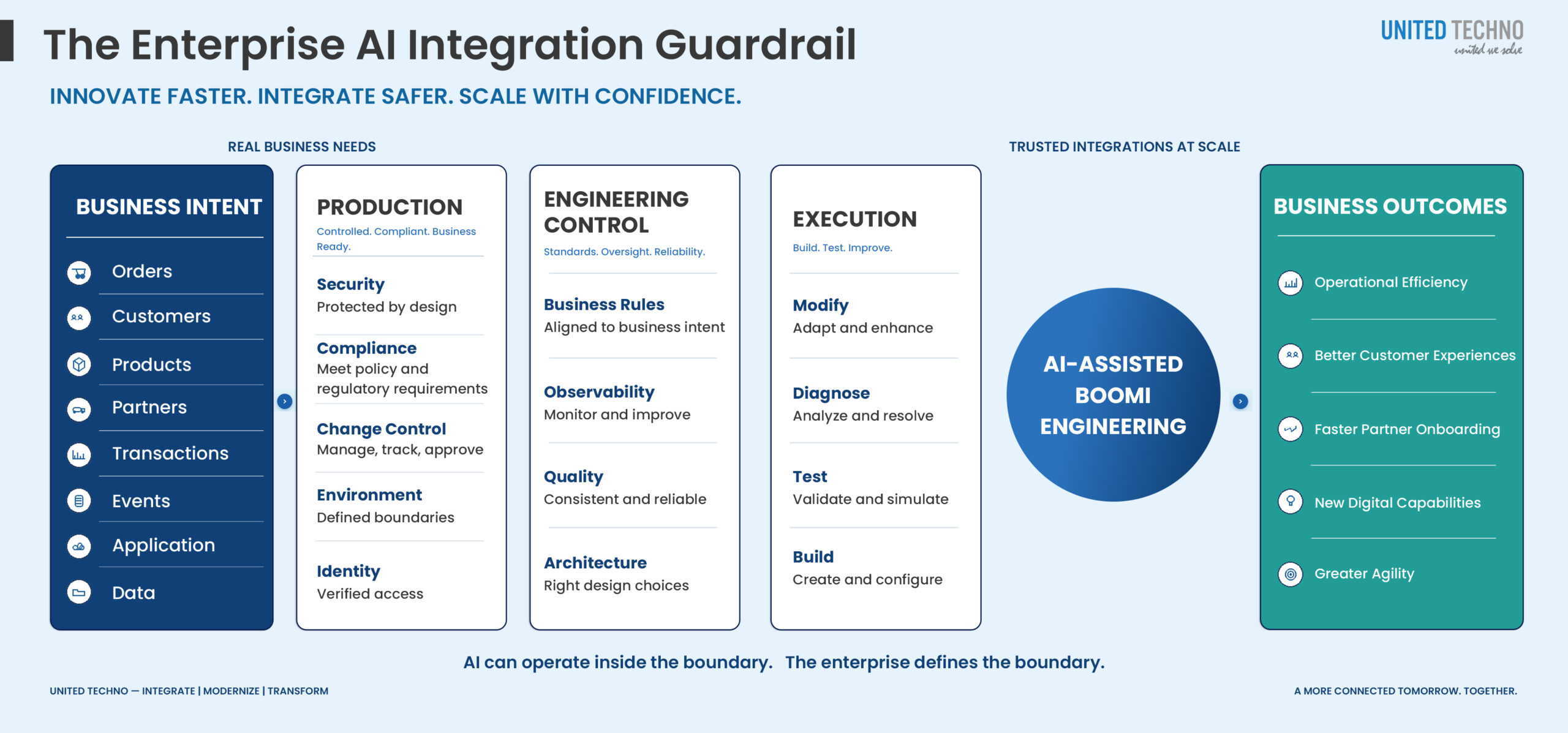
The architect becomes responsible for establishing the boundaries within which automated construction can safely occur.
That includes:
Business rules
What must the integration accomplish?
Ownership
Which system owns each piece of information?
Interaction model
Should the transaction be synchronous, asynchronous or event-driven?
Failure behavior
What happens when a dependency is unavailable?
Security
What data can move, and who can initiate the movement?
Operational behavior
How will the integration be monitored, recovered and maintained?
AI can help construct the answer.
It should not silently define the answer.
The New Unit of Productivity Is Not “Integrations Per Developer”
This is another area where enterprise teams should think differently.
If Boomi Companion reduces the time required to construct an integration, counting completed processes is an obvious metric.
It is also incomplete.
The more useful measurement is the distance between a business requirement and a production-ready outcome.
For example:
| Traditional Measure | More Useful Measure |
| Developer hours | Requirement-to-release time |
| Components created | Business processes enabled |
| Lines/configuration changed | Rework avoided |
| Number of integrations | Production-ready integrations |
| Build speed | Build-to-validation cycle |
| AI usage | Engineering friction removed |
This shifts the conversation away from:
“How much AI are we using?”
toward:
“What part of integration delivery became materially easier?”
That is a much better enterprise question.
Where Companion Becomes Particularly Interesting
The strongest use cases for Boomi Companion are not necessarily the most complicated ones.
They are often the areas where integration engineers repeatedly perform similar work.
EDI onboarding
A new trading partner can trigger a familiar sequence of mapping, profile, validation and testing activities.
Existing-process changes
An established process may need a connector change, new routing rule or additional downstream system.
Failure investigation
Execution logs, process structure and configuration can be examined together rather than reviewed manually in isolation.
API enablement
Existing integration logic can become the foundation for exposing reusable services.
Data movement
As integration and data capabilities converge, the same conversational development model can span operational integration and data workflows.
Prototype architecture
Architects can test an integration pattern before committing a development team to a larger implementation.
These are not replacements for engineering expertise.
They are opportunities to remove repetitive translation work from engineering expertise.
A Different Way to Think About AI-Assisted Integration
I would describe the emerging model as a five-layer progression:
01 — DESCRIBE
Explain the business requirement.
02 — CONSTRUCT
Translate intent into platform components.
03 — TEST
Execute the resulting process and examine behavior.
04 — CORRECT
Use execution evidence to identify and resolve problems.
05 — CONTROL
Keep human authority over architecture, security and production change.
That last layer is what separates enterprise engineering from experimentation.
The Intent-to-Integration Shift
The Production Boundary Matters More Than the Prompt
One of the easiest mistakes is to think of Companion as simply another conversational interface.
That misses the enterprise issue.
The important question is:
What happens between the moment an AI agent proposes a change and the moment that change becomes operational?
That boundary needs structure.
A mature implementation should distinguish:
Explore
Safe experimentation and architecture discovery.
Build
AI-assisted component creation and modification.
Validate
Functional, integration, security and failure-path testing.
Approve
Human review of material architectural changes.
Promote
Controlled movement through environments.
Observe
Production monitoring and operational feedback.
The AI can participate across these stages.
The organization still needs to determine where autonomous action stops and accountable engineering begins.
Governance Cannot Be Added After the Experiment
This is especially important for enterprises with large Boomi estates.
An AI-assisted development model using Boomi Companion should fit into the existing engineering operating model rather than creating a parallel one.
That means defining:
- approved AI agents
- service-account boundaries
- environment access
- development and production separation
- component ownership
- naming conventions
- reusable patterns
- review requirements
- deployment controls
- auditability
- rollback procedures
The objective is not to prevent AI from doing useful work.
It is to ensure that speed does not bypass the controls that made the integration estate reliable in the first place.
What I Would Pilot First
I would not start with the most business-critical integration in the company.
I would select a contained workflow where:
- the business outcome is clear;
- the integration pattern is repeatable;
- test data is available;
- production access can remain restricted;
- Success can be measured.
Then establish a baseline.
For example:
Current
Requirement → Design → Build → Test → Rework → Deploy
Measure the elapsed time.
Then introduce Boomi Companion for AI-assisted development.
Pilot
Requirement → AI-Assisted Build → Human Review → Test → Correct → Deploy
Measure the same workflow.
The question is not whether the AI produced something impressive.
The question is whether the engineering cycle became measurably better without increasing operational risk.
The Enterprise AI Integration Guardrail
The Bigger Shift Is Already Underway
Boomi Companion started around integration-focused development and has expanded rapidly across the Boomi platform. Current capabilities extend into areas including EDI, event-driven integration, master data, data integration and agent development.
That makes the long-term question more interesting than whether developers will use AI assistants.
The question is whether integration platforms themselves become environments where humans describe business intent and AI performs increasingly large portions of the engineering work under enterprise controls.
If that happens, integration architecture will become less about manually assembling every component and more about:
Intent.
Patterns.
Constraints.
Validation.
Governance.
Outcomes.
That is the shift worth watching.
United Techno Perspective
We see Boomi Companion as an opportunity to reconsider the integration delivery model, not simply add another developer tool.
The starting point should be the existing integration estate:
Where is the engineering effort being consumed?
Which patterns are repetitive?
Where are teams waiting on specialist knowledge?
Which changes can be safely accelerated?
Where must human architectural control remain absolute?
From there, enterprises can establish an AI-assisted engineering model that fits their existing Boomi architecture, delivery standards and governance framework.
The future of integration development may require fewer manual construction steps, but it will require better architectural decisions.
United Techno helps enterprises assess, modernize and govern Boomi integration environments for the next generation of AI-assisted engineering.