Why successful Boomi programs are less about connecting applications, and more about deciding how information should move across the enterprise
A business rarely has a single system that knows everything.
The commerce platform knows the order.
The ERP knows the financial transaction.
The WMS knows what is available to ship.
The CRM knows the customer relationship.
The carrier knows where the shipment is.
The data platform knows what happened across all of them.
The problem begins when those systems operate as separate versions of the same business.
That is where integration architecture matters.
Boomi can provide the technology layer for connecting applications, APIs, data sources, partners, and business processes. However, an effective Boomi Integration Strategy goes beyond simply creating connections. It involves designing how information should move, where decisions should happen, what should be reusable, and how the entire flow should be governed.
That distinction is what separates an integration project from an enterprise integration strategy.
The First Architecture Decision Is Not the Connector
When a new integration requirement arrives, the easiest question is:
“Which Boomi connector should be used?”
It is also the wrong place to begin.
An effective Boomi Integration Strategy starts with understanding the business requirements rather than selecting connectors. A Boomi architect should first determine:
- What business event starts the flow?
- Which system owns the information?
- Which systems consume it?
- How quickly does it need to move?
- What transformations are required?
- What happens when the destination is unavailable?
- Which applications need the same capability?
- How will the transaction be traced?
Consider a simple business event:
Order Confirmed
That event may trigger inventory allocation, payment processing, ERP updates, fulfillment, customer notifications, analytics, and downstream partner communication.
One business event can therefore become multiple integration decisions.
Boomi’s role is to provide the orchestration layer through which those decisions can be implemented consistently.
Integration Architecture Should Mirror Business Architecture
Point-to-point integration usually starts innocently.
Application A → Application B
Then another requirement appears:
Application A → Application C
Then:
Application D → Application A
Eventually, the integration landscape becomes difficult to understand because application relationships, not business capabilities, are driving the architecture.
A stronger Boomi Integration Strategy begins with the business domain.
CUSTOMER
Customer identity, profile, preferences, service history
PRODUCT
Product master, pricing, availability, attributes
ORDER
Order capture, validation, fulfillment, status
INVENTORY
Availability, reservation, movement, reconciliation
FINANCE
Invoice, payment, settlement, revenue
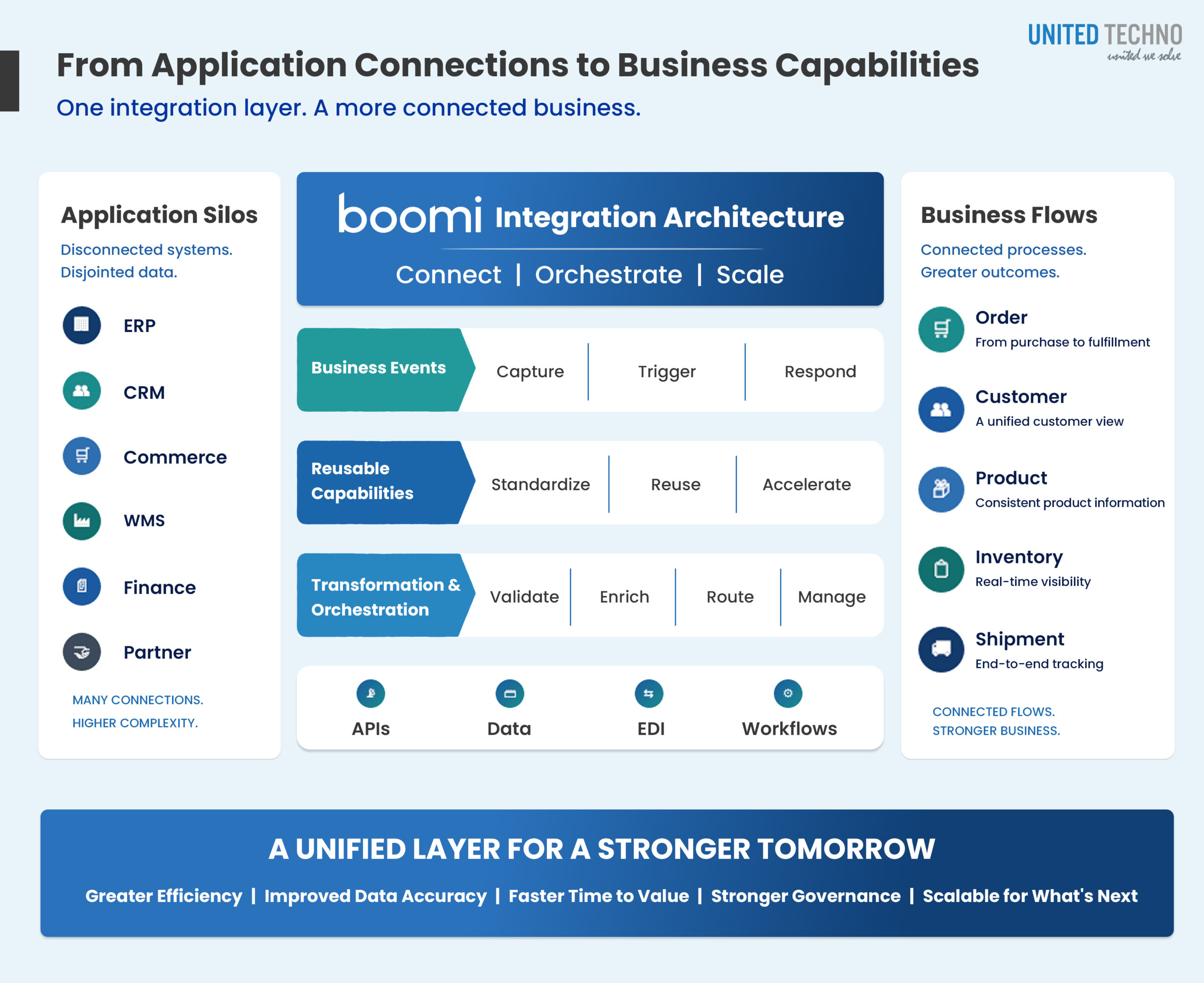
Boomi can then be used to implement reusable integration capabilities around those domains instead of creating isolated flows for every application combination.
This is a fundamental architectural shift:
Design integration around capabilities first. Connect applications second.
The Most Valuable Integration Is Often the One You Do Not Build Twice
Enterprise environments frequently contain the same business logic in multiple places.
A customer update may be transformed differently for CRM, ERP, marketing, and customer service.
An inventory quantity may be calculated separately by commerce and warehouse applications.
A product identifier may be translated independently for every trading partner.
Each additional implementation creates another maintenance point.
A well-defined Boomi Integration Strategy establishes common rules once and allows downstream consumers to use them consistently, reducing duplicated logic and simplifying ongoing maintenance.
For example:
Product Capability
→ ERP
→ Commerce
→ Marketplace
→ WMS
→ Data Platform
→ Customer Experience
The integration layer becomes a place where business context is standardized, rather than merely a transport mechanism.
That is where Boomi implementation starts producing architectural leverage.
From Application Connections to Business Capabilities
Not Every Data Flow Deserves the Same Architecture
One of the easiest ways to make an integration estate unnecessarily complicated is to use the same pattern everywhere.
A strong Boomi Integration Strategy assigns the integration pattern to the business requirement rather than forcing every process into the same approach.
When immediacy matters
Use APIs or event-driven patterns.
Examples:
- Order submission
- Inventory availability
- Payment status
- Shipment events
When volume matters
Use controlled batch or scheduled processing.
Examples:
- Historical data movement
- Financial reconciliation
- Large master-data synchronization
When external organizations are involved
Use governed B2B/EDI processes.
Examples:
- Purchase orders
- Advance shipment notices
- Invoices
- Partner acknowledgements
When a capability has multiple consumers
Expose it through an API or reusable service.
The architecture should therefore answer:
What does the business need this information to do?
Not:
What integration feature can be switched on?
Boomi’s platform supports application integration alongside API and B2B/EDI capabilities, making this pattern-oriented approach possible across different integration requirements.
The Integration Does Not End When the Message Arrives
This is where many integration programs underestimate complexity.
Suppose an order successfully reaches the ERP.
That does not necessarily mean the process succeeded.
The warehouse may reject the order.
The payment confirmation may arrive late.
The customer record may not match.
The same order may be submitted twice.
A downstream API may become unavailable.
A partner may send an unexpected data format.
A well-designed Boomi Integration Strategy accounts for these scenarios by focusing on end-to-end transaction visibility, reliability and recovery.
The real enterprise requirement is therefore not simply:
Move the message.
It is:
Know what happened to the transaction.
That requires architecture around:
Validation → Correlation → Exception handling → Retry → Reconciliation → Monitoring → Recovery
The integration platform becomes part of the operational fabric of the business.
This is particularly important when Boomi processes support revenue-generating transactions rather than simple background synchronization.
Integration Observability Should Follow the Business Event
Technical monitoring often tells an operations team that an integration failed.
Business monitoring should tell them what the failure means.
For example:
Integration failure:
Order process failed.
versus:
Business exception:
347 customer orders are waiting because the fulfillment system has not acknowledged inventory allocation.
The second message is actionable.
An effective Boomi Integration Strategy should therefore connect technical telemetry with business context, helping teams understand not only where an integration failed but also how that failure affects business operations.
Useful measures include:
- Transaction success rate
- Processing latency
- Failed transactions
- Retry volume
- Reconciliation exceptions
- API availability
- Partner processing status
- Manual intervention
- Processing throughput
The goal is not more dashboards.
The goal is faster understanding of business impact.
Boomi Becomes More Valuable as the Enterprise Gets More Complex
Boomi is particularly relevant when the architecture contains a mixture of:
- SaaS applications
- Enterprise applications
- Legacy platforms
- APIs
- Databases
- Files
- EDI
- External partners
- Data platforms
- Digital channels
This is common in retail, logistics, manufacturing, healthcare, financial services, and enterprise services.
A well-defined Boomi Integration Strategy evolves as the integration landscape expands, addressing the changing needs of the business at every stage.
Early stage
Connect systems.
Growth stage
Standardize integration.
Enterprise stage
Create reusable capabilities.
Mature stage
Govern and optimize the integration estate.
The technology may remain Boomi.
The architectural responsibility changes significantly.
Modernizing Integration Does Not Mean Rebuilding Every Interface
A large integration estate often contains years of accumulated decisions.
Some interfaces are business-critical.
Some are duplicated.
Some exist only because two legacy systems could not communicate differently.
Some should become APIs.
Some should disappear with the application they support.
That makes integration modernization a portfolio decision.
United Techno’s approach is to classify the estate before rebuilding it:
| Integration condition | Architectural action |
| Stable and valuable | Retain |
| Duplicated | Consolidate |
| Tightly coupled | Redesign |
| Business capability worth reusing | Expose |
| Legacy dependency | Modernize |
| No longer required | Retire |
This reduces the risk of simply reproducing yesterday’s architecture on a newer platform.
Where Boomi Architecture Creates the Most Business Value
The strongest Boomi programs usually have a clear business problem behind them.
Commerce
Connect storefronts, marketplaces, ERP, inventory, payment, fulfillment, and customer systems.
Logistics
Coordinate orders, warehouse activity, carriers, shipment events, and customer notifications.
Retail
Synchronize product, inventory, pricing, order, store, and customer information across channels.
Manufacturing
Connect ERP, suppliers, production systems, warehouse operations, and logistics.
Enterprise Services
Connect CRM, ERP, HR, finance, service platforms, data platforms, and external applications.
B2B Ecosystems
Manage structured exchanges between enterprises, suppliers, distributors, carriers, and trading partners.
The common requirement is not simply connectivity.
It is continuity across a business process that crosses system boundaries.
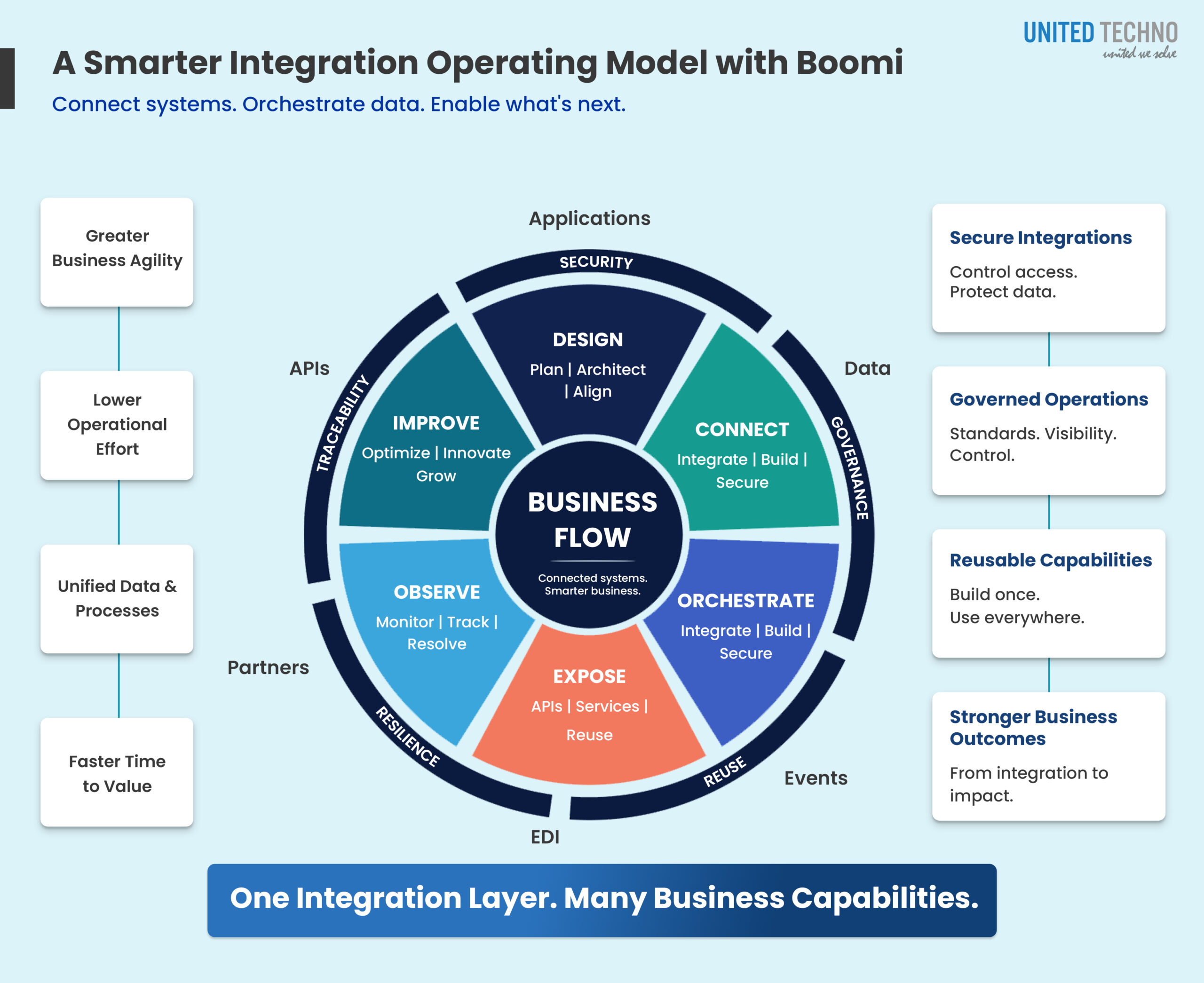
The United Techno Boomi Architecture Method
For enterprise Boomi programs, United Techno structures the work around six decisions.
01 — Understand the Flow
Map the business event, systems, dependencies, ownership, and failure points.
02 — Establish the Capability
Determine what business capability should exist independently of the underlying applications.
03 — Select the Pattern
Choose API, event, batch, application integration, workflow, or B2B/EDI based on the business requirement.
04 — Engineer for Failure
Design retries, validation, exception handling, reconciliation, and recovery before production.
05 — Govern the Estate
Standardize security, naming, versioning, deployment, reuse, ownership, and lifecycle management.
06 — Measure the Business
Track transaction reliability, latency, manual intervention, operational effort, and business-process performance.
This creates an integration environment designed for change, not simply for today’s system landscape.
The Enterprise Does Not Need More Integrations. It Needs Better Integration Architecture.
Every new application adds another potential connection.
Every acquisition introduces another technology landscape.
Every new sales channel creates another transaction path.
Every modernization program changes dependencies.
A well-defined Boomi Integration Strategy helps enterprises manage this complexity by establishing consistent integration patterns, reusable capabilities, and clear architectural governance.
Boomi can provide the foundation for managing that complexity, but the architecture surrounding it determines whether the platform becomes a strategic enterprise capability or simply another collection of interfaces.
Design the Integration Architecture Before the Complexity Designs It for You
United Techno helps enterprises architect, implement, modernize, rationalize, and govern Boomi integration environments across applications, APIs, data platforms, EDI ecosystems, cloud systems, and legacy estates.
With a well-defined Boomi Integration Strategy, United Techno helps organizations build integration environments that are reusable, observable, resilient, and aligned with the way the business actually operates. From a single critical integration to an enterprise-wide modernization program, the focus remains on creating a scalable architecture that supports evolving business needs.
Talk to United Techno About Your Boomi Integration Architecture →