
AS400 Modernization for Retail : Improve Efficiency & Uptime
In retail today, speed isn’t just a nice-to-have; it’s make-or-break. Customers expect to see what’s in stock instantly, check out with a single click, and often have their orders delivered to their doorsteps the very next day. For retailers still running legacy systems like AS400, these new expectations can quickly turn into roadblocks. Once praised for stability, AS400 now struggles to keep up with cloud-native tools, omnichannel workflows, and the fast pace of data-driven retail.
Yet, thousands of retailers, from fashion houses to grocery chains to electronics stores, continue to rely on AS400 to manage orders, pricing, and fulfillment. The problem is that reports take longer to generate, integrations don’t always flow smoothly, and maintenance costs keep creeping upward. The result is a drag on both customer experience and profitability.
Modernizing AS400 is no longer just a technical upgrade; it’s a business-critical move. For today’s retailers, it’s the difference between innovating with confidence or getting left behind
The Modern Retail Reality: When Legacy Starts to Hurt
Retail has transformed more in the past five years than in the two decades before it. Shoppers now expect a seamless experience wherever they interact with a brand, whether that’s through a mobile app, an in-store visit, social media, or an online marketplace. But many retailers still rely on AS400 systems that hold them back from delivering this level of consistency.
- Slow Inventory Visibility: AS400’s batch-based data updates delay information sharing across systems, making it hard to show accurate stock levels in real time. The result? Missed sales or unhappy customers dealing with stockouts.
- Omnichannel Disconnects: Connecting AS400 with modern eCommerce sites, POS software, and logistics partners usually means patchwork integrations and manual fixes that strain teams and limit agility.
- Limited Insights: Today’s retail success depends on unified analytics, yet AS400 environments keep data locked in silos. This makes it challenging to forecast trends, track performance, or personalize customer experiences.
- Costly Maintenance: Finding people with AS400 expertise grows harder each year. Maintaining old code absorbs resources and time that could be spent on innovation.
- Inflexible Framework: Trying to bolt new channels or API integrations onto AS400 often feels like fitting modern retail needs into an outdated mold.
Each of these challenges quietly chips away at a retailer’s agility – the very trait that defines market leaders today.
How AS400 Modernization for Retail Turns Pain Points into Progress
AS400 modernization isn’t about abandoning what works – it’s about extending it intelligently. Retailers can retain the proven reliability of their AS400 environment while unlocking new capabilities through modernization approaches such as API enablement, cloud integration, UI/UX transformation, and database migration from DDS to DDL.
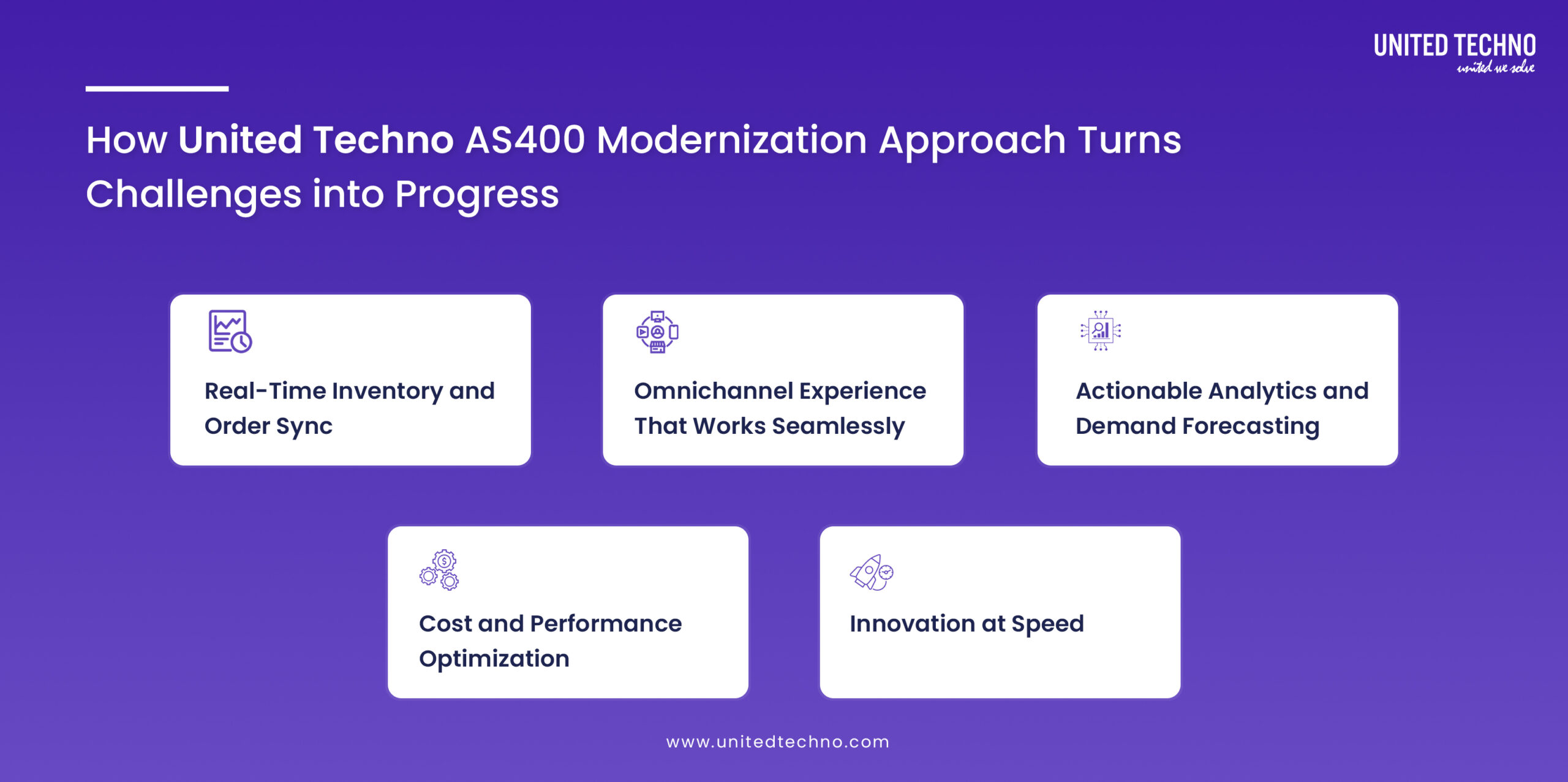
Here’s how modernization directly addresses retail challenges:
1. Real-Time Inventory and Order Sync
By integrating AS400 with cloud platforms like AWS or Azure and modern tools like Boomi, retailers can achieve live synchronization between their ERP, warehouse systems, and eCommerce storefronts. That means no more stale inventory counts or missed sales due to stock visibility issues.
2. Omnichannel Experience That Works Seamlessly
Modernized APIs enable AS400 to talk fluently with POS, Shopify, Salesforce Commerce Cloud, and even mobile apps, ensuring consistent pricing, promotions, and product availability across all channels.
3. Actionable Analytics and Demand Forecasting
By moving AS400 data into a modern data warehouse such as Snowflake, retailers gain instant access to dashboards for sales performance, regional trends, and customer behavior, transforming their operations from reactive to predictive.
4. Cost and Performance Optimization
Migrating workloads to cloud infrastructure and automating repetitive batch jobs reduces maintenance overhead and enhances scalability. Retailers can now handle seasonal surges without worrying about system slowdowns or capacity limits.
5. Innovation at Speed
Once AS400 is modernized, retailers can introduce loyalty apps, AI-driven recommendations, or automated replenishment systems – innovations that previously seemed impossible within the old architecture.
Business Impact: What AS400 Modernization for Retail Really Delivers
Retailers who’ve invested in AS400 modernization consistently report measurable business benefits:
- 40 – 60% faster inventory updates across eCommerce and in-store systems
- 25 – 35% improvement in order fulfilment speed through real-time data flow
- 30% reduction in IT maintenance costs after automating legacy workloads
- Higher customer satisfaction through accurate stock, delivery, and service data
- Greater business resilience by eliminating single points of legacy failure
These aren’t just IT metrics – they translate into smoother operations, stronger brand trust, and sustainable revenue growth.
Success Story Snapshot: Smart Retail on Legacy Systems
For over 15 years, a leading apparel retailer, home to several iconic teen fashion brands has trusted United Techno to keep its AS400-based retail backbone running strong. What began as a single-brand engagement supporting 2,000+ stores evolved into a multi-brand ecosystem spanning retail and wholesale operations. Even through restructuring, United Techno remained a steady partner, ensuring operations never missed a beat.
Instead of a costly ERP replacement, the retailer doubled down on modernization. United Techno optimized AS400 applications, integrated Blue Yonder for allocation and FlexPLM for product data, upgraded Island Pacific and High Jump, and implemented Boomi, Cleo, and IBM MQ for seamless B2B integrations. A custom-built Assortment Planning system automated PO creation and cut manual workloads across merchandising teams.
The results were transformative: uninterrupted operations through financial transitions, 30 – 40% faster merchandising cycles, and unified visibility across brands and warehouses. By modernizing smartly, and not massively, the retailer turned its legacy systems into a foundation for agility, efficiency, and long-term growth.
The Road Ahead: Modernization Without Disruption
For most retail CIOs, the hesitation isn’t whether to modernize – it’s how to do it without breaking what still works. That’s where experience matters.
United Techno’s AS400 modernization framework ensures business continuity at every step, from assessment and pilot APIs to full migration and cloud integration. The approach minimizes disruption, accelerates ROI, and enables retailers to move confidently from legacy to future-ready ecosystems.
Final Thoughts
The truth is simple: Retail brands can’t compete on yesterday’s infrastructure.
Modernization isn’t just an upgrade, but the foundation for agility, insight, and customer excellence in the era of omnichannel commerce. With the right partner, AS400 modernization becomes less about risk and more about unlocking what’s next.
Accelerate your retail transformation – with AS400 modernization that transforms legacy strength into modern agility.