Introduction – Why AS400 Modernization Still Matters
Many businesses, especially in retail, logistics, and manufacturing, still rely on the AS400 (now called IBM i). It’s old, yes. But it’s also stable and has powered operations reliably for decades.
So why even think about Modernize Your AS400 initiatives?
Here’s the simple truth:
-
AS400 is reliable but not user-friendly. Those green-screen UIs are hard for new teams to use.
-
The system is solid, but it’s stuck in the past. It wasn’t built for today’s cloud, mobile, or API-driven world.
-
Modernize Your AS400 doesn’t mean replacing everything. It means fixing what’s outdated—step by step—without breaking what still works..
-
You can modernize gradually. Start small, such as improving the interface or converting data formats, and build from there.
-
It’s about keeping your business running better. Not flashy, but functional.
At United Techno, we don’t push for full replacements. We help businesses that are still on AS400 make it easier to maintain, integrate, and improve, without losing what they’ve built over the years.
Common Triggers for AS400 Modernization
Most companies don’t wake up one day and say, “Let’s Modernize Your AS400.” They’re usually pushed into it because of growing pain points that can’t be ignored anymore.
Here’s what we commonly hear:
-
Aging Workforce: Most AS/400 developers are nearing retirement. New talent doesn’t want to work on outdated tech. That leaves your business exposed.
-
Business Growth Constraints: Legacy systems hinder scalability and time-to-market.
-
Lack of Integration: Whether it’s cloud apps, mobile tools, or other business systems, AS400 just doesn’t play well with them out of the box.
-
User Experience Expectations: Green screens no longer cut it for business users.
Data Limitations: Older database setups make it hard to get real-time insights or run analytics. That slows down decisions.
Questions to Ask Before You Start
A successful Modernize Your AS400 strategy begins with clear alignment between IT and business. Ask:
-
What are the top 5 AS400-supported processes that impact revenue or operations? – Think order processing, inventory updates, customer billing – anything that hits revenue or operations. These must be protected throughout the modernization effort.
-
Which parts of the system are still delivering value, and which of them are bottlenecks? – Identify the parts of your AS400 system that still deliver value (like rock-solid business logic or stable data processes) and flag the ones causing delays or user frustration.
-
Do we have documentation for our RPG programs, CL scripts, and DB2 structures? – If your RPG code, CL programs, and DB2 structures aren’t documented, modernization will be harder and riskier.
-
What’s our integration landscape? – Are there batch jobs, file transfers, or APIs running behind the scenes? All these need to be mapped before changes begin.
-
What’s the long-term plan – cloud migration, hybrid model, or on-prem continuity?
Do we have the right team – or do we need external experts? – Upskilling your internal team is an option, but many companies accelerate safely by bringing in expert partners who’ve done this before.
Essentials for AS400 Modernization
Every organization will Modernize Your AS400 differently, but successful modernization programs typically include:
-
UI/UX Modernization: Replace green screens with web/mobile-friendly front-ends using tools like Rocket LegaSuite.
-
Code Refactoring: Modularize monoliths, move from RPG/400 to RPG IV/ILE or Free-Form RPG.
-
Database Modernization: Convert DDS to DDL to unlock modern SQL and analytics capabilities.
-
API Enablement: Use DB2 Web Services, REST/RPC layers, or third-party middleware.
DevOps Readiness: Source control with Git, automation with Jenkins, testing frameworks.
Take a Look at Our Approach
Our approach helps organizations Modernize Your AS400 without disrupting business-critical operations.
-
We specialize in DDS-to-DDL conversion, making your DB2 data ready for analytics and external integrations.
-
Users get intuitive, responsive interfaces without breaking what works under the hood.
-
RPG remediation, modularization, and service program adoption using proven best practices.
-
Expose AS400 as a service, so it talks to the rest of your tech stack effortlessly.
-
We automate manual jobs using job schedulers, batch monitoring, and CI/CD pipelines tailored for legacy environments.
-
Keep legacy systems compliant with today’s data protection and audit requirements.
Visual Timeline: The Modernization Journey at a Glance
Each stage is iterative and collaborative. No “big bang.” Just consistent progress.
|
Month |
Phase |
Key Activities |
Milestone |
|
Month 1 |
Discovery & Planning |
– AS400 system assessment – Code inventory and dependency mapping – Prioritize business-critical workflows |
Modernization Blueprint Approved |
|
Month 2 |
Architecture & Design |
– UI/UX redesign concepts – API & integration planning – Define cloud/on-premises hybrid approach |
Modernization Architecture Signed Off |
|
Month 3 |
Foundation Build |
– DDS to DDL conversion – Set up DevOps pipelines – Build secure REST APIs |
Core Modernization Stack Ready |
|
Month 4 |
UI & Code Modernization |
– Green-screen to web UI using Rocket Software or Profound UI – Modularize RPG IV into Free Format or Java |
UI & Business Logic Modernized |
|
Month 5 |
Testing & Automation |
– CI/CD for RPG programs- Automated regression and job testing – Security hardening (exit programs, encryption) |
System Validated and Hardened |
|
Month 6 |
Deployment & Knowledge Transfer |
– Go-live for modernized components – Team training + documentation- Runbook creation |
Modernized AS/400 in Production |
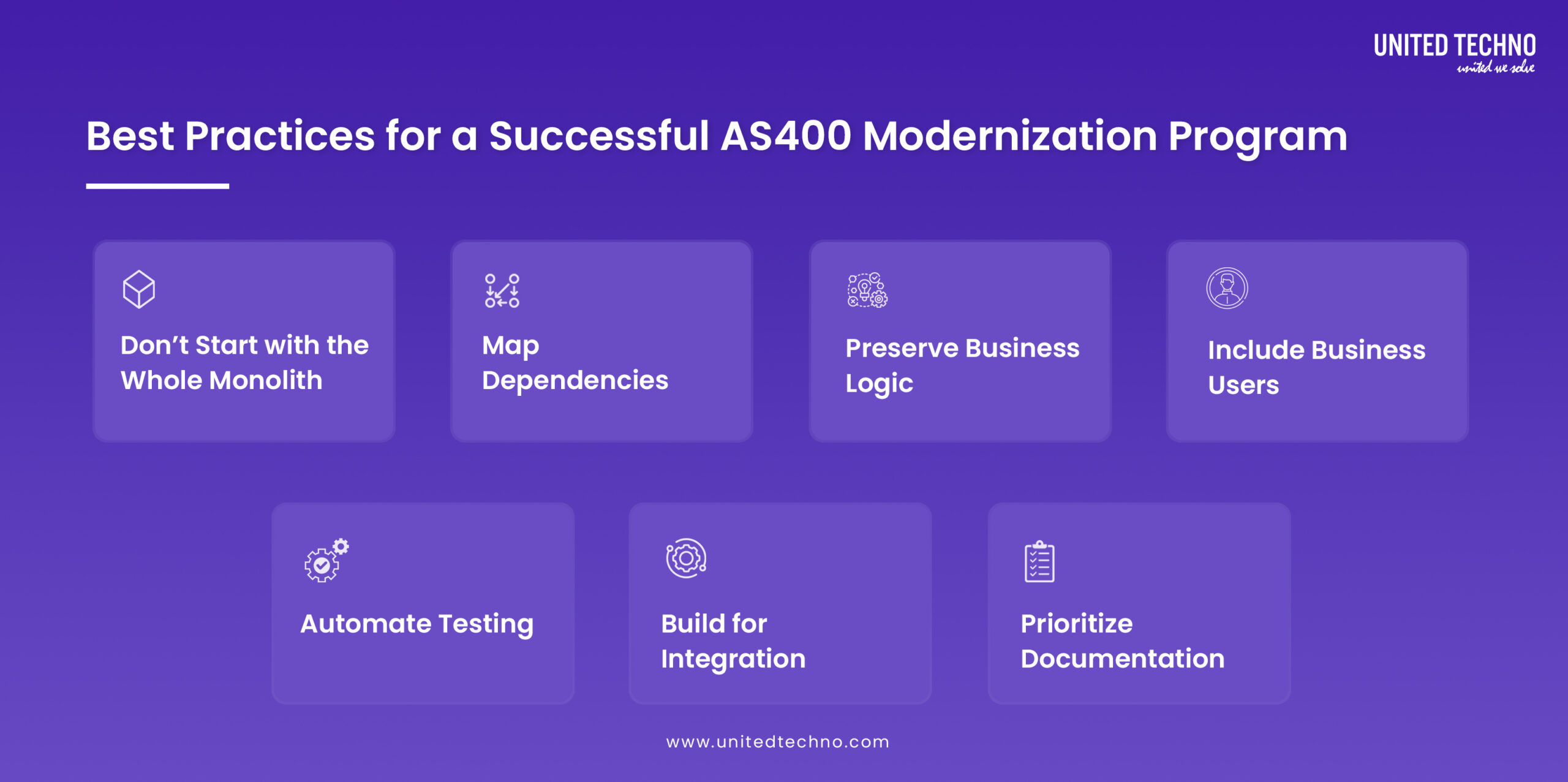
Best Practices for a Successful AS400 Modernization Program
- Don’t Start with the Whole Monolith: Begin with a high-impact process (e.g., Order-to-Cash).
- Map Dependencies: Gain understanding of how RPG, CL, and DB2 artifacts talk to each other.
- Preserve Business Logic: Wrap or rehost first; rewrite only where ROI is clear.
- Include Business Users: UI/UX modernization fails without frontline feedback.
- Automate Testing: Legacy systems often lack regression suites – build them early.
- Build for Integration: Assume AS400 must play well with cloud, APIs, and modern tools.
- Prioritize Documentation: Tools like X-Analysis and Rational Developer help reverse engineer what’s undocumented.
Tools & Accelerators That Speed Things Up
At United Techno, we combine technical acumen with accelerators to reduce time and risk:
-
Rocket Aldon Lifecycle Manager: For robust change control and versioning.
-
X-Analysis: Dependency mapping, code visualization, and documentation generation.
-
LegaSuite GUI: Web enablement of legacy interfaces with minimal code changes.
-
HOD Automation: Automate repetitive green-screen interactions via scripting.
-
Custom Conversion Scripts: DDS to DDL, RPG to Free Format conversion tools.
We also maintain a library of reusable API patterns, UI templates, and modernization playbooks developed from over 150 successful AS400 projects.
Final Thoughts: It’s Not Just About Code, It’s About Continuity
Modernizing AS400 is not just a technical upgrade; it’s a business enabler. Done right, it ensures continuity of your mission-critical processes while opening the door to modern cloud, data, and AI integrations.
United Techno brings more than code remediation. We bring context, clarity, and commitment. Whether you’re looking to wrap, rehost, refactor, or rebuild, we’ve done it at scale, across industries.