The Biggest Announcement at Snowflake Summit 2026 Highlights Wasn’t AI
For the past few years, enterprise conversations have been dominated by generative AI, copilots, assistants, large language models, and automation. Organizations have launched pilots, explored use cases, and invested heavily in experimentation.
Yet a persistent challenge remains.
Why do so many AI initiatives struggle to move beyond demonstrations and deliver measurable business impact?
At Snowflake Summit 2026 Highlight, the answer emerged as a recurring theme across keynote sessions, product announcements, and customer stories.
The future of enterprise AI will not be determined by access to the most advanced models. It will be determined by an organization’s ability to operationalize intelligence using trusted data, strong governance, real-time information, and connected business processes.
This year’s Summit felt less like a product conference and more like a preview of how enterprises will operate over the next decade.
Snowflake’s message was clear: AI is moving beyond experimentation. The next phase is execution.
Snowflake’s Next Evolution: From Data Platform to Agentic Enterprise
To understand the significance of Snowflake Summit 2026 Highlights, it helps to look at Snowflake’s broader journey.
Snowflake was originally built to solve one of the most persistent challenges in enterprise technology: data silos. Over time, the platform evolved into a unified environment capable of supporting structured, semi-structured, and unstructured data across clouds, regions, and business functions.
That foundation enabled organizations to centralize data.
Now Snowflake is focused on helping organizations operationalize intelligence.
The centerpiece of this vision is what Snowflake calls the Agentic Enterprise.
According to Snowflake, the modern enterprise will increasingly rely on four interconnected layers:
- Enterprise Data
- AI Models
- Enterprise Applications
- Agentic Control Plane
Together, these components create an environment where AI agents can access trusted information, interact with business systems, coordinate decisions, and support enterprise workflows at scale.
This represents a significant shift from traditional analytics.
Historically, data platforms were designed to help organizations understand what happened.
The next generation of platforms will help organizations decide what to do next.
That distinction may ultimately define the difference between AI experimentation and enterprise-wide AI adoption.
The Real Story Behind Snowflake Summit 2026 Highlights: AI and Data Are Finally Converging
One of the most important themes throughout the Summit was the convergence of AI and data on a single platform.
For years, organizations have built separate ecosystems for analytics, machine learning, business intelligence, and operational systems. The result has often been additional complexity, fragmented governance, and disconnected decision-making.
Snowflake’s vision suggests a different path.
Rather than treating AI as a separate layer, Snowflake is embedding intelligence directly into the data platform.
This strategy was reflected across nearly every major announcement, from CoCo and CoWork to Horizon Context, Agentic Search, and MCP integrations.
The goal is not simply to make AI more powerful.
The goal is to make AI more useful.
Why Data Foundations Still Determine AI Success
Among all the messages delivered at Snowflake Summit 2026 Highlight, one stood out above the rest:
“AI is not your competitive advantage. Your data is.”
It is a simple statement, but it captures one of the biggest realities facing enterprises today.
Most organizations do not struggle because they lack AI capabilities.
They struggle because their data remains fragmented across applications, business units, clouds, and legacy systems.
Snowflake repeatedly emphasized that successful AI initiatives depend on:
- Data quality
- Accessibility
- Governance
- Context
- Enterprise-wide trust
The Accenture keynote reinforced this point by noting that the majority of organizations face data challenges long before they face AI challenges.
That observation resonates across industries.
When data definitions vary across departments, governance policies are inconsistent, and business context is difficult to locate, AI often amplifies existing inefficiencies rather than solving them.
The lesson from Snowflake Summit 2026 Highlight was unmistakable.
Before organizations scale AI, they must first establish trusted and unified data foundations.
The Rise of the AI-Native Workforce
Several announcements highlighted how AI is beginning to reshape the daily experience of both technical and business teams.
CoCo: An AI Engineering Assistant
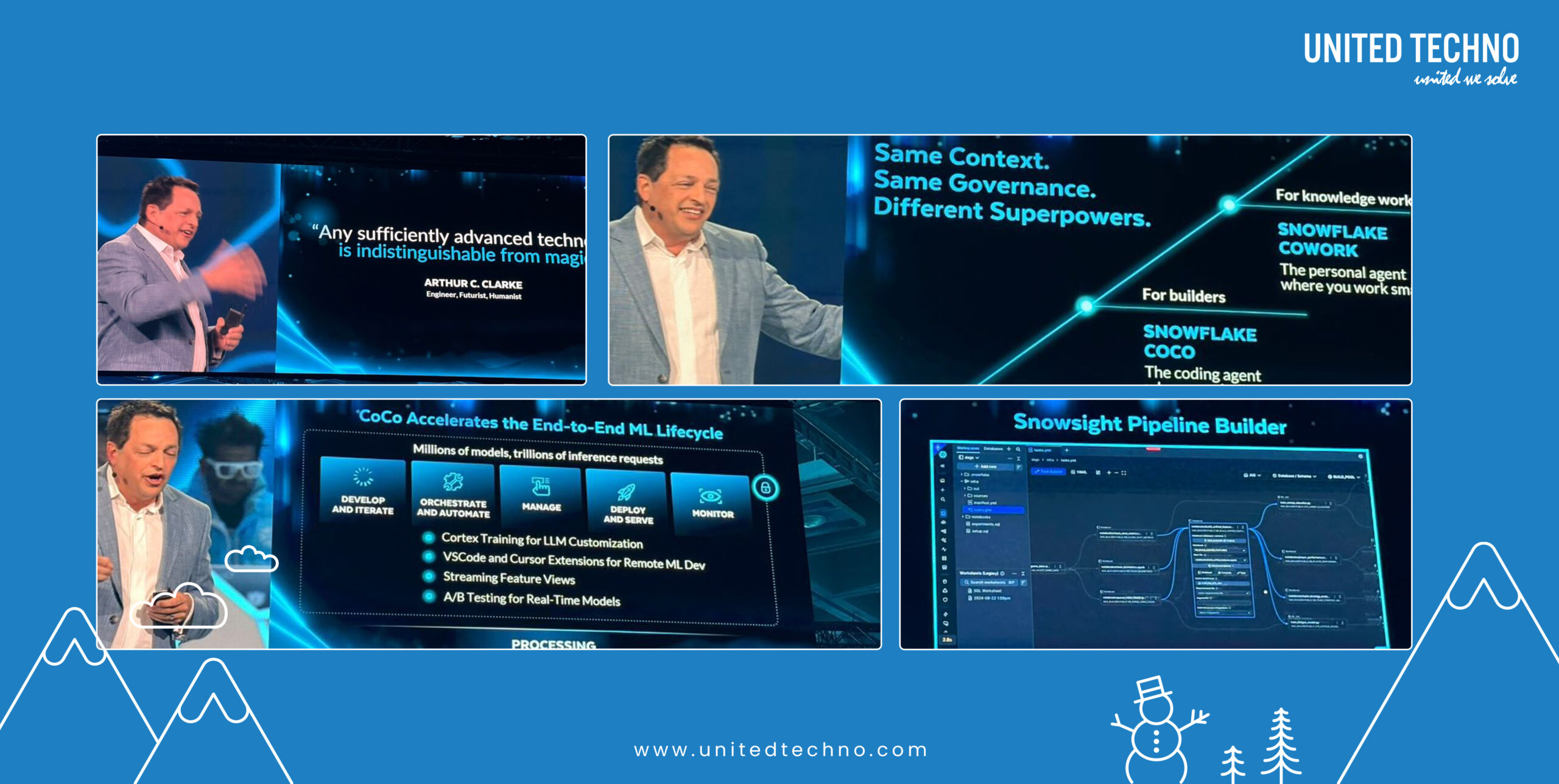
Snowflake expanded Cortex Code into CoCo, an AI-powered assistant designed for developers, data engineers, and platform teams.
CoCo supports technologies such as:
- SQL
- Python
- Spark
- Airflow
- dbt
It can assist with pipeline creation, migrations, code generation, operational tasks, and agent development.
For engineering teams, this is more than a productivity enhancement.
It signals a shift in how data platforms will be built and managed.
As repetitive development tasks become increasingly automated, engineers will spend less time creating pipelines and more time designing trusted data products, governance frameworks, and AI-enabled business capabilities.
CoWork: Bringing Enterprise AI to Every Employee
While CoCo focuses on builders, CoWork focuses on business users.
CoWork provides natural language access to enterprise data, applications, workflows, and business context.
Employees can ask questions, retrieve insights, automate actions, and interact with enterprise systems without needing technical expertise.
For many organizations, this may represent the first practical step toward democratizing AI across the enterprise.
The long-term opportunity is significant.
AI is no longer being positioned as a tool for specialists. It is becoming a productivity layer for every employee.
Real-Time, Open, and Interoperable: The New Data Architecture
Another major takeaway from Snowflake Summit 2026 was that enterprise data architectures are evolving beyond traditional batch processing models.
Real-Time Data Is Becoming Essential
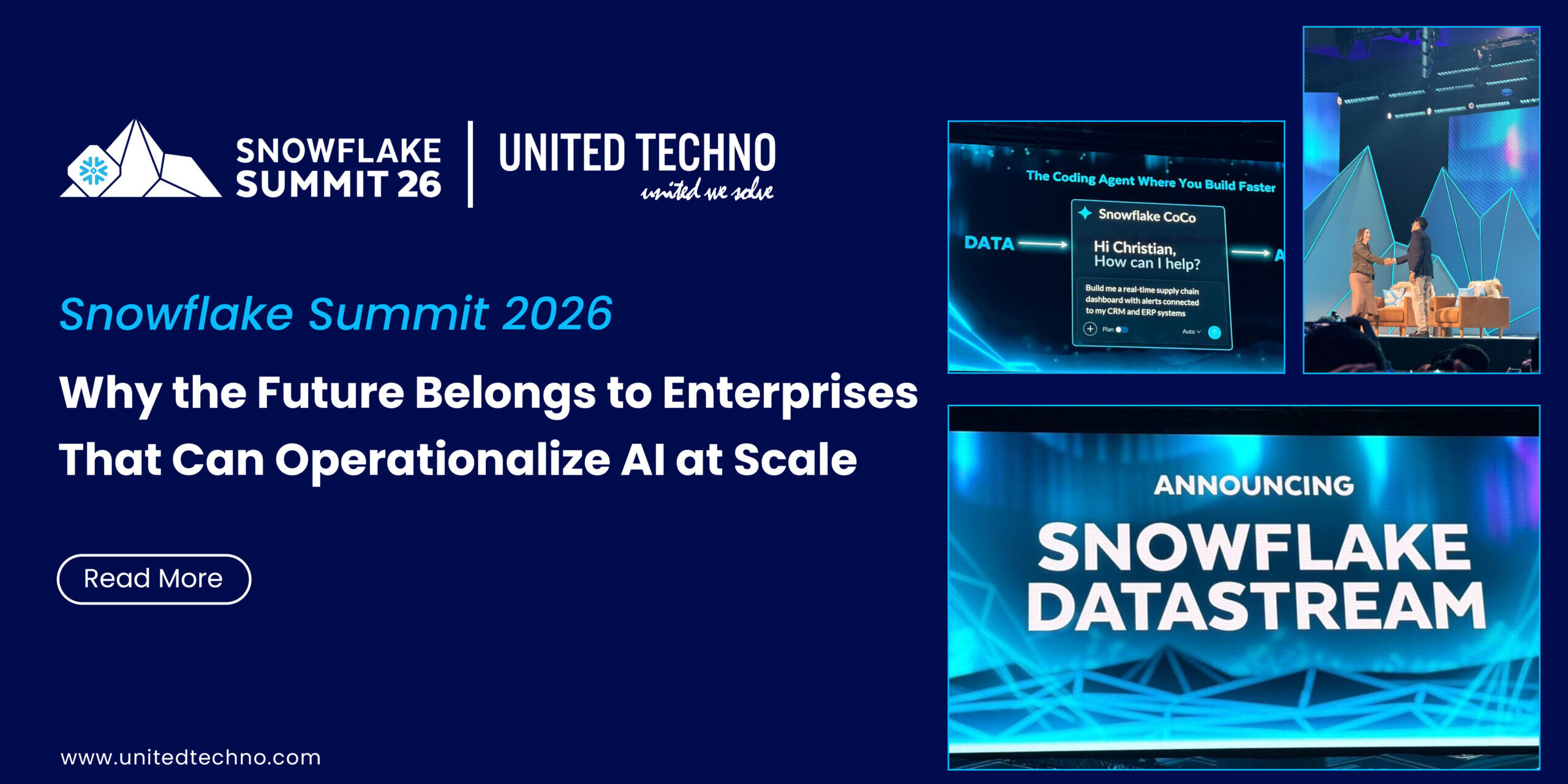
Snowflake introduced Data Stream, a Kafka-compatible managed streaming platform that supports sub-second latency and zero-copy streaming architectures.
This matters because agentic systems cannot operate effectively on outdated information.
Whether organizations are optimizing supply chains, personalizing customer experiences, or supporting autonomous business workflows, real-time context increasingly becomes a business requirement rather than a technical enhancement.
OpenFlow Continues to Expand
Snowflake also announced enhancements to OpenFlow, including new APIs, expanded connectivity, and additional enterprise connectors.
Support for platforms such as Oracle, MongoDB, Shopify, and Veeva helps accelerate enterprise data integration while reducing operational complexity.
Openness Remains a Strategic Priority
Snowflake continued to reinforce its commitment to interoperability through investments in:
- Apache Iceberg
- Open Sharing
- Multi-party collaboration
- Open Semantic Interchange
This is an important signal for enterprise leaders.
As AI ecosystems mature, organizations are looking for flexibility, not lock-in.
The future will be built on connected ecosystems rather than isolated platforms.
Governance Is Becoming an AI Enablement Strategy
For years, governance was viewed primarily as a compliance function.
Snowflake Summit 2026 Highlight reframed governance as something far more strategic.
As organizations move toward agent-based workflows and autonomous decision support, trust becomes a prerequisite for adoption.
Several announcements reflected this shift, including:
- Agent Identity
- Data Movement Policies
- Horizon AI Guardrails
- Multi-Party Approvals
Snowflake also introduced Horizon Context, which enriches enterprise data with metadata, ownership information, business definitions, and semantic understanding.
This may prove to be one of the most important innovations announced at the event.
AI accuracy depends on more than access to data.
It depends on understanding what that data means.
Context, ownership, lineage, and business definitions are increasingly becoming essential inputs for enterprise AI systems.
Organizations that invest in governance and context today will likely see faster and safer AI adoption tomorrow.
Why MCP May Become a Defining Enterprise Integration Pattern
Snowflake’s planned acquisition of Natoma received significant attention during the Summit, and for good reason.
The acquisition strengthens Snowflake’s support for Model Context Protocol (MCP) connectivity.
MCP enables AI systems to securely interact with enterprise applications including Slack, Jira, GitHub, Zoom, Microsoft 365, and Google Workspace.
While the concept may sound technical, the business implications are substantial.
Enterprise AI systems are most valuable when they can move beyond generating answers and begin supporting actions.
That requires secure access to business systems.
It requires governance. And it requires coordination.
The emerging architecture increasingly resembles:
AI Agents → Enterprise Context → Business Applications → Business Outcomes
MCP is helping establish the connective layer that makes this possible.
Business Outcomes Have Officially Replaced AI Pilots as the Primary KPI
If there was one message repeated consistently throughout the Summit, it was this:
AI initiatives must be measured by business outcomes.
Not by the number of models deployed.
Not by the number of dashboards created.
Not by the number of proof-of-concepts completed.
Organizations should evaluate AI investments using metrics such as:
- Revenue growth
- Cost reduction
- Productivity improvements
- Operational efficiency
- Customer experience gains
Accenture shared examples where organizations dramatically reduced query times while lowering compute costs. Other customer stories highlighted measurable improvements in decision-making, operational agility, and business productivity.
The direction is clear.
The AI conversation is shifting from experimentation metrics to business metrics.
That shift may be one of the most important indicators of enterprise AI maturity.
The Most Powerful Customer Story Wasn’t About AI. It Was About Foundation.
Customer sessions from organizations including Canva, Nestle, Thomson Reuters, Under Armour, Samsung, and Sanofi reinforced a common lesson.
The organizations creating measurable AI value are not necessarily deploying more AI.
They are building stronger foundations.
Sanofi’s transformation journey stood out as a compelling example.
Before deploying enterprise AI workflows, the organization focused on consolidating fragmented environments and creating a unified data foundation.
Only after establishing that foundation did it expand AI capabilities across procurement, HR, IT support, and sales operations.
The lesson is difficult to ignore.
Successful AI strategies rarely begin with AI.
They begin with data.
What Enterprise Leaders Should Do Next
For CIOs, CDOs, Chief Data Officers, and technology leaders, Summit 2026 offers a practical roadmap.
Modernize Data Foundations
Eliminate silos, improve quality, and establish trusted enterprise-wide data products.
Build Governance Into Every AI Initiative
Treat governance as an accelerator for AI adoption rather than a compliance requirement.
Prepare for Agentic Architectures
Evaluate how AI agents, workflows, enterprise applications, and business processes will interact.
Prioritize Real-Time Data Capabilities
Modern AI experiences increasingly depend on current and contextual information.
Measure Outcomes Relentlessly
Connect every AI initiative to operational and financial performance indicators.
Snowflake Summit Highlight 2026 in 60 Seconds: Quick Highlights
✓ Agentic Enterprise becomes Snowflake’s long-term strategic vision
✓ CoCo introduces AI-assisted development across SQL, Python, Spark, Airflow, and dbt
✓ CoWork expands enterprise AI access beyond technical teams
✓ Data Stream delivers Kafka-compatible real-time streaming with sub-second latency
✓ OpenFlow broadens enterprise integration capabilities
✓ AI-powered migrations accelerate modernization initiatives
✓ Horizon Context strengthens enterprise context and AI accuracy
✓ Governance innovations reinforce trusted AI operations
✓ MCP connectivity expands enterprise application integration
✓ Open ecosystem investments strengthen interoperability and collaboration
✓ Customer stories consistently highlighted data foundations as the key to AI success
The Next Competitive Advantage Is Execution
Snowflake Summit Highlights 2026 will likely be remembered as the moment enterprise AI moved from possibility to practicality.
The most successful organizations over the next decade will not necessarily be those with the most AI tools or the largest model investments.
They will be the organizations that can combine trusted data, governance, interoperability, real-time information, and business context into a repeatable operating model.
That is ultimately what Snowflake’s Agentic Enterprise vision represents.
Not another AI platform.
A new blueprint for how modern enterprises will make decisions, automate work, and create business value.
The technology is advancing rapidly.
The real differentiator now is execution.