

Can You Automate Testing in a Day? Meet the AI Powered Testing Tool That Speeds Up QA
The Modern Software Race: Why Testing Is Under Pressure
Across industries ranging from retail, banking, healthcare, and beyond, the software teams are shipping new features at breakneck speed. The pressure to deliver seamless user experiences and fix bugs in real time has never been higher. Yet, while development accelerates, testing often lags behind, becoming a bottleneck that can delay releases, increase costs, and drain team morale.
The Illusion of Easy Automation
Automation testing is frequently seen as the magic solution to these challenges. But as any experienced QA professional will tell you, it’s far more complicated than simply “writing a script.” The reality is that automation requires significant effort, expertise, and ongoing maintenance.
- Test Design Bottlenecks: Most people focus on execution speed, but the real slowdown starts with designing tests. Manually writing test cases, identifying all user scenarios, and building reusable scripts can take days or even weeks, especially when requirements change mid-sprint.
- Rapid Change, Fragile Scripts: Agile and DevOps environments mean features change fast. A single UI tweak can break dozens of scripts, forcing testers to scramble and update automation suites. Traditional tools struggle to keep up, leaving teams with brittle, high-maintenance scripts.
- Unclear Failures: Automated tests often fail for reasons that aren’t immediately obvious – locator changes, timing issues, or outdated scripts. Debugging eats into valuable release time.
The Myth of Automation Savings: Despite heavy investment, many organizations don’t see the expected ROI. Test design remains manual, script creation is labor-intensive, and ongoing maintenance is a constant drain.
The Hidden Complexity Behind “Simple” Automation
When stakeholders ask, “Can we automate this by the end of day?”. It’s often an optimistic expectation. Building automation scripts that reliably work over time involves much more than coding. It requires orchestrating multiple technical and process elements, including:
- Stable locator strategies to ensure scripts remain resilient despite UI changes.
- Page objects and reusable methods that promote maintainability and reduce duplication.
- Dynamic waits to handle asynchronous loading and timing variations.
- Test data orchestration through APIs or databases to simulate realistic scenarios.
- Assertions, logging, and error handling to verify outcomes and provide traceability.
- CI/CD integration, tagging, and peer reviews to embed automation within modern development pipelines.
Automation is not just about writing code, it’s about managing logic, data, reliability, and process cohesively.
Real Industry Data Shows It’s Not Easy
- The World Quality Report (2021–22) found that automating a single test case takes an average of 7–8 hours, depending on complexity, tool maturity, and data availability.
- According to a Katalon survey, while 68% of QA professionals view scripting as crucial, 51% cite limited automation skills as a significant barrier.
- WifiTalents (2025) reports that approximately 40% of automation scripts become obsolete within six months due to rapid application changes.
- Afor Research (2025) highlights that up to 70% of automation initiatives fail to deliver expected outcomes.
Daily Challenges That Slow Down QA Teams
- Resource Crunch: Most QA teams are staffed just enough to support current release cycles. When busy validating new features, regression, or environment issues, automation is often deprioritized, creating a backlog that rarely gets addressed.
- Shortcuts Under Pressure: To meet tight deadlines, teams sometimes skip robust assertions, hardcode test data, use fragile selectors, or bypass peer reviews. These shortcuts lead to flaky test suites and erode trust in automation’s effectiveness.
Why Reducing Test Design Time Is Critical
Test design remains the most underestimated time sink in QA. Without accelerating the process of analyzing requirements, identifying scenarios, writing test cases, and scripting automation, teams will perpetually chase deadlines. Reducing this time is no longer a luxury, but it’s essential for organizations striving to deliver quality at speed.
Introducing United Techno’s Proprietary AI Powered Testing Tool “QA Genie” To Automate & Speed Up QA
At United Techno, we understand these challenges deeply. That’s why we have developed a proprietary AI Testing Tool designed to address the pain points that slow QA teams down. Our goal is clear: to help teams overcome traditional automation bottlenecks and move toward smarter, faster, and more reliable testing.
Our AI Powered Testing Tool is not just another automation framework, it’s a self-learning, intelligent assistant that accelerates QA from day one.
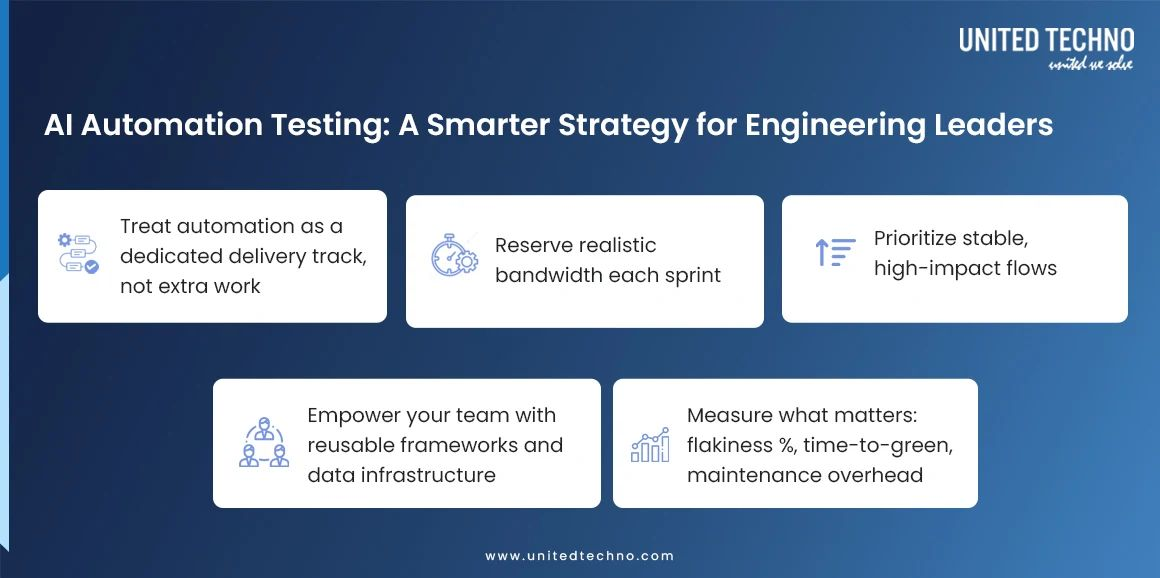
A Smarter Path Forward for QA Leaders
Track what matters: flakiness rates, time-to-green, and maintenance overhead.
Conclusion
Automation testing is a journey, not a checkbox. The challenges are real, but with the right AI-powered solutions, teams can finally break free from manual bottlenecks, unstable scripts, and missed deadlines. United Techno’s AI Testing Tool redefines what’s possible making automation smarter, faster, and more reliable for QA teams everywhere.
Can You Automate in a Day?
Absolutely. With United Techno’s AI Testing Tool, the answer to “Can you automate in a day?” is a confident yes for many scenarios. Our AI powered QA tool enables teams to:
- Instantly generate test cases from requirements—no manual scripting marathons.
- Convert those cases into automation scripts with a single click, drastically reducing setup time.
- Integrate seamlessly into CI/CD pipelines for immediate feedback and deployment readiness.
This means what once took days or weeks—test design, scripting, and integration—can now be achieved within hours, empowering teams to respond to business needs at the speed of innovation.
How United Techno’s AI Powered Testing Tool Resolves Your Hidden Complexities In QA
Our AI Powered Testing Tool is built to tackle the real-world challenges that hinder smooth automation.
- Simplifies Test Design: AI-driven scenario identification ensures comprehensive coverage without manual effort.
- Bridges Skill Gaps: Intuitive interfaces and intelligent assistance allow both QA specialists and product teams to participate in automation.
- Ensures Robustness: Built-in best practices—like dynamic waits, and error handling are embedded by default.
Planned Enhancements:
- Reduces Maintenance (Coming Soon): Automated updates and reusable components—designed to minimize script flakiness and reduce rework—are in our product roadmap for upcoming releases.
- Handles Rapid Change (Planned Feature): Self-healing scripts and adaptive locators, which will further reduce breakage when UIs or APIs change, are planned for future updates.
Ready to transform your QA practice?
Follow United Techno for more AI powered testing tool insights.
Have questions or want a demo? Drop them in the comments and we’re here to help!
Stay tuned for future insights on how AI is transforming testing and how United Techno is empowering QA teams to keep pace in the software race.