An integration architect’s view on turning a complex integration landscape into a clear modernization roadmap
Enterprise integration rarely fails because two systems cannot exchange data.
It fails in the space between the connection and the business outcome.
A customer order may move from commerce to ERP, but pricing may arrive late. Inventory may update, but not across every channel. An API may be available, but nobody knows which applications still depend on it. A failed transaction may be retried three times, creating a duplicate instead of recovering cleanly.
That is the part Integration Audit Services need to uncover.
A conventional audit can tell an enterprise what integrations exist. A useful architectural audit should answer a harder question:
Where is the integration layer creating business risk, technical debt, or unnecessary complexity?
That distinction changes the entire exercise.
An Integration Inventory Is Not an Integration Audit
Most enterprises already have some form of integration inventory: APIs, interfaces, middleware processes, EDI flows, batch jobs, event streams, file exchanges, and application connections.
The inventory tells you what exists.
Effective Integration Audit Services need to establish:
- What business process does each integration support?
- Which systems depend on it?
- What happens when it fails?
- Where is data transformed?
- Where can duplication occur?
- Who owns the interface?
- How is it monitored?
- How difficult is it to change?
- What happens when transaction volume increases?
- Is the integration still justified?
This is where an integration audit moves from documentation exercise to architecture assessment.
Start With the Business Transaction
An integration architect should rarely begin with the middleware console.
Start with a transaction.
Consider a retail order:
Customer → Commerce → Payment → ERP → Inventory → Warehouse → Carrier → Customer
That single transaction may cross APIs, databases, event streams, files, third-party platforms and legacy applications.
Effective Integration Audit Services follow the transaction across that chain.
They looks for points where:
Data changes.
Ownership changes.
Systems wait.
Failures occur.
Business rules are applied.
That produces a much more meaningful picture of integration health than a list of interfaces.
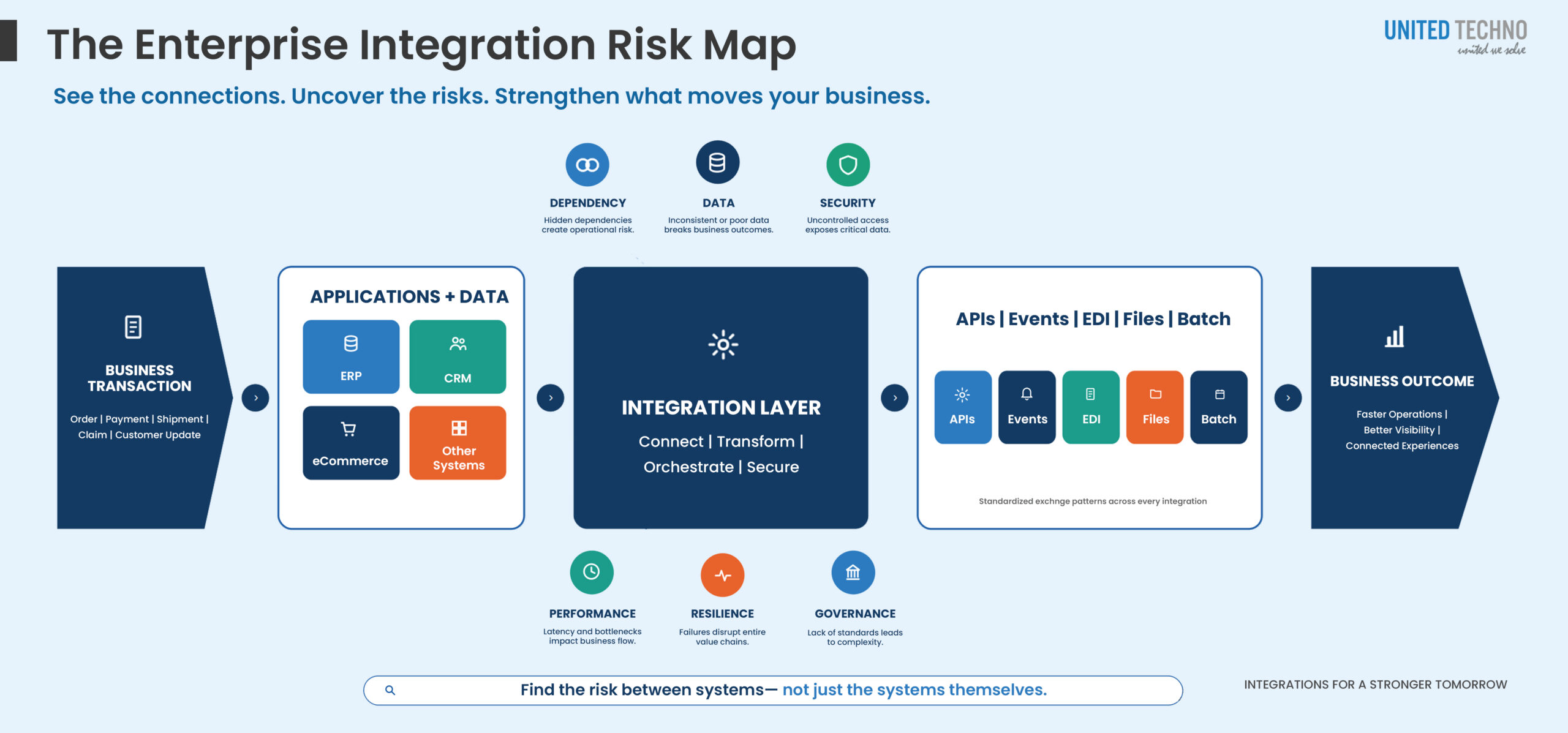
The Enterprise Integration Risk Map
Follow the Data, Not Just the Message
An interface can be technically successful while the business transaction is still wrong.
For example:
An order leaves System A with a customer ID.
The integration transforms the payload.
System B receives it successfully.
But the customer identifier maps incorrectly.
From an integration platform perspective:
Success.
From a business perspective:
Failure.
That is why Integration Audit Services must examine the entire data path:
Source → Transformation → Mapping → Validation → Destination → Reconciliation
The important questions are not simply whether data moves, but whether it retains its meaning as it moves.
This becomes particularly important when enterprises have multiple versions of customer, product, order, pricing, inventory, or supplier data distributed across applications.
The Most Expensive Integration Problem May Be the One Nobody Owns
Ownership is often overlooked.
An interface may have been created five years ago for a project that no longer exists. The developer who built it may have moved teams. The business process may have changed. Yet the interface remains because something somewhere still depends on it.
That creates integration debt.
Effective Integration Audit Services should therefore expose:
| Area | Questions to answer |
| Ownership | Who is accountable for the integration? |
| Dependency | What systems and processes rely on it? |
| Lifecycle | Is it actively maintained? |
| Change risk | What breaks if it changes? |
| Observability | Can failures be detected quickly? |
| Recovery | Can failed transactions be safely replayed? |
| Reuse | Is the capability duplicated elsewhere? |
The result is often revealing: the enterprise discovers that its integration landscape has grown organically rather than architecturally.
Test What Happens When Things Go Wrong
Happy-path testing tells only part of the story.
Integration Audit Services should examine the failure path as well.
What happens when:
- an API times out?
- a downstream system is unavailable?
- a message arrives twice?
- a required field is missing?
- a partner sends an unexpected format?
- processing stops halfway through a transaction?
- a batch job fails overnight?
- a message cannot be delivered?
- a downstream system accepts data but processes it incorrectly?
The architecture should have explicit answers for these conditions.
That means examining:
Timeouts → Retries → Idempotency → Queues → Dead-letter handling → Replay → Reconciliation → Alerting
This is where the difference between a working integration and an enterprise-grade integration becomes visible.
Performance Is More Than Response Time
An integration may perform perfectly at 10,000 transactions per day and struggle at 500,000.
That is why Integration Audit Services should examine the workload, not just current latency.
Key signals include:
- Transaction volume
- Peak concurrency
- API response time
- Queue depth
- Batch duration
- Retry frequency
- Error rate
- Processing throughput
- Dependency latency
- Infrastructure utilization
The objective is not simply to make integrations faster.
It is to determine where the architecture will break as the business changes.
Security Must Follow the Data Path
Integration creates additional pathways into enterprise data.
Integration Audit Services should therefore trace:
Who sends → What is sent → Where it travels → Who can access it → How credentials are managed → What gets logged
This can expose issues such as excessive privileges, unsecured endpoints, inappropriate data exposure, weak credential management, or sensitive information appearing in operational logs.
Security cannot be treated as a separate layer added after integration design. It is part of the integration architecture itself.
From Audit Findings to Architecture Decisions
The real value of Integration Audit Services appears after the findings are collected.
Not every problem deserves the same response.
One interface may need better monitoring.
Another may need to be redesigned.
A duplicated integration may be consolidated.
A fragile legacy interface may need API enablement.
A high-volume batch flow may be a candidate for event-driven processing.
An obsolete interface may simply need to be retired.
That leads to a more useful classification:
RETAIN → HARDEN → REUSE → REFACTOR → REPLACE → RETIRE
The audit becomes a decision engine rather than a report.
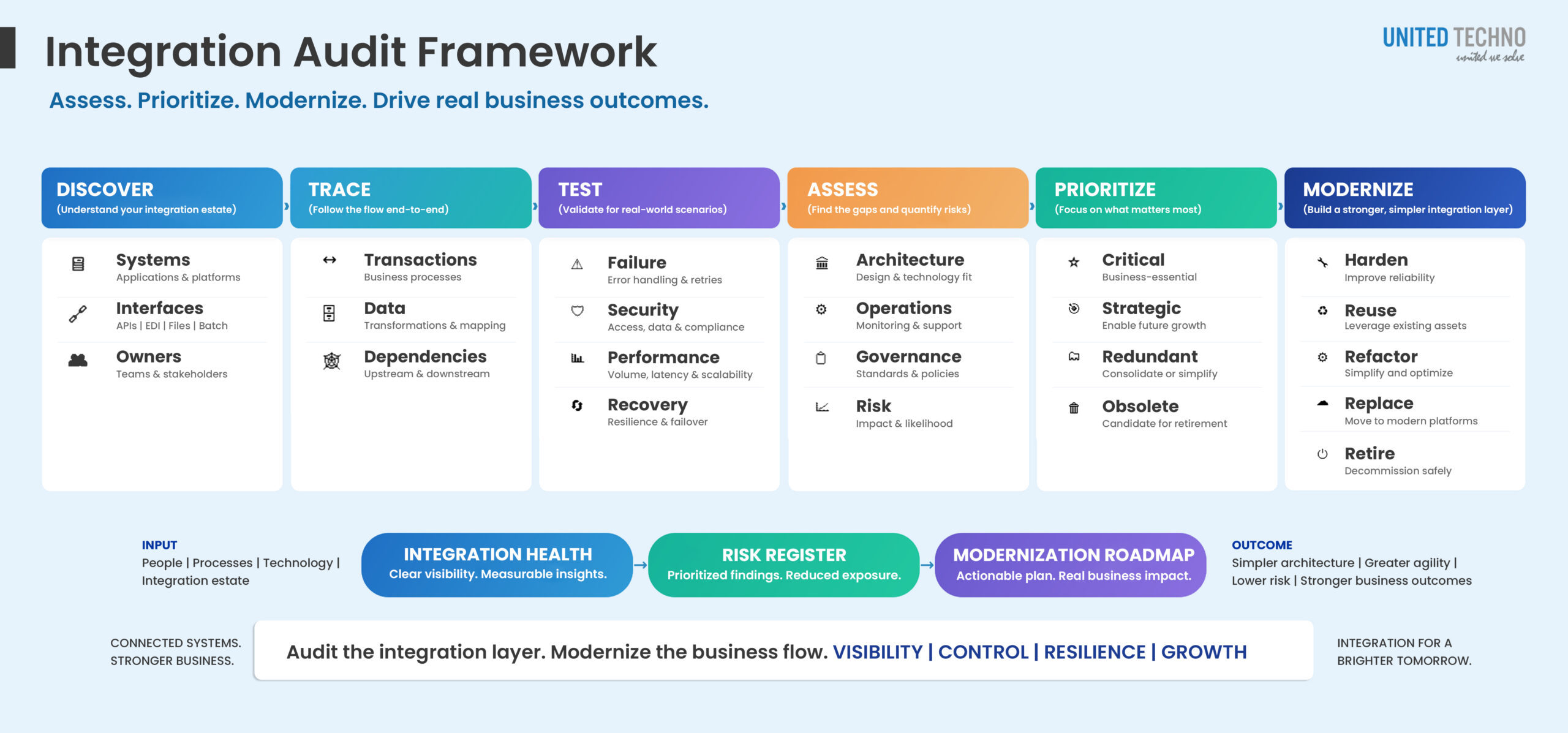
United Techno Integration Audit Framework
The Output Should Be More Than an Audit Report
A useful integration assessment should leave the technology and business teams with something they can act on.
The final output should connect technical findings to business priorities:
Integration Health
What is working, what is fragile and what is becoming obsolete?
Risk Exposure
Which dependencies could affect critical business transactions?
Integration Debt
Where are duplication, ownership gaps and outdated patterns increasing cost?
Modernization Priorities
Which integrations should be changed first—and why?
Target Architecture
What should the integration landscape look like after remediation?
Execution Roadmap
What can be addressed immediately, and what belongs in a longer modernization program?
That last step matters.
An audit that identifies 200 problems but provides no sequencing is simply a longer problem list.
United Techno Integration Audit Approach
United Techno approaches integration audits as an architecture and modernization exercise, not a documentation exercise.
Our Integration Audit Services follow seven stages:
MAP → TRACE → TEST → ASSESS → PRIORITIZE → MODERNIZE → GOVERN
The analysis can span:
- Boomi and iPaaS environments
- API ecosystems
- EDI and B2B integrations
- Legacy application interfaces
- ERP and CRM integrations
- Event-driven architectures
- Batch and file-based integrations
- Cloud and hybrid environments
- Integration security and observability
- Data synchronization and reconciliation
The outcome is a practical view of where the integration estate is creating friction—and what should change first.
The Question Is Not “Do Our Integrations Work?”
Most enterprises can answer that.
The more valuable questions are:
Can we explain how critical transactions move?
Can we identify where they can fail?
Can we change one system without destabilizing five others?
Can we scale the integration layer with the business?
Can we retire old interfaces without discovering hidden dependencies six months later?
If those answers are unclear, the integration layer deserves an architectural audit.
Turn Integration Complexity Into an Actionable Roadmap
United Techno helps enterprises assess integration architecture, identify hidden dependencies and technical debt, strengthen resilience and governance, and define modernization priorities across APIs, Boomi, EDI, applications, data and cloud environments.
Start Your Integration Architecture Assessment →