A reverse engineering expert’s view on uncovering application behavior before modernization
Most legacy applications are not difficult to understand because the code is old.
They are difficult because the system that exists today is different from the system that was originally designed.
Over ten years of working with enterprise applications, one pattern becomes clear: the source code is only one part of the story. Business rules have moved. Interfaces have accumulated. Database structures have evolved. Batch jobs have become operational dependencies. Temporary fixes have become permanent behavior.
By the time an organization decides to modernize, nobody may have a complete picture of how all those pieces work together.
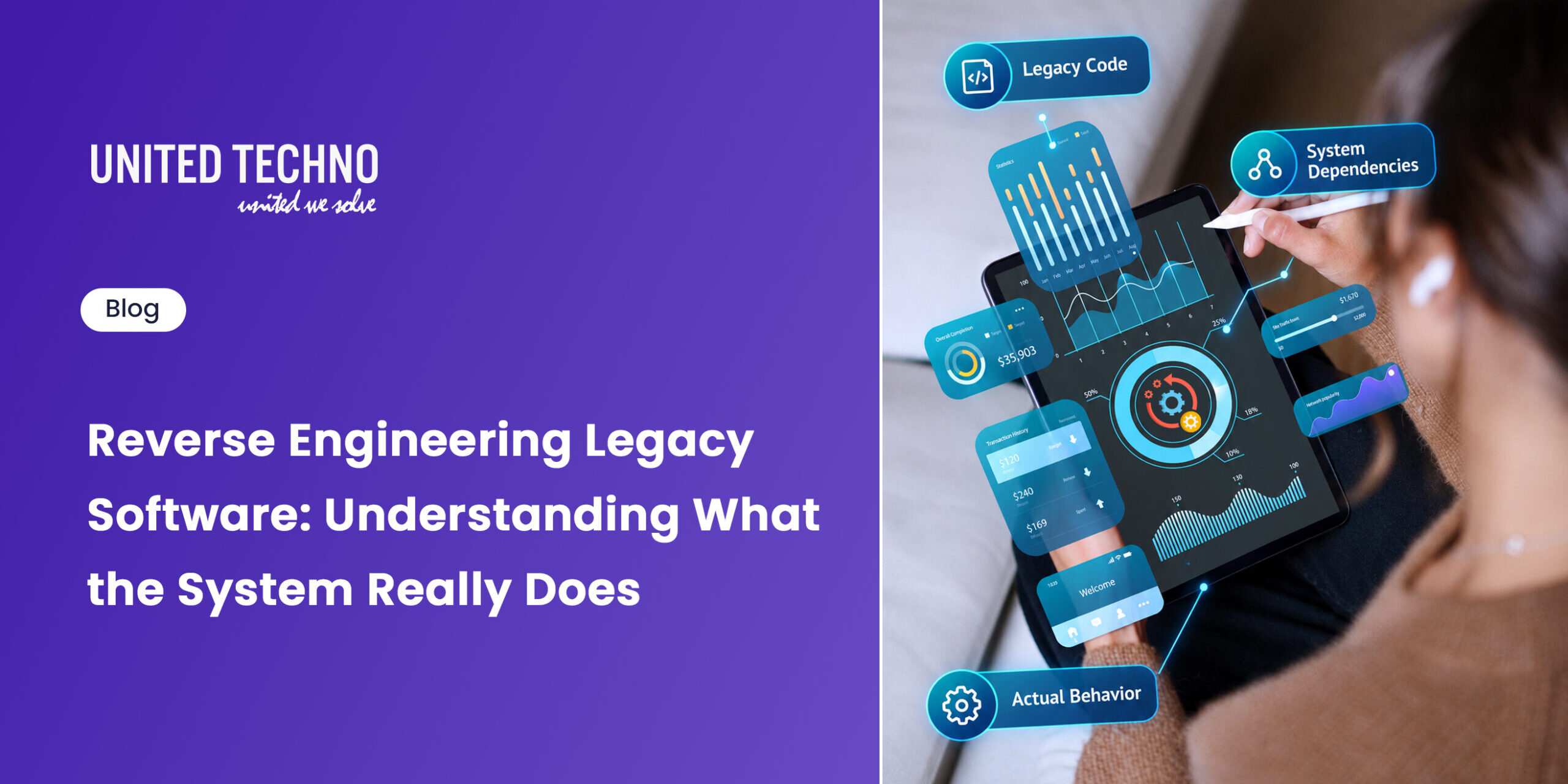
That is where Reverse Engineering Legacy Software earns its place. It is not about translating old code into a newer language. It is about reconstructing the application’s actual behavior well enough to make safe engineering decisions.
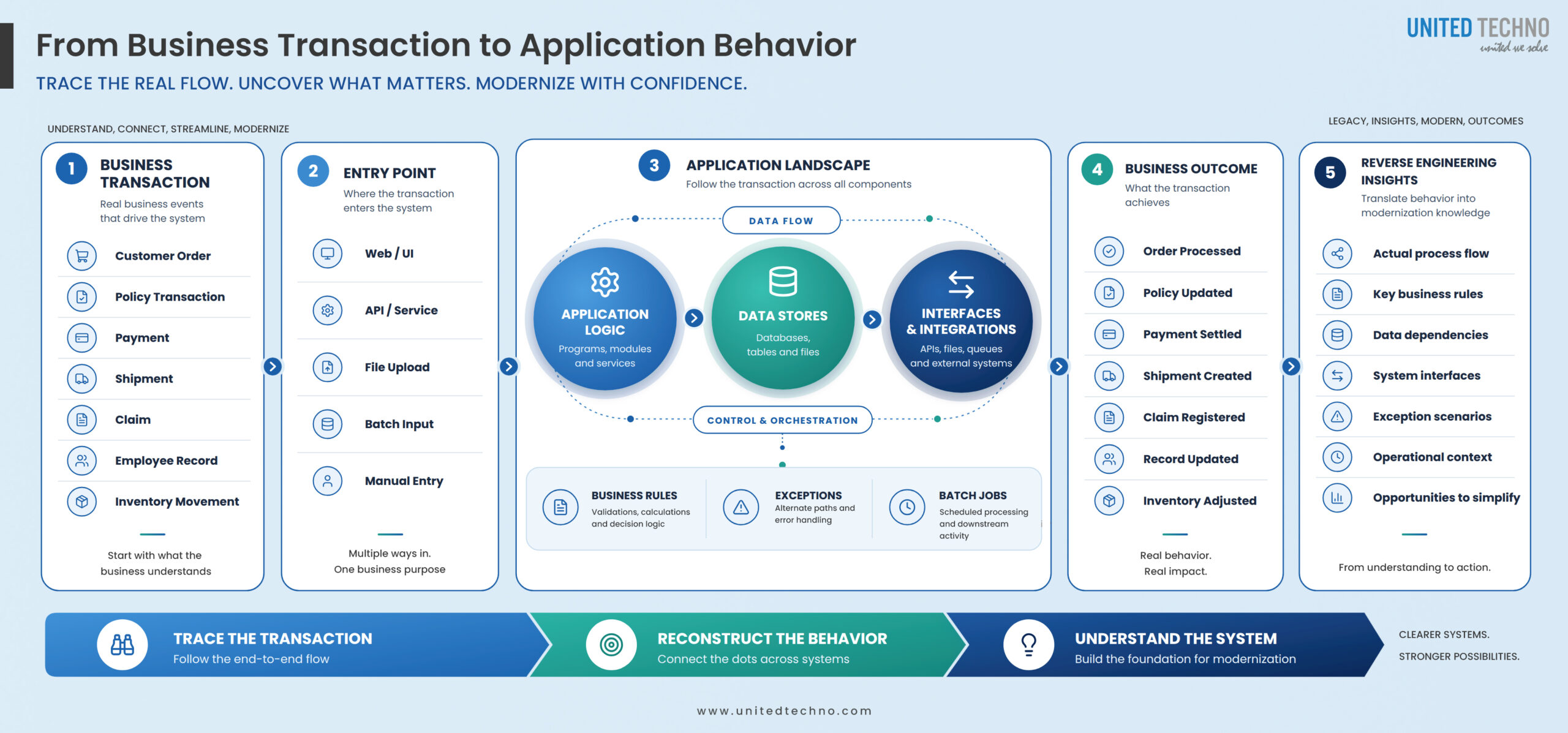
Start With the Transaction, Not the Technology
I rarely recommend starting a reverse-engineering exercise by opening thousands of source files.
Start with something the business understands.
In Reverse Engineering Legacy Software, a practical starting point is to take a customer order, policy transaction, shipment, payment, claim, employee record, or inventory movement and follow it through the application.
Ask:
- Where does the transaction enter?
- Which program or service receives it?
- What validations occur?
- Which data is read?
- Which rules change the outcome?
- What gets written?
- Which downstream process receives the result?
- What happens when something fails?
- What happens later in the batch cycle?
This approach exposes something a static code inventory cannot:
the execution path that actually supports the business process.
Once that path is understood, the surrounding code becomes considerably easier to interpret.
Four Things I Look For in a Legacy Application
A useful reverse-engineering exercise should reconstruct four different dimensions of the system. In Reverse Engineering Legacy Software, these dimensions help establish how the application actually operates beyond what its documentation describes.
1. Execution
Which programs, modules, jobs, procedures and interfaces participate in a transaction?
This establishes the actual processing sequence.
2. Data
What information is created, modified, referenced and passed between components?
A field that looks insignificant in one program may determine a major business decision somewhere else.
3. Decisions
Where does the application decide what happens next?
This is where pricing logic, eligibility rules, approval conditions, allocation rules, calculations and exceptions usually surface.
4. Operational Behavior
What does the application depend on outside its immediate codebase?
Schedulers, files, database jobs, control tables, manual interventions, restart procedures and external systems can all become part of the application’s real operating model.
These four dimensions together provide a much more reliable picture than a simple application inventory.
The Hardest Part Is Finding the Exceptions
Happy-path processing is usually easy to describe.
The real knowledge of an enterprise system often sits in the exceptions.
In Reverse Engineering Legacy Software, identifying these exceptions is essential to understanding how the application behaves under real-world conditions.
A transaction may follow one route for a standard customer and another for a strategic account.
A shipment may be processed differently when inventory is split across locations.
A payment may be held when several conditions occur simultaneously.
A batch job may behave differently depending on a control-table value that was introduced years ago.
Those exceptions are easy to miss because they may not appear in architecture documents or functional specifications.
They are often buried in conditional logic, database procedures, configuration, interface mappings or operational workarounds.
A modernization that captures only the normal path is not a modernization of the real application.
It is a modernization of the documented application.
There is a difference.
Code Is Evidence. It Is Not Always the Whole Answer.
One of the mistakes I see in reverse-engineering projects is treating source code as the unquestionable definition of system behavior.
In Reverse Engineering Legacy Software, I want to compare three things:
| Evidence | What it tells us |
| Source code | What the application was programmed to do |
| Runtime behavior | What the application actually does |
| Business knowledge | Why the behavior exists |
When these three agree, confidence is high.
When they disagree, that disagreement is valuable.
For example, code may contain a rule that nobody in the business recognizes anymore. Conversely, an operations team may describe a process that cannot be found in the application’s formal documentation.
Both situations require investigation before modernization proceeds.
This is why experienced reverse engineering is partly technical analysis and partly disciplined questioning.
Build a Behavioral Map, Not a Documentation Dump
A reverse-engineering project can produce hundreds of pages and still leave architects without the information they need.
The useful output is much more focused.
In Reverse Engineering Legacy Software, I typically want to establish:
Transaction map
How important business transactions move through the system.
Dependency map
Which components rely on one another.
Data lineage
Where critical information originates, changes and travels.
Decision inventory
Which rules materially affect business outcomes.
Interface inventory
How the application communicates with other systems.
Exception catalogue
Where processing deviates from the normal path.
Operational dependencies
Jobs, schedules, controls and manual activities required to keep the system functioning.
The purpose is not documentation for documentation’s sake.
The purpose is to create a behavioral baseline against which the modernized solution can be designed and tested.
Reverse Engineering Changes the Modernization Conversation
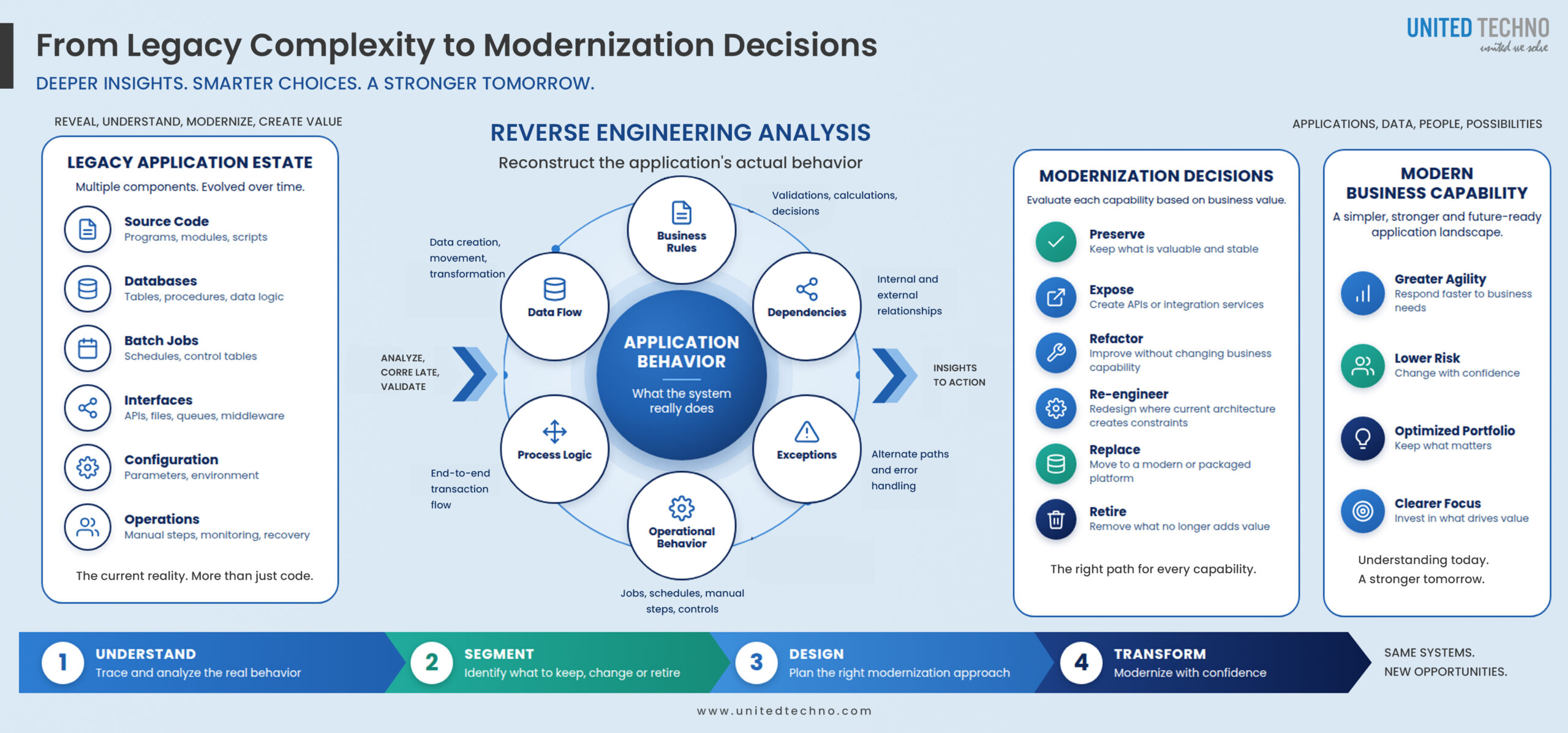
Once the application’s behavior is understood, the modernization discussion becomes more precise. Reverse Engineering Legacy Software helps establish the foundation for making informed decisions about what to retain, improve, replace or remove.
Instead of asking:
“How do we move this application to the cloud?”
the team can ask:
“Which business capabilities are still valuable, which technical dependencies are constraining them, and what is the safest way to separate the two?”
That can lead to very different decisions.
Preserve
Keep functionality where the existing implementation still provides value and carries low modernization risk.
Expose
Place an API or service boundary around valuable functionality that other applications need.
Refactor
Improve internal structure without changing the business capability.
Re-engineer
Redesign a capability where the current implementation prevents the business from evolving
Replace
Move a well-understood capability to a packaged or modern platform.
Retire
Remove functionality that no longer has a legitimate business purpose.
The important point is that the technology decision comes after the understanding.
A Practical Reverse Engineering Method
After years of working with complex enterprise systems, I prefer a controlled sequence rather than a broad “analyze everything” exercise.
01 — Select
Choose a business transaction or capability that matters.
02 — Trace
Follow its execution path through programs, data stores, jobs and interfaces.
03 — Correlate
Compare source code, configuration, database behavior, runtime evidence and operational knowledge.
04 — Reconstruct
Document the actual business behavior, including exceptions and dependencies.
05 — Challenge
Question obsolete, duplicated, unexplained or conflicting behavior.
06 — Validate
Review the reconstructed behavior with business and technical owners.
07 — Decide
Determine what should be preserved, separated, redesigned, replaced or retired.
08 — Baseline
Convert the validated behavior into scenarios that can be used during modernization and migration testing.
This sequence keeps reverse engineering connected to the eventual transformation instead of allowing it to become an isolated assessment exercise.
What Good Reverse Engineering Gives the Architecture Team
At the end of a Reverse Engineering Legacy Software exercise, the modernization team should be able to answer five questions with confidence:
What does the application actually do?
Which behavior is business-critical?
What does the application depend on?
What can safely change?
How will we prove that the new solution still behaves correctly?
If those questions cannot be answered, the organization is probably not ready to start a large-scale rewrite or replacement.
The missing information is itself a modernization risk.
United Techno Perspective
Reverse engineering is often positioned as the first step before modernization.
I see it differently.
Reverse Engineering Legacy Software is the discipline that makes modernization controllable.
The objective is not to preserve old code. It is to preserve the right business behavior while creating freedom to change the technology underneath it.
That requires looking beyond source files and understanding the complete operating reality of the application, transactions, data, decisions, interfaces, exceptions and operational dependencies.
At United Techno, we approach legacy application reverse engineering with that principle in mind:
Trace the behavior. Recover the logic. Validate the dependencies. Then decide what deserves to survive.
That is how a legacy application moves from being a technical unknown to becoming an engineering decision.
Modernizing a complex legacy application?
United Techno provides Reverse Engineering Legacy Software services to help reconstruct application behavior, identify critical dependencies and business rules, establish a reliable current-state baseline, and define a modernization path based on evidence rather than assumptions.