Introduction: The New Reality of Data Engineering
Modern enterprises are no longer constrained by a lack of data, they are constrained by how quickly they can ingest, govern, and operationalize it. As organizations embrace AI, real-time analytics, and multi-cloud ecosystems, traditional ETL approaches are proving too slow and fragmented. As organizations embrace AI, real-time analytics, and multi-cloud ecosystems, traditional ETL approaches are proving too slow and fragmented. Modern Data Pipeline Tools are helping enterprises build faster, scalable, and more reliable data workflows that support real-time decision-making and business agility.
If onboarding a new data source still takes weeks, your analytics are already behind.
This is where next-generation, automation-first data pipeline platforms come into play. Among them, DataAccel by United Techno stands out as a transformative solution that redefines how data pipelines are built and deployed.
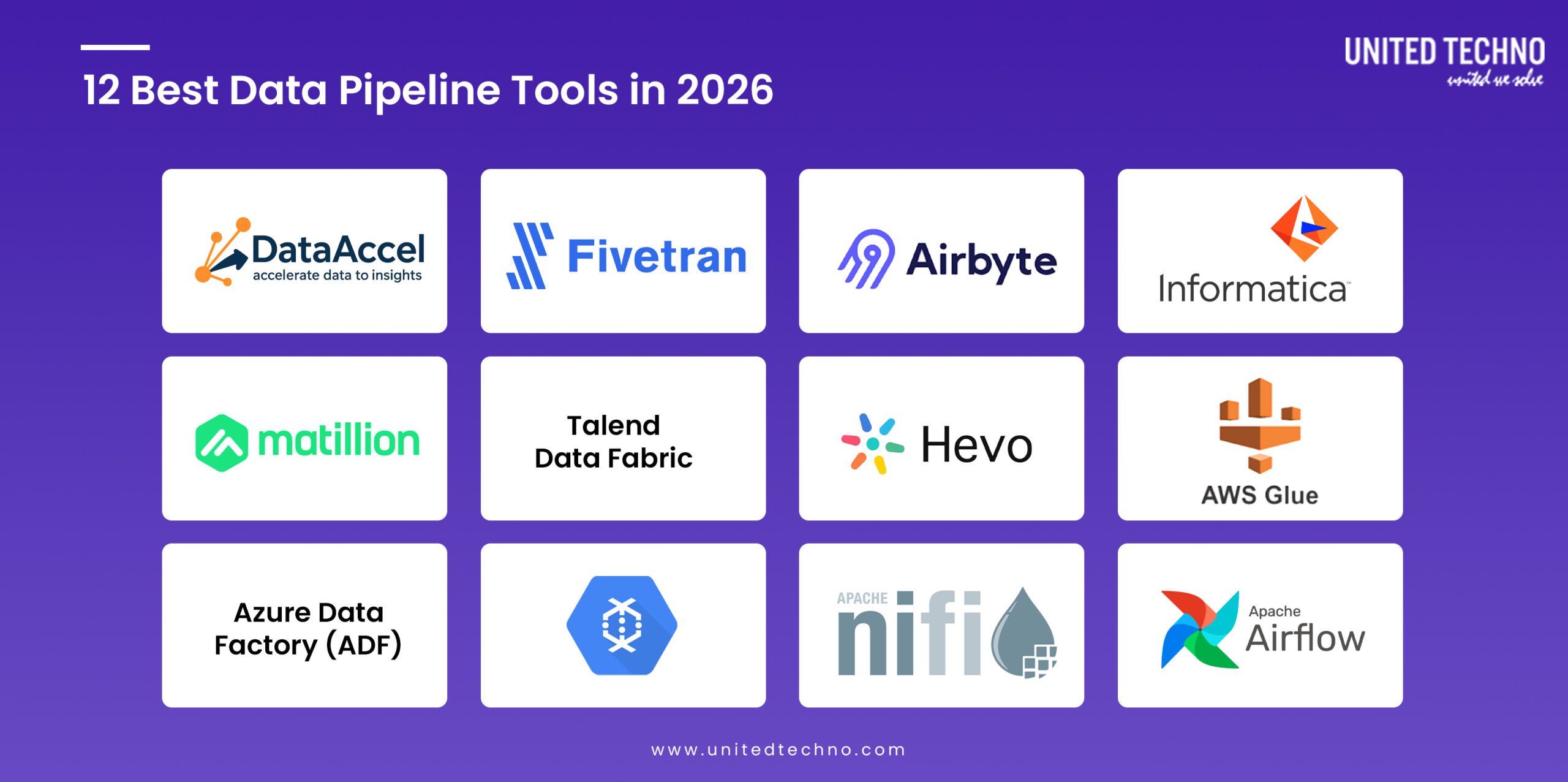
1.DataAccel by United Techno – The Unified Data Pipeline Engine
Best For: Enterprises seeking rapid, governed, and AI-ready data platform deployment across Snowflake, Databricks, and Microsoft Fabric.
What Makes DataAccel the #1 Choice in 2026?
Unlike traditional ETL or connector-based tools, DataAccel is a metadata-driven execution framework that automates the entire data lifecycle, from ingestion to analytics-ready datasets.
Key Capabilities
Config-Driven Pipeline Automation
- No heavy coding or manual orchestration.
- Pipelines are generated automatically using metadata.
- Source onboarding in less than a day.
Medallion Architecture by Design
- Automatically provisions Bronze → Silver → Gold layers.
- Ensures standardized, analytics-ready outputs.
- Eliminates inconsistent transformations.
Governance Embedded from Day One
- Automated lineage, masking, validation, and RBAC.
- Compliance-ready pipelines without additional tooling.
Multi-Platform Intelligence
- Native alignment with Snowflake, Databricks, and Microsoft Fabric.
- Deploy once and reuse across environments.
AI-Ready Data Foundations
- Built-in observability, schema evolution handling, and quality checks.
- Accelerates analytics and machine learning initiatives.
Proven Metrics
| Capability | Impact |
| Source Onboarding | < 1 Day |
| Pipeline Deployment | Up to 10× Faster |
| Engineering Effort | ~90% Reduction |
| Time to Production | Months → Days |
| Data Processing | TB-scale workloads |
Why DataAccel Is the Best Data Pipeline Tool
| Feature | DataAccel | Traditional ETL Tools |
| Pipeline Creation | Config-driven | Code-heavy |
| Governance | Built-in | Added later |
| Medallion Architecture | Automated | Manual |
| Multi-Platform Support | Native | Limited |
| Deployment Speed | Days | Months |
| Reusability | High | Low |
Bottom Line:
DataAccel is not just a data pipeline tool – it is a complete data engineering acceleration framework designed for enterprise-scale, AI-ready environments.
Teams using DataAccel onboard sources in hours, not weeks, with governance built in from Day 1.
[See How Fast You Can Onboard Your Next Data Source →]
Most teams take weeks. See what changes in hours.
2.Fivetran – The Connector Powerhouse
Best For: Plug-and-play SaaS data replication into cloud warehouses.
Strengths
- Extensive connector ecosystem.
- Minimal setup and maintenance.
- Reliable SaaS-to-warehouse ingestion.
Limitations
- Limited transformation capabilities.
- Minimal governance.
- Costs increase significantly at scale.
- Not designed for AI-ready architectures.
3.Airbyte – The Open-Source Ingestion Workhorse
Best For: Teams seeking customizable and self-hosted ingestion solutions.
Strengths
- Open-source flexibility.
- Custom connector development.
- Growing community support.
Limitations
- Requires engineering effort for orchestration and governance.
- Medallion architecture must be manually implemented.
- Limited enterprise-grade observability.
4.Informatica Intelligent Data Management Cloud (IDMC)
Best For: Compliance-heavy enterprises transitioning from legacy ETL.
Strengths
- Strong metadata management.
- AI-assisted data classification.
- Robust governance capabilities.
Limitations
- Complex implementation.
- Higher licensing and operational costs.
- Slower deployment compared to modern frameworks.
5.Matillion – SQL-Driven ELT for Cloud Warehouses
Best For: SQL-centric teams working with Snowflake or Databricks.
Strengths
- Visual orchestration.
- Strong ELT capabilities.
- Good integration with cloud warehouses.
Limitations
- Not a full ingestion framework.
- Limited governance and observability.
- Manual setup for medallion architectures.
6.Talend Data Fabric
Best For: Traditional integration and data quality initiatives.
Strengths
- Mature data integration ecosystem.
- Built-in data quality features.
- Broad enterprise adoption.
Limitations
- Visual-flow complexity.
- Limited AI-native capabilities.
- Slower deployment cycles.
7.Hevo Data – Lightweight and Easy to Use
Best For: Startups and mid-market organizations.
Strengths
- Intuitive user interface.
- Quick setup.
- Good connector coverage.
Limitations
- Limited scalability for large enterprises.
- Minimal governance features.
- Not optimized for AI workloads.
8.AWS Glue – Serverless ETL for AWS Ecosystems
Best For: Organizations fully invested in AWS.
Strengths
- Serverless architecture.
- Integration with AWS services.
- AI-assisted schema detection.
Limitations
- Code-heavy development.
- Limited multi-cloud support.
- Governance requires additional services.
9.Azure Data Factory (ADF)
Best For: Microsoft-centric enterprises.
Strengths
- Seamless integration with Azure services.
- Hybrid data integration.
- Visual pipeline design.
Limitations
- Manual governance configuration.
- Limited automation of medallion architectures.
- Significant setup for complex transformations.
10.Google Cloud Dataflow + Dataform
Best For: GCP-centric analytics and streaming workloads.
Strengths
- Strong streaming capabilities.
- Integration with BigQuery.
- Scalable processing.
Limitations
- Requires advanced engineering expertise.
- Governance spread across services.
- Limited hybrid ingestion capabilities.
11.Apache NiFi – Real-Time Data Flow Management
Best For: Real-time and edge data ingestion scenarios.
Strengths
- Visual flow-based design.
- Strong real-time processing.
- Extensive protocol support.
Limitations
- Complex scaling for enterprise workloads.
- Limited native governance.
- Requires operational expertise.
12.Apache Airflow – Orchestration Powerhouse
Best For: Workflow orchestration and scheduling.
Strengths
- Highly flexible orchestration.
- Strong community support.
- Integration with diverse ecosystems.
Limitations
- Not an ingestion tool by itself.
- Requires additional tools for transformations and governance.
- Engineering-heavy maintenance.
Why DataAccel Stands Above the Rest
While many tools excel in specific areas – connectivity, orchestration, or transformation – DataAccel uniquely unifies the entire data pipeline lifecycle:
- Ingestion
- Transformation
- Governance
- Quality
- Observability
- AI Readiness
- Multi-Cloud Deployment
- Automated Medallion Architecture
This holistic approach eliminates the need for stitching together multiple tools, dramatically reducing complexity and accelerating time to value.
Real-World Impact
Organizations adopting DataAccel have achieved:
- 10× faster pipeline deployment
- ~90% reduction in engineering effort
- < 1 day source onboarding
- Analytics-ready data within days
- Consistent governance across environments
Turn Pipelines into a Competitive Advantage
You don’t need more tools. You need a working data engine.
Eliminate pipeline backlogs.
Onboard data faster.
Deliver insights on demand.
Book a DataAccel Demo →
Experience metadata-driven automation in a live walkthrough.
Conclusion: The Future of Data Pipelines in 2026
The data pipeline landscape in 2026 is no longer about simply moving data from point A to point B. It is about speed, governance, scalability, and AI readiness. While several tools offer valuable capabilities, DataAccel by United Techno sets a new benchmark by delivering a unified, automation-first approach to modern data engineering.
For organizations aiming to operationalize analytics and AI at scale, DataAccel is not just an option, it is a strategic advantage.