Why We Built a Small Language Model (SLM)
Large Language Models offer powerful capabilities, but hosting a large model locally requires high-end GPU infrastructure, which leads to substantial hardware and maintenance costs. To avoid this, many teams rely on API-based access to cloud-hosted models—but this introduces ongoing paid API expenses that increase as usage scales. In addition, cloud-based models can create latency issues for real-time applications and raise privacy concerns when sensitive data must be transmitted outside the organization.
Why Use SLMs Instead of LLMs?
Small Language Models (SLMs) were not created to replace Large Language Models (LLMs). They were created because, in many practical scenarios, LLMs are too expensive, too slow, or unnecessary.
1. Cost Optimization
LLM Drawback – LLMs require expensive GPU resources for inference, especially when deployed at scale.They also incur high cloud compute costs, making long-term usage financially demanding.
SLM Advantage – SLMs have a lower memory footprint, requiring significantly less compute power.They can run on cheaper hardware, reducing overall infrastructure costs.
2. Infrastructure Efficiency
LLM Drawback – LLMs typically require cloud hosting and powerful GPU clusters to operate effectively.
SLM Advantage – SLMs can run on laptops, mobile devices, and edge servers, making them far more infrastructure-efficient.
3. Domain-Specific AI Customization
LLM Drawback: Large Language Models are often oversized and costly for focused, single-domain business tasks.
SLM Advantage: Small Language Models can be fine-tuned specifically for a customer’s domain, delivering efficient, purpose-built performance with lower cost and complexity.
4. Data Privacy Control
LLM Drawback: LLMs often require transmitting sensitive data to external cloud APIs, raising compliance and trust concerns.
SLM Advantage: SLMs can run locally within the organization, ensuring sensitive data remains secure and fully controlled.
How United Techno Solved This Challenge?
For clients needing general-purpose applications, we evaluated open-source Large Language Models deployed in GGUF format. These models are optimized for CPU and low-resource environments, As a result, they are well-suited for on-premise and private deployments with controlled infrastructure. GGUF-based deployment also enables more predictable and cost-efficient operations, making it a practical solution for scalable AI systems.
We also developed a domain-specific Small Language Model by fine-tuning a quantized version of the Alibaba Cloud Qwen 7B model. Quantization reduced memory and compute requirements, enabling efficient local deployment. We applied LoRA (Low-Rank Adaptation) along with Supervised Fine-Tuning (SFT) on a carefully curated question-and-answer dataset tailored to our domain.The dataset itself was created using diverse question–answer pairs generated by large language models and other question -answer generation techniques
Base Model (Qwen 7B)
↓
Quantization (4-bit / 8-bit)
↓
LoRA Adaptation
↓
SFT Training (Q&A Dataset)
↓
Domain-Specific SLM
↓
Deployment (Local / GGUF)
Fine-tuning with fewer resources
One of the biggest reasons Small Language Models became popular is that they are much easier and cheaper to fine-tune compared to large foundation models.
Organizations using ecosystems from Hugging Face, OpenAI, and Google are increasingly adopting lightweight fine-tuning strategies because they reduce cost while keeping strong performance in domain tasks.
Smaller Parameter Count
- Large LLM → 70B – 500B parameters
- SLM → 1B – 15B parameters
Techniques That Make SLM Fine-Tuning Even Cheaper
Parameter Efficient Fine-Tuning (PEFT)
- Freeze base model weights
- Train only small adapter layers
Quantized Fine-Tuning
- 8-bit training
- 4-bit training
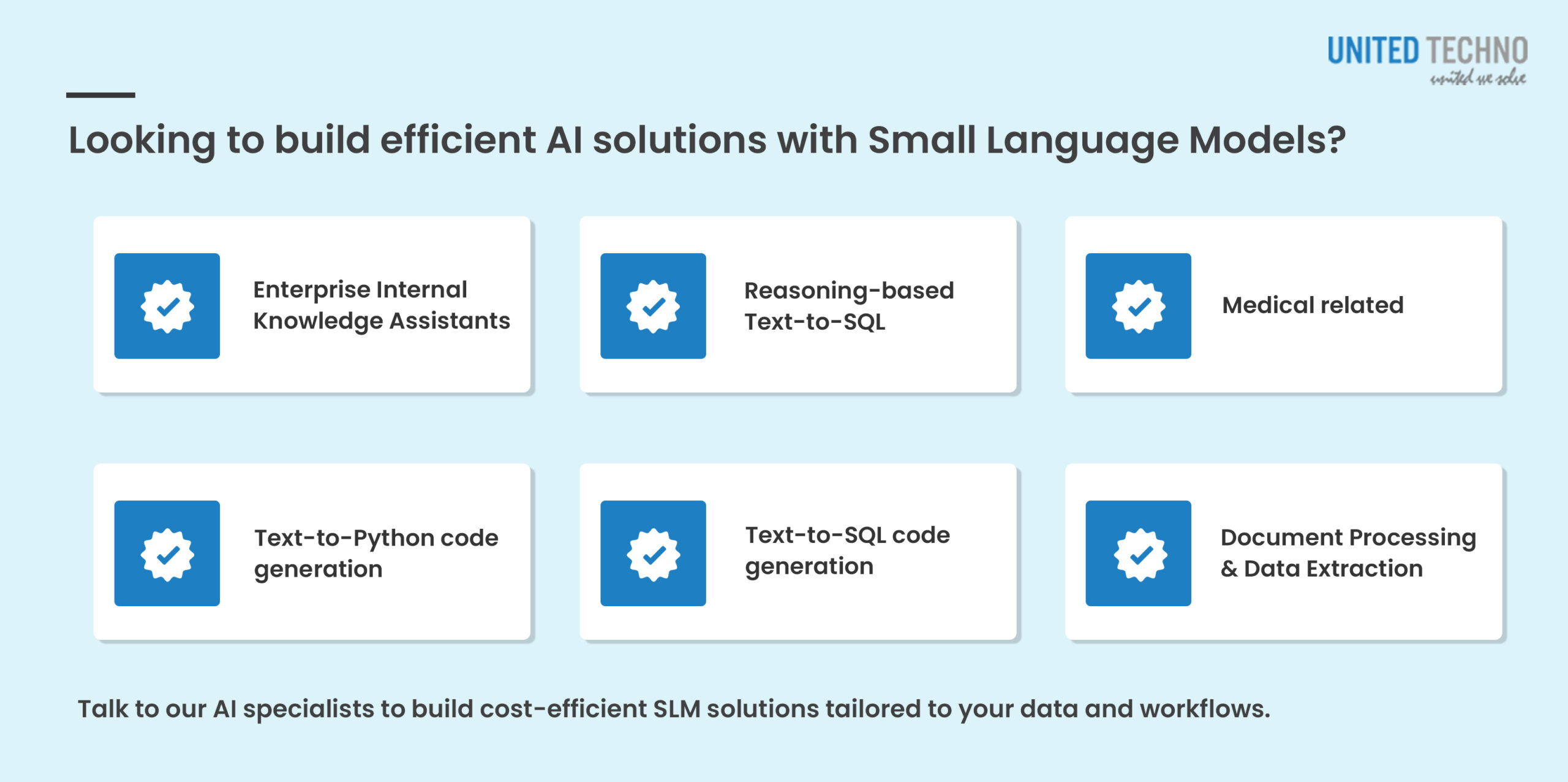
Use Cases We Addressed with SLM
- Enterprise Internal Knowledge Assistants
- Reasoning-based Text-to-SQL
- Medical related
- Text-to-Python code generation
- Text-to-SQL code generation
- Document Processing & Data Extraction
Across the implemented domain-specific use cases, our Small Language Model achieved an overall accuracy of approximately 85% to 90%