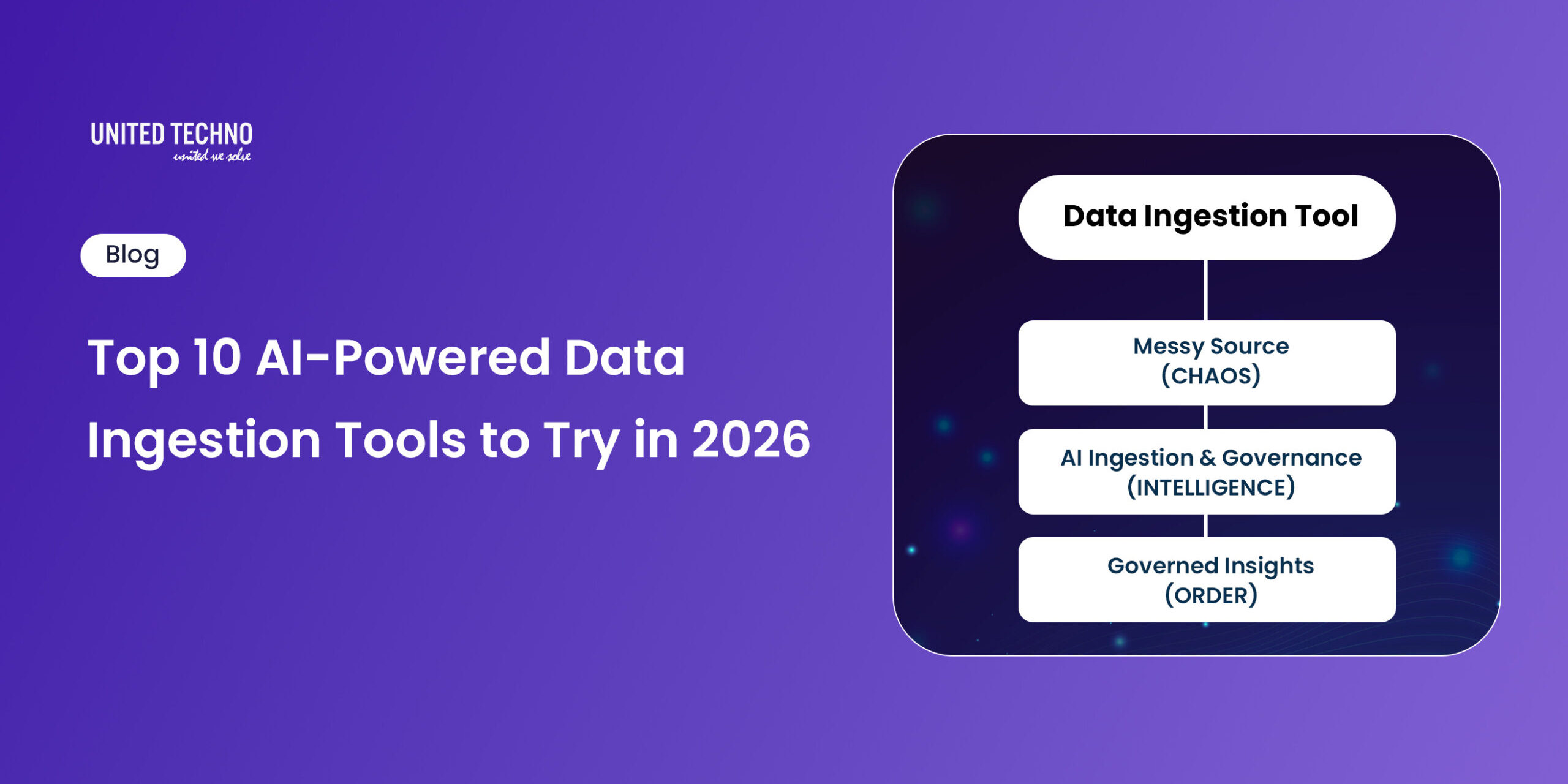
Top 10 AI-Powered Data Ingestion Tools to Try in 2026
(And Why DataAccel Deserves the First Spot on Your Radar)
If you’ve been anywhere near a data engineering team in the last decade, you know one universal truth:
Ingestion is always the bottleneck.
New platform? New warehouse? New migration? Great, still doesn’t matter if your ingestion pipelines take 6 to 12 weeks per source.
2026 isn’t going to be kinder.
More SaaS apps. More APIs. More real-time demands. More compliance. More “Can you get this into the dashboard by Friday?” messages that ruin a perfectly good afternoon.
The good news?
The ingestion landscape is finally evolving, not with more ETL scripts, but with AI-assisted, config-driven, governance-aware tooling that takes the heavy lifting away from engineers.
And at the center of that shift is a category we call:
“AI-accelerated ingestion frameworks.”
These don’t just move data.
They understand it.
They prepare it.
They govern it.
They recover when things break.
And most importantly – they compress weeks of manual effort into hours or days.
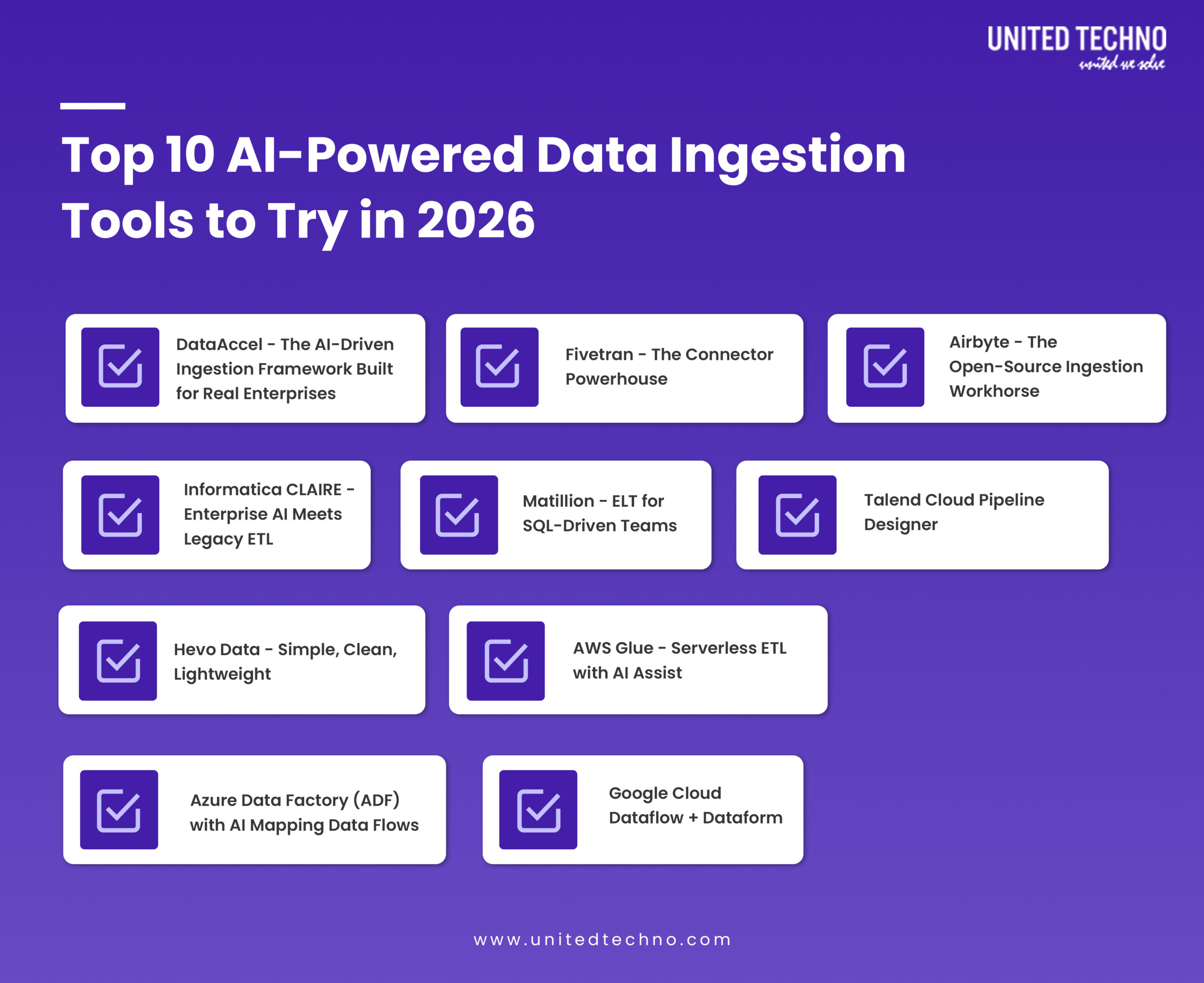
So let’s walk through the Top 10 AI-powered ingestion tools worth paying attention to in 2026, starting with the one that has quietly become my personal favorite.
1. DataAccel – The AI-Driven Ingestion Framework Built for Real Enterprises
Let us get this out of the way:
If you’re expecting a light, connector-only ingestion tool, DataAccel will surprise you.
DataAccel is not a connector marketplace.
It’s not a “copy data from here to there” utility.
It’s not just a CDC tool.
It’s an end-to-end ingestion and transformation accelerator used by teams that don’t have months to wire pipelines together.
What makes it stand out in 2026?
✓ Config-driven ingestion (no scripting, no Spark boilerplate)
Add a source → choose CDC/full load → pick tables → apply governance → done.
Pipelines generate themselves intelligently, including file handling, schema mapping, and incremental checkpoints.
✓ Medallion architecture auto-built (Bronze → Silver → Gold)
No other ingestion engine builds all three layers with governance, lineage, and validation baked into every hop.
✓ AI-enabled source understanding
DataAccel uses metadata patterns to understand:
- which fields need masking,
- what keys drive incremental loads,
- where schema drift is likely,
- and how to optimize partitioning/storage.
✓ Best-in-class governance
Lineage? Automatic.
Masking? Automatic.
Data quality? Pre-configured.
Observability? Logs + alerts + archival + schema evolution.
✓ Cloud-agnostic execution
Works the same whether the destination is:
- Snowflake
- Databricks
- Microsoft Fabric
- Azure SQL / S3 / ADLS
- On-prem SQL Server / Oracle
- Or even mixed environments
✓ Speed that actually matters
Most ingestion tools claim “fast.” DataAccel reliably delivers:
- 5-day ingestion from source to insights
- <1 hour source onboarding
- 85 to 90% reduction in pipeline engineering
- Zero rework on schema drift
This is the only tool on the list we’ve personally seen migrate 150+ tables in 45 days with governance running from Day 1.
If you want a tool that eliminates manual ingestion engineering rather than smoothing its edges, DataAccel sits at the top of the 2026 leaderboard.
2. Fivetran – The Connector Powerhouse
If your team needs connectors, lots of them – Fivetran still leads the category. It’s great for SaaS → Warehouse replication, and it’s incredibly stable.
Where it falls short:
- Very limited transformation capabilities
- No medallion automation
- Governance is minimal
- Not built for AI workloads or unstructured data
- Price creeps up fast at scale
Best use case: plug-and-play SaaS ingestion.
3. Airbyte – The Open-Source Ingestion Workhorse
Airbyte is perfect for teams that want:
- fully customizable connectors
- self-hosted control
- an open-source backbone
The new AI-assisted connector builder is impressive.
Still, you’ll need engineers for transformations, orchestration, governance, and drift management.
4. Informatica CLAIRE – Enterprise AI Meets Legacy ETL
Informatica’s attempt to modernize ETL + AI.
CLAIRE does help with metadata and classification, but it’s still rooted in traditional enterprise patterns.
Strong for compliance-heavy orgs.
Falls short for modern medallion pipelines or rapid ingestion cycles.
5. Matillion – ELT for SQL-Driven Teams
Matillion continues to shine for:
- visually orchestrated ELT
- SQL-first transformations
- decent CDC support
Where it struggles:
- not a full ingestion framework
- limited observability & drift handling
- transformations still mostly manual
Useful when your team is SQL-heavy and you need ELT control.
6. Talend Cloud Pipeline Designer
Talend’s cloud-native tool offers decent ingestion + transformations, but:
- it leans heavily on visual flows
- lacks AI-native lineage
- doesn’t automate medallion patterns
- struggles with modern API load volumes
Still good for traditional integration workloads.
7. Hevo Data – Simple, Clean, Lightweight
Hevo is a pleasant tool for startups and mid-market teams:
- easy UI
- good connector library
- straightforward pipelines
But for large data estates, or governed ingestion across 50+ sources, it becomes limiting.
8. AWS Glue – Serverless ETL with AI Assist
Glue continues to be the default ingestion + ETL engine for AWS-heavy shops.
Recent AI-assisted schema detection and job suggestions are useful, but:
- still code-heavy
- weak lineage
- limited multi-cloud compatibility
- not medallion-native
If your entire stack is on AWS, Glue is a safe (though engineering-heavy) option.
9. Azure Data Factory (ADF) with AI Mapping Data Flows
ADF is improving fast with AI recommendations on mappings and transformations.
Strengths:
- strong Microsoft ecosystem integration
- growing support for hybrid sources
Weaknesses:
- limited “governance-first” design
- transformations still require a lot of setup
- medallion flows not automated
Works best for Microsoft-first enterprises.
10. Google Cloud Dataflow + Dataform
On the Google side, Dataflow (streaming/batch) + Dataform (SQL transforms) make a solid ingestion framework.
AI-powered metadata insights are emerging, but:
- requires advanced engineering skill
- not designed for hybrid ingestion
- governance is spread across different services
Best for GCP-centric AI workloads.
So… Why Does Data Accel Stand Out in 2026?
Because every tool above does pieces of the ingestion puzzle.
Some ingest.
Some transform.
Some govern.
Some handle drift.
Some manage lineage.
Some generate metadata.
Only Data Accel unifies all of it in one AI-driven ingestion framework:
- Ingestion
- Transformation
- Governance
- Quality
- Observability
- AI readiness
- Multi-cloud execution
- Medallion pipeline automation
And it does it without a single handwritten pipeline.
This isn’t an evolution of ETL.
It’s the future of ingestion itself.
Closing Thoughts: The 2026 Ingestion Landscape Has Changed
2026 will be the year ingestion stops being viewed as a “plumbing task.”
It becomes:
- a strategic differentiator,
- a cost saver,
- a compliance enabler,
- and the backbone of every GenAI and analytics initiative.
If you want to try one tool this year that fundamentally changes how your data team works, not just how fast, start with DataAccel.
Try Data Accel Today & Experience seamless Data Ingestion & Migration