How United Techno Accelerated AI Powered ERD Automation with LLM
Project Overview
Accurate and complete data models are foundational to modern data management, enabling organizations to structure, govern, and retrieve information effectively. Traditionally, building an Entity Relationship (ER) model requires manually identifying tables, columns, keys, and relationships, a process that is slow, tedious, and error-prone.
United Techno partnered with the client to develop an AI-powered data modeling framework that uses Large Language Models (LLMs) to automate table extraction, relationship discovery, and ER diagram generation.
By integrating intelligent text interpretation with database metadata processing, the solution dramatically reduces manual effort and improves the accuracy and consistency of enterprise data models.
The result: faster data architecture cycles, cleaner models, and a foundation that scales across analytics, engineering, and application development teams.
Business Challenge
The client needed a way to modernize and accelerate their data modeling processes. They faced several challenges:
Manual Model Creation – Data architects had to examine schema definitions table by table, mapping keys and relationships manually.
High Error Risk – Human oversight often led to missing relationships, inconsistent naming, and incomplete metadata capture.
Slow Onboarding & Documentation – New projects required days or weeks to produce baseline ER diagrams for analysis and design.
Lack of Standardization – Modeling conventions varied across teams, making enterprise diagrams inconsistent and difficult to maintain.
Limited Scalability – As databases grew in size and complexity, traditional modeling techniques became bottlenecks.
United Techno was tasked with designing an automated and scalable solution that brought intelligence and structure to the modeling lifecycle.
United Techno’s Solution Approach
United Techno developed an LLM-driven data modeling and ER diagram automation framework that transforms how teams build, update, and maintain data models.
Automated Table Structure Extraction
The system retrieves metadata directly from the database, including:
- Table names
- Column names
- Data types
- Primary keys
- Foreign keys
This eliminates manual schema review and ensures complete coverage.
Intelligent Relationship Identification
Using LLM reasoning and schema analysis, the engine detects:
- Foreign key mappings
- One-to-one, one-to-many, and many-to-many relationships
- Referenced and referencing tables
- Implied or missing relationships (based on naming conventions and patterns)
Automated ER Diagram Generation
The framework constructs detailed ER diagrams featuring:
- Entities (tables)
- Attributes (columns with data types)
- Primary and foreign keys
- Relationship lines and cardinality
- Standardized notation styles for consistency
ERDs can be exported as images, PDFs, or integrated into documentation pipelines.
Standardized, Repeatable Modeling Process
Regardless of database size or complexity, the framework ensures:
- Uniform modeling conventions
- Repeatable processes
- Consistent documentation
Scalable Across Multiple Databases
The system supports enterprise-grade environments with hundreds or thousands of tables.
Technology Landscape
| Technology / Component | Role in Solution |
| Large Language Models (LLMs) | Metadata interpretation, relationship inference, automated documentation |
| Database Metadata Extractors | Structured retrieval of tables, columns, keys |
| ER Diagram Generation Engine | Visual modeling and exportable diagram creation |
| Python / Automation Scripts | Pipeline orchestration and transformation |
| Enterprise Data Platforms | Supports multi-database modeling at scale |
Business Impacts and Outcomes
The automated data modeling framework delivered significant value across the organization:
Faster Modeling Cycles
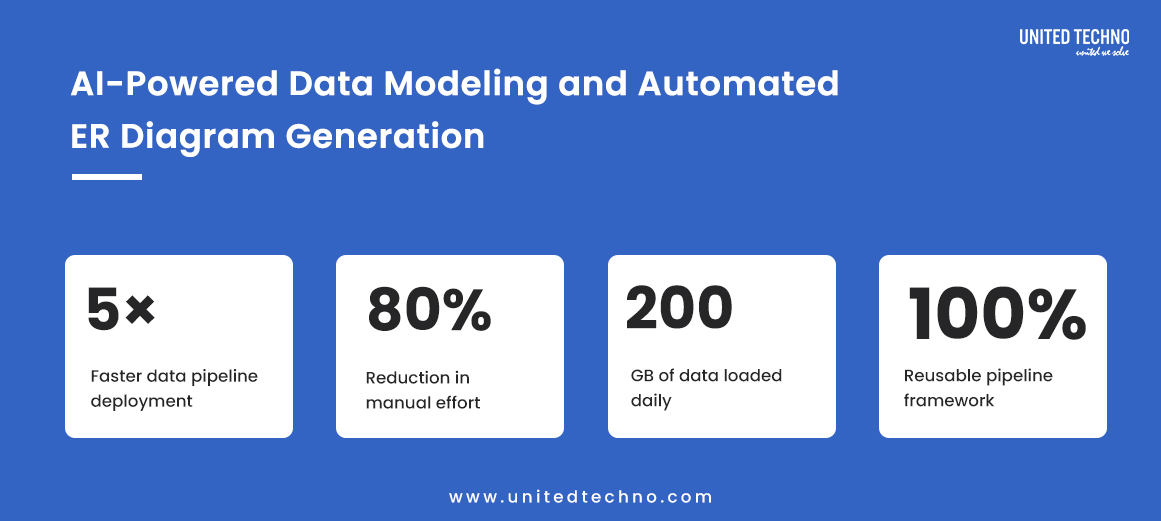
ER diagrams that once took days or weeks can now be generated in minutes.
Higher Accuracy
AI-driven relationship detection minimizes the risk of incomplete or incorrect models.
Scalable Documentation
The solution consistently handles large and complex databases with hundreds of tables.
Improved Consistency
Standardized modeling ensures uniformity across teams and projects.
Reduced Engineering Overhead
Data architects and DBAs can focus on validation and design rather than manual mapping.
Better Project Kickoffs
Rapid ERD generation accelerates discovery, requirement gathering, and system design phases.
Services Provided with AI Powered ERD Automation with LLM
- AI-Powered Data Modeling Strategy
- Metadata Extraction & Automation Framework Development
- LLM-Driven Relationship Identification
- Automated ER Diagram Generation
- Modeling Standardization & Governance Setup
- Documentation & Visualization Pipelines
- Ongoing Enhancements & Support
Value Delivered
By introducing automation and intelligence into the data modeling process, United Techno enabled the client to modernize one of the most foundational elements of enterprise data management.
Teams now spend less time deciphering schemas and more time designing scalable, high-quality data architectures.
With consistent, accurate, and auto-generated ER diagrams, the organization has improved decision-making, accelerated project delivery, and established a repeatable modeling methodology that supports long-term growth.
Conclusion
United Techno’s AI-powered data modeling framework transforms how organizations build and maintain ER diagrams. By leveraging LLMs to extract structure, identify relationships, and generate diagrams automatically, enterprises gain faster, more reliable, and more scalable modeling capabilities than ever before.
If you’re looking to modernize your data architecture and eliminate manual modeling bottlenecks, United Techno can help you build a smarter, future-ready foundation.
Contact our subject matter experts today!