
Solving Inventory & Omnichannel Challenges Via AS400 Modernization in Retail
The Retail Reality – Built on AS400, Stressed by Modern Demands
Decades into working with fashion, department stores, and specialty retail chains, one truth has remained constant: AS400 still runs retail.
From allocation logic and store replenishment to vendor EDI and warehouse operations, this system has quietly powered the back office while the customer-facing world has transformed around it.
Yet, the challenges have grown louder.
Inventory mismatches between eCommerce and stores, delayed replenishment, and siloed order data are now business-critical issues. These aren’t caused by AS400’s age; they’re caused by how it’s been isolated.
At United Techno, we’ve modernized AS400 environments for over 30+ retail and apparel clients, covering everything from 2,000-store chains to omnichannel brands managing both wholesale and DTC. The lesson is simple:
You don’t need to replace the AS400. You need to re-architect how it connects, scales, and informs.
Overcoming Inventory & Omnichannel Challenges Via AS400 Modernization in Retail
Retail data moves fast, and customers expect real-time stock visibility, dynamic pricing, and instant fulfilment options. But AS400’s batch-based DNA wasn’t built for this pace.
Let’s break down the main friction points we see in most retail AS400 setups:
| Challenge | Business Impact |
| Overnight batch jobs for allocation & replenishment | Reports arrive late in the morning; merchandisers lose a selling window. |
| Siloed channel data between stores, eCommerce, and the warehouse | Duplicate orders and inaccurate ATP (Available-to-Promise). |
| Rigid DDS structures in DB2 | Reporting latency, limited visibility for finance and supply chain. |
| Manual data transfer between PLM, WMS, and ERP | Lost hours and higher order-entry errors. |
| Green-screen UIs for new merchandisers | Slower training and inconsistent data entry. |
Over time, these inefficiencies create what we call “invisible shrink” – not inventory theft, but lost margin from delayed data.
Modernizing Without Replacing: The United Techno Approach
Our modernization strategy for retail clients centers on incremental transformation, upgrading the AS400 layer-by-layer, while business continues as usual.
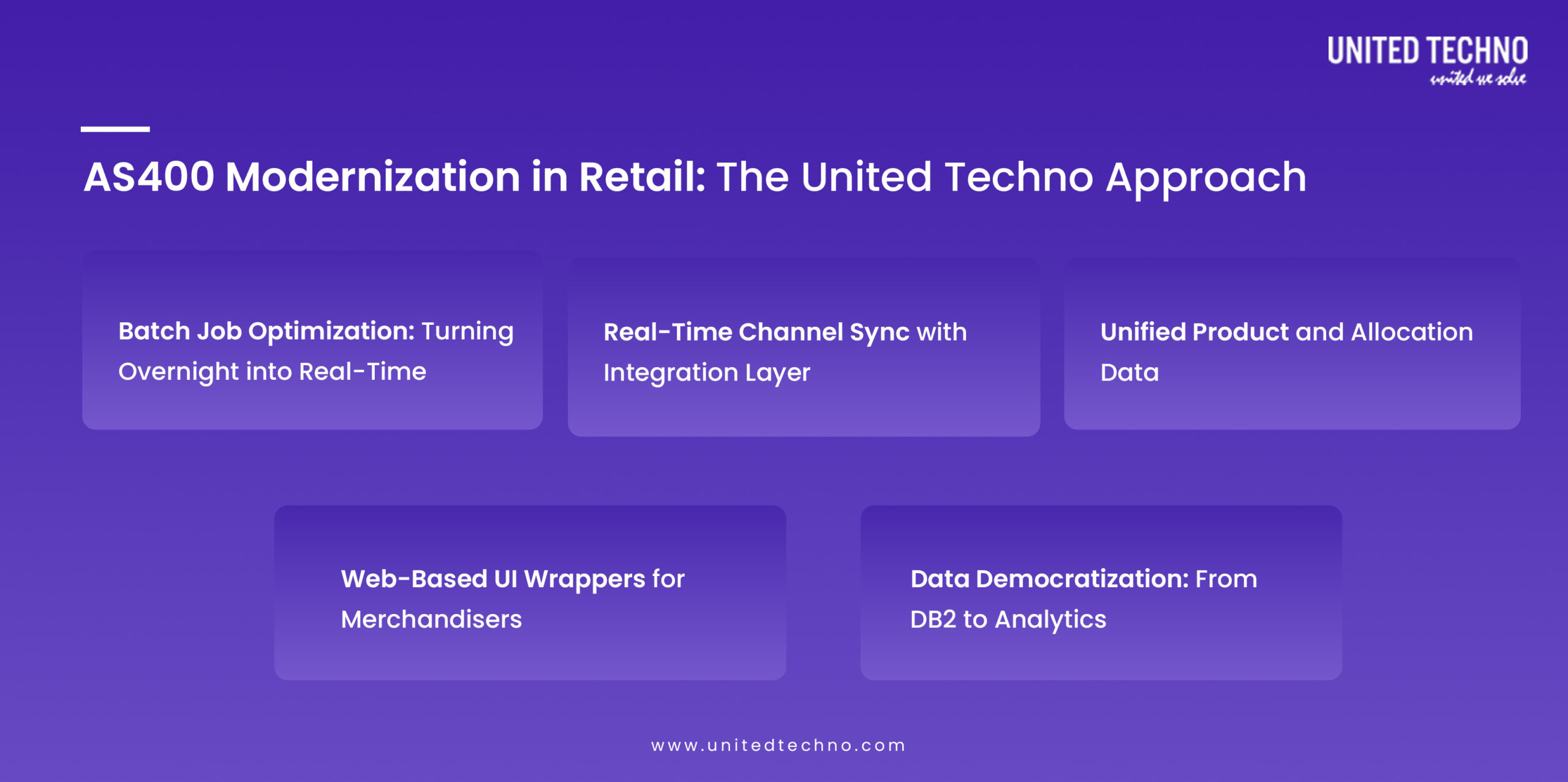
Here’s How We’ve solved The Toughest Inventory & Omnichannel Challenges:
1. Batch Job Optimization: Turning Overnight into Real-Time
In one engagement with a global fashion brand, allocation and replenishment jobs ran nearly 9 hours overnight.
By converting DDS files to DDL, tuning DB2 indexes, and automating job distribution via Python/HOD scripts, we reduced batch run-time to under 90 minutes, an 80% performance gain.
Now, merchandisers start their day with ready-to-use allocation reports by 8 AM instead of noon.
2. Real-Time Channel Sync with Integration Layer
Retailers often maintain separate logic for eCommerce, wholesale, and stores, each posting updates to AS400 in batches.
We implemented Boomi-based API triggers between AS400, Shopify, and NetSuite to enable instant stock updates across channels.
Result: inventory accuracy improved by 35%, and online overselling dropped to single digits during peak season.
3. Unified Product and Allocation Data
Instead of migrating away from AS400, we extended it.
By integrating FlexPLM and Blue Yonder Allocation, product master and allocation data now flow directly into the core DB2 system.
This eliminated redundant SKU setups and cut PO creation time by 50%.
4. Web-Based UI Wrappers for Merchandisers
To remove green-screen fatigue, we wrapped legacy RPG programs in Rocket LegaSuite, giving teams a browser-based interface.
Training time for new merchandisers dropped from 10 days to 4, and daily productivity rose visibly with no backend disruption required.
5. Data Democratization: From DB2 to Analytics
Legacy AS400 data isn’t a barrier; it’s an untapped asset.
We built pipelines streaming transactional data into Snowflake, enabling Power BI dashboards for planners, finance, and store ops.
Forecasting cycles went from weekly to daily, creating what one CFO called “a living P&L.”
The Results: What AS400 Modernization Actually Delivers
When executed correctly, modernization doesn’t just keep the lights on. It transforms decision velocity:
- 80% faster allocation jobs (9 hours → 90 mins)
- 30% fewer fulfilment delays after integration
- Real-time inventory view across eCommerce and stores
- 50% faster PO creation via automated assortment tools
- ERP replacement avoided, saving $40 to 50 million in estimated costs
More importantly, retailers regained trust in their data. That trust drives smarter replenishment, tighter open-to-buy cycles, and faster reaction to demand trends.
Architect’s Perspective: Evolution in Action
With AS400 expertise since the early 2000s, United Techno can say this confidently – it’s not a relic, it’s a platform that has quietly adapted.
The issue isn’t age; it’s architecture.
When you expose AS400 data securely through APIs, automate jobs intelligently, and give business users the visibility they crave, the system stops being “legacy.” It becomes your most reliable, modern-ready engine.
Final Takeaway
Retailers that treat AS400 as a liability will end up paying for costly ERP overhauls they don’t need. Retailers that modernize AS400 as a strategic foundation gain agility, continuity, and measurable ROI.
At United Techno, we call this Retail Modernization without Disruption, evolving your AS400 to support real-time inventory, omnichannel visibility, and cloud analytics without rebuilding your enterprise core.
Want to see how leading retailers achieved this transformation?
Book a Discovery Call with Our AS400 Architects.