Snowflake Retail Analytics Case Study: Modernizing Analytics for a Global Fashion Retailer
Project Overview:
One of our clients, a leading fashion and retail management company, operates multiple brands across various sales channels including physical stores, e-commerce, retail, and wholesale. With data flowing in from many different systems and formats, managing and making sense of this information has become increasingly complex.
To address this, we designed a centralized and scalable data platform using Snowflake as the core analytics system. Data from enterprise applications, databases, cloud storage, IoT foot traffic sensors, file transfers, and even email-based reports was seamlessly brought together through automated and configurable data workflows.
This approach provides the client with a dependable and adaptable data foundation – enabling faster insights, improved reporting, and confident data-driven decision-making across brands and channels.
Business Challenges:
As near real-time retail visibility became critical, the client faced several operational and platform challenges:
Tool Sprawl & High Licensing Costs – A separate third-party ETL platform was used for SAP ingestion, email-based file processing, reporting, and external integrations. While functional, it increased overall complexity, dependency on external systems, and total cost of ownership.
Fragmented Platform Governance – Airflow was hosted on a third-party managed service despite the organization’s strong AWS footprint, leading to additional licensing costs and divided governance.
Inefficient Job Orchestration – A large number of simple and platform-native jobs were scheduled through Airflow, adding unnecessary load, execution costs, and operational overhead.
Underutilized Data Catalog Investment – Although a data catalog tool was implemented, low adoption and limited business usage resulted in avoidable licensing and maintenance costs.
Manual Data Validation & Communication – Data availability checks and stakeholder notifications were handled manually, increasing effort, slowing response times, and creating risk of missed updates.
Reactive Monitoring Approach – Data pipeline performance and table freshness were typically checked only after business users reported discrepancies, leading to delayed issue detection.
Limited Real-Time Visibility – Business teams required store-level flash sales and footfall data every 15 minutes, but existing processes did not consistently support this speed of reporting.
United Techno’s Strategic Approach to Snowflake Retail Analytics
Snowflake-Centric Consolidation – All third-party ETL workflows were redesigned and consolidated into a unified Snowflake-centered architecture, reducing tool dependency and simplifying data operations.
AWS-Native Orchestration – Airflow workloads were migrated to AWS Managed Workflows (MWAA), aligning scheduling, security, and governance within the existing AWS ecosystem.
Optimized Processing Framework – Snowflake Tasks, AWS Lambda, and lightweight EC2 scripts were used strategically to distribute workloads efficiently and reduce operational overhead.
Proactive Monitoring & Alerts – Automated monitoring and alerting were implemented to detect missing files, delayed data, long-running jobs, and SLA breaches — ensuring timely notifications to stakeholders.
Direct API-Based Sensor Integration – A Snowflake-native ingestion framework was built to connect directly to SenSource and ShopperTrak APIs, enabling secure, scheduled data loads every 15 minutes.
Tool Rationalization & Cost Reduction – Third-party ETL and catalog tools were removed, leveraging native platform capabilities to lower licensing costs and reduce platform complexity.
Business Impact and Outcomes:
The transformation delivered measurable operational and business benefits:
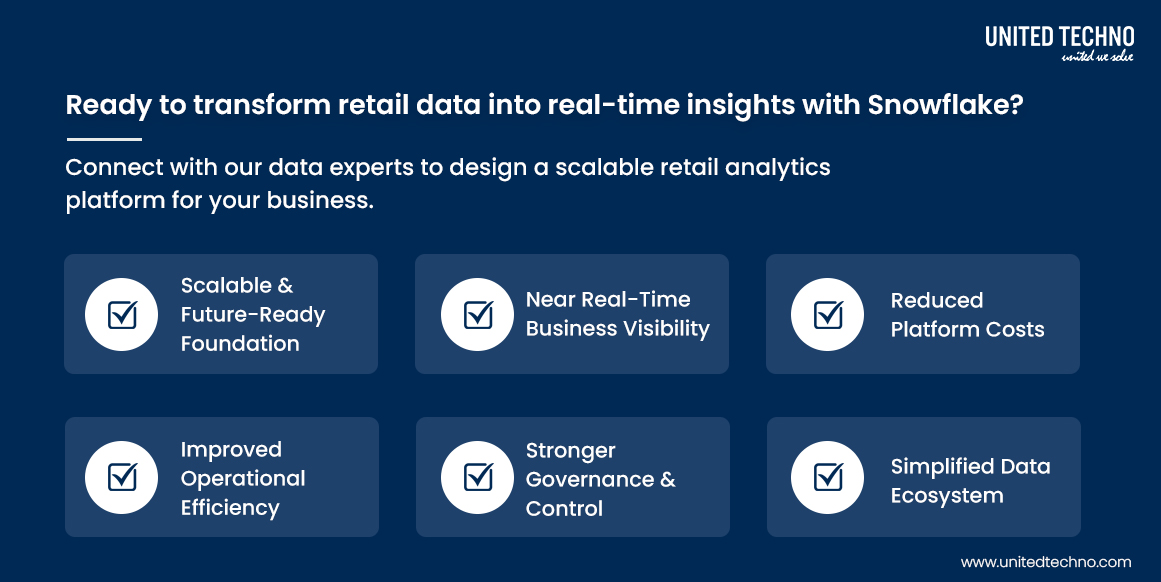
Scalable & Future-Ready Foundation – The cloud-native design supports growing data volumes, additional integrations, and evolving reporting needs without major redesign.
Near Real-Time Business Visibility – Reliable 15-minute sensor data ingestion enabled faster flash sales tracking and footfall analysis across stores.
Reduced Platform Costs – Eliminating third-party tools and optimizing workloads significantly lowered licensing and infrastructure expenses reduced up to 25 – 30%.
Improved Operational Efficiency – Automated monitoring, alerts, and streamlined orchestration reduced manual intervention and ongoing maintenance effort by 60 – 70%.
Stronger Governance & Control – Aligning orchestration within AWS improved security oversight, platform governance, and architectural consistency.
Simplified Data Ecosystem – Consolidating ingestion, transformation, and reporting within Snowflake reduced complexity and improved usability for business teams.
Conclusion:
The client transitioned from a fragmented, tool-heavy data environment to a streamlined, Snowflake-centered, cloud-native architecture. The modernized platform now delivers reliable near real-time insights, reduces operational overhead, and simplifies governance. This transformation not only lowered costs and improved efficiency but also established a scalable and resilient data foundation to support the organization’s long-term growth and digital strategy.
Ready to transform retail data into real-time insights with our expert Snowflake service? Connect with our data experts to design a scalable retail analytics platform for your business